Eccentric medium spiny neuron (eMSN)

I've been skimming through a few papers on eMSNs/eSPNs. A few brief notes so far:

Their existence seems to have been first highlighted in this 2018 paper (link) that profiled ~690k cells and identified a rare spiny projection neuron population in the striatum.

This interesting review from 2021 (link) gives a possible reason for them having been overlooked:
Some of the eSPN markers encompass genes typically used to distinguish iSPNs and dSPNs, such as Adora2a and Drd1, which likely explains why this population was overlooked so far.
The Human Protein Atlas (link) lists a brain-neuron cluster annotated as "eccentric medium spiny neurons GAD1/GAD2 (CXCL14+ DRD1+ ADARB2+)".

A 2024 paper in PNAS (link) on Parkinson's reports high relative LRRK2 RNA in direct, indirect, and eccentric spiny neurons.

From this 2022 paper (link) - (". . . imply that the LGE_FOXP2/TSHZ1 initial class also explains the previously unknown developmental origin of recently described striatal projection neurons in adult mice, eccentric spiny projection neurons (eSPNs) and amygdala ITCs")

Two papers using the Siletti human brain atlas (Duncan et al (link); Yao et al (link)) make a link to schizophrenia. Duncan et al relates that eMSNs are rare, transcriptomically distinct, and not reliably separated by classical D1/D2 markers.
 
HTT and spiny neurons seems maybe worthy of more investigation, they seem very interrelated. It’s not a gene I think we spent much time on but was one of the DecodeME candidates even if a bit below the threshold.

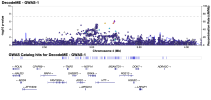
LocusZoom for HTT.
Agree, thanks for pointing this out!

To give a bit more background: HTT stands for Huntingtin, the gene behind the Huntington disease.

HTT is important for axonal transport and helps in regulating the expression of survival factors like BDNF (Brain-Derived Neurotrophic Factor). Medium spinal nerves (I suppose this includes the eccentric ones) are particularly dependent on HTT and thus the first to be affected in Huntington disease.
Despite the widespread expression of huntingtin, HD has long been considered primarily as a disease of the striatum. It is characterized by selective vulnerability with dysfunction followed by death of the medium size spiny neuron.
Huntington's Disease and the Striatal Medium Spiny Neuron: Cell-Autonomous and Non-Cell-Autonomous Mechanisms of Disease - ScienceDirect

1779283437115.png
 
The ones on medium spiny neurons (MSN) might be interesting as well, but it's only the eccentric subgroup that is highlighted by the genetic analysis.
Yes, but we don't understand what they do or don't do, so the eccentric ones might be affecting the regular ones. It seems reasonable to me that the brain might have evolved specialized controller cells scattered around to provide a coordinated response to various factors. Some cells might respond to immune signals, signalling other cells to enter a "healing" state, which we experience as feeling lousy enough to hide under blankets.

I hope that this sort of research will get funding, rather than yet another search for hidden viruses or muscle dysfunction.
 
HTT was flagged in the fibromyalgia GWAS study preprint: "The strongest association was with a coding variant in HTT…"


HTT was flagged in the fibromyalgia GWAS study preprint: "The strongest association was with a coding variant in HTT…"
Yes this something we haven't discussed much but the fibromyalgia results were very similar to those from DecodeME. Genes such as HTT, OLFM4, GPR52, DCC, PCDH8, came up in the fibromyalgia GWAS as well.

Caudate and putamen were included in the significant brain regions while cortical projection neurons, and striatal neurons were some of the top cell types (although none reached significance). That's the same area I'm seeing several hints at in the ME/CFS data.

So I suspect that it points to a very similar disease process, perhaps a different flavor of it.

Might be useful to do a GWAS with ME/CFS and fibromyalgia cases combined.
 
Yes this something we haven't discussed much but the fibromyalgia results were very similar to those from DecodeME. Genes such as HTT, OLFM4, GPR52, DCC, PCDH8, came up in the fibromyalgia GWAS as well.

Caudate and putamen were included in the significant brain regions while cortical projection neurons, and striatal neurons were some of the top cell types (although none reached significance). That's the same area I'm seeing several hints at in the ME/CFS data.

So I suspect that it points to a very similar disease process, perhaps a different flavor of it.

Might be useful to do a GWAS with ME/CFS and fibromyalgia cases combined.

Would a combined GWAS be possible using a methodology like Paolo used, or would a much more formal process be necessary? Also, would that boost the effective sample size?
 
Last edited:
Here is a quote from the Results section of the fibromyalgia GWAS paper:

The strongest cell-type association was with neurons from the dentate gyrus (p = 1.3 × 10⁻⁶), a hippocampal
region critical for contextualizing sensory experiences, including pain. Significant enrichments were also
found in enteric neurons (p = 7.9 × 10⁻⁶) and diverse interneurons, cortical projection neurons, and striatal
neurons. The sole enriched non-neuronal cell type, pulmonary neuroendocrine cells (p = 5.6 × 10⁻⁶), is a
specialized sensory cell type with well-established neuron-like properties. Even when grouping cell types by
lineage with the goal of increasing power, the only significant lineage was neural (p = 2.3 × 10⁻⁴; p > 0.05 for
all other cell types; Table S9).

Collectively, these results implicate a broad network of neurons across the central and peripheral nervous
systems, including sensory-processing neurons, in the genetic etiology of fibromyalgia. There was no
evidence of enrichment in non-neural tissues or cell types, including immune ones.
 
To give a bit more background: HTT stands for Huntingtin, the gene behind the Huntington disease.

HTT is important for axonal transport and helps in regulating the expression of survival factors like BDNF (Brain-Derived Neurotrophic Factor). Medium spinal nerves (I suppose this includes the eccentric ones) are particularly dependent on HTT and thus the first to be affected in Huntington disease.
In case anyone sees the connection to HD and get worried because it’s a truly horrific disease, HD isn’t caused by HTT having one of the «normal» forms of the gene. It’s caused by excessive repeats of one of the sequences (from wikipedia):
HD is caused by a mutated form of the huntingtin gene, where excessive (more than 36) CAG repeats result in formation of an unstable protein.[34] These expanded repeats lead to production of a huntingtin protein that contains an abnormally long polyglutamine tract at the N-terminus. This makes it part of a class of neurodegenerative disorders known as trinucleotide repeat disorders or polyglutamine disorders. The key sequence which is found in Huntington's disease is a trinucleotide repeat expansion of glutamine residues beginning at the 18th amino acid. In unaffected individuals, this contains between 9 and 35 glutamine residues with no adverse effects.[5] However, 36 or more residues produce an erroneous mutant form of Htt, (mHtt). Reduced penetrance is found in counts 36–39.[35]
This repeat starts to increase in numbers until the neuron dies:
In the pathogenesis of the disease, there is further somatic expansion of CAG repeats. It takes decades to reach 80 repeats, then years to reach 150 repeats. Beyond 150, cellular toxicity start to manifest. Over months, the neuron slowly loses its cell identity until cell death pathways are activated.[42]
There have been no documented cases of HD that had less then 35 repeats.

It is also not certain that the Huntingtin protein is the cause of the disease:
Further, it is possible the pathogenic mechanism lay more with the RNA transcripts and their potential CAG repeats to exhibit RNAi than with the actual huntingtin protein itself.[41]
Edit: and if the protein is the cause of HD, it’s probably because the mutation makes it not work properly.
 
Last edited:
That’s a good point @Utsikt talking about neurological conditions and some of these topics could worry people. The way I see it we can have these genes or pathways involved or implicated by them involved in ME/CFS without any need for ongoing tissue damage or a degenerative condition.

It’s a topic we’ve discussed before but good to mention it again probably. To me at least, it all ties in to a picture of different factors with a balance shifted slightly this way or that so under certain circumstances multiple feedback loops perpetuate some dodgy signalling.
 
For research, perhaps the next step would be to do animal experiments and test whether these eMSN are involved in sickness behavior during acute infection?
Had a look at what's already out there, mostly small studies in mice given LPS or people with hepatitis C or malignant melanoma given interferon-alpha.

A problem is that sickness behavior includes things like fever, lack of appetite, depression/anhedonia, slowed moving that likely isn't relevant for ME/CFS cause it isn't part of the syndrome. Most studies have been on these things that are more easily measurable in animals. But for us it's the malaise and fatigue part that is of interest.

Multiple brain regions have been associated with sickness behavior.

The hypothalamus has been associated with fever and appetite.​
Brainstem regions have been linked to eating, drinking, movement, sleep​
The genetic data for ME/CFS also do not suggest its sensory nerves that pick up an immune signal that might be abnormal​

When it comes to fatigue in humans, some papers have pointed to the basal ganglia and more specifically the left nucleus accumbens and putamen. I think this fits well with the striata region that seems to come out of the ME/CFS data and the main location of eMSN. A main paper on this is Capuron 2007 which found:
whole-brain metabolic activity as assessed by fluorine-18-labeled fluorodeoxyglucose uptake and positron emission tomography was examined before and 4 weeks after IFN-a administration in patients with malignant melanoma

[…]

IFN-a administration was associated with widespread bilateral increases in glucose metabolism in subcortical regions including the basal ganglia and cerebellum

[…]

Correlational analyses revealed that self-reported fatigue (specifically as assessed by the ‘energy’ subscale of the Visual Analog Scale of Fatigue) was associated with increased glucose metabolism in the left nucleus accumbens and putamen
Basal ganglia hypermetabolism and symptoms of fatigue during interferon-alpha therapy - PubMed

Some other studies:
Dopaminergic mechanisms of reduced basal ganglia responses to hedonic reward during interferon alfa administration - PubMed
IFN-alpha-induced cortical and subcortical glutamate changes assessed by magnetic resonance spectroscopy - PubMed
 
HTT was flagged in the fibromyalgia GWAS study preprint: "The strongest association was with a coding variant in HTT…"


I thought this was also notable:

Our study directly addresses the sex bias in fibromyalgia prevalence. Despite several-fold higher prevalence in females, we found no sex difference in the genetic architecture of fibromyalgia.
 
Our study directly addresses the sex bias in fibromyalgia prevalence. Despite several-fold higher prevalence in females, we found no sex difference in the genetic architecture of fibromyalgia.

Except that females have two X and males XY!!!
That surely is where the sex bias lies.

It is interesting that the rest of the risk is similar, suggesting that men and women have the same 'fibromylagia' process but the 'despite' seems misplaced.
 
I am in way over my head on this topic, but I’m encouraged to see you smart people working through it! It’s a really interesting finding, and it would be a shame if it didn't get any follow-up.

Would a combined GWAS be possible using a methodology like Paolo used, or would a much more formal process be necessary? Also, would that boost the effective sample size?
I have this question too. It would be really great if Paolo’s approach was appropriate for this.
 
Back
Top Bottom