Distinct functional connectivity patterns in [ME/CFS & LC] during cognitive fatigue: a 7 Tesla task-fMRI study, 2026, Inderyas, Marshall-Gradisnik+

I mean it's pretty obvious looking at the daily discussions on S4ME over a decade that one thing ME/CFS patients absolutely do not lack is motivation (and interest and desire and...).
Indeed. It has been noted for decades, including in the formal literature IIRC, that one way to differentiate ME/CFS from depression is to ask a patient what they would do if they were suddenly cured.

ME/CFS patients typically have a long list of things they would like to do. Depressive patients just shrug their shoulders.
 
Indeed. It has been noted for decades, including in the formal literature IIRC, that one way to differentiate ME/CFS from depression is to ask a patient what they would do if they were suddenly cured.

ME/CFS patients typically have a long list of things they would like to do. Depressive patients just shrug their shoulders.
I’d answer «I have no idea because I don’t see any use in speculating in that when I’m so far away from it».
 
Our findings of reduced dopaminergic hippocampal-nucleus-accumbens connectivity imply blunted motivation
If that's because the areas involved are typically described as involved in motivation, then that means that traditional description is wrong or incomplete, not that there is such a finding. If anything, I actually see elevated motivation, taking it to relentless levels. I have never experienced reduced motivation, I am actually fuming with it.
 
If anything, I actually see elevated motivation, taking it to relentless levels.
The whole argument is about poorly defined things, using poorly defined words. We can't clinically measure motivation, apathy, fatigue, etc. I often feel motivated and even enthusiastic about starting some project, but when faced with actually soldering components or whatever, I feel overwhelming weariness. I don't consider that fatigue, apathy, or lack of motivation; it's feeling ill/malaise. I had the same response pre-ME while trying to finish a task while suffering from a flu. We simply don't have the technology yet for measuring what's going on in the brain to cause these feelings.
 
Does the use of terminology I have bolded here worry anyone else?
Yep.

Worth remembering that pwME/CFS had normal reward motivation on the EEfRT in Walitt et al.'s study.

And despite ME/CFS having been occupied by psychiatry and psychology for three decades, lack of motivation and apathy have not been big themes of their work. They've either been very remiss, or there's little or nothing there.

I'm not good cognitively at the moment, admittedly, and the subject matter is beyond me, but I cannot follow these sentences:
Both long COVID and ME/CFS patients showed impaired functional connectivity among regions of
the cerebellum, vermis, and deep grey matter during interference-induced cognitive fatigue which is indicative
of cognitive exhaustion. This suggests reduced motivation and a decreased dopaminergic influence thereby
inducing neural exhaustion.
They found impaired functional connectivity which is indicative of cognitive exhaustion which suggests reduced motivation which induces neural exhaustion. Huh?
 

News Release 27-Jan-2026

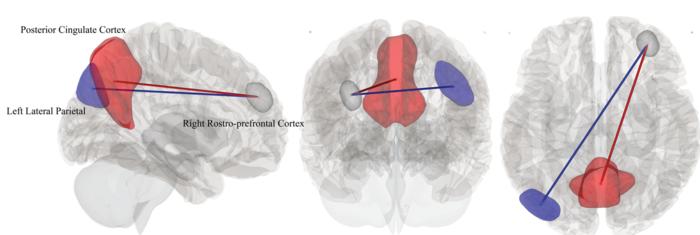
Altered brain connection found in people with ME/CFS and Long COVID​

People with Myalgic Encephalomyelitis/Chronic Fatigue Syndrome (ME/CFS) and Long COVID experience a disruption to their brain connectivity during a mentally demanding task.

Peer-Reviewed Publication
Griffith University


FacebookXLinkedInWeChatBlueskyMessageWhatsAppEmail
Altered brain connection found in people with ME/CFS and Long COVID
image:

Altered brain connection found in people with ME/CFS and Long COVID

view more


Credit: Griffith University

People with Myalgic Encephalomyelitis/Chronic Fatigue Syndrome (ME/CFS) and Long COVID experience a disruption to their brain connectivity during a mentally demanding task.

The new Griffith University research, published today, used ultra-high field MRI technology to investigate the significant reduction in brain connectivity in specific parts of the brain.

Professor Sonya Marshall-Gradisnik from Griffith’s National Centre for Neuroimmunology and Emerging Diseases said there were common symptoms experienced by people with ME/CFS or Long COVID with this study focusing on neurological features.

“The symptoms include cognitive difficulties, such as memory problems, difficulties with attention and concentration, and slowed thinking,” Professor Marshall-Gradisnik said.

Lead author and PhD candidate Maira Inderyas said the study saw participants undertake a cognitive test while inside the MRI machine to gauge their brain activity.

“The task, called a Stroop task, was displayed to the participants on a screen during the scan, and required participants to ignore conflicting information and focus on the correct response, which places high demands on the brain’s executive function and inhibitory control,” Ms Inderyas said.

“The set up allowed us to precisely measure which areas of the brain were activated while the patient was performing a mentally demanding task.

“The scans show changes in the brain regions which may contribute to cognitive difficulties such as memory problems, difficulty concentrating, and slower thinking.”

The research supported what many people with ME/CFS and Long COVID experience which was that cognitive effort was not just tiring but could have real neurological impacts, and adequate rest was not optional but essential.

The ultra-high field MRI used in the study was one of only two available in Australia.

The research was funded by ME Research UK and the Stafford Fox Medical Research Foundation.

The paper ‘Distinct functional connectivity patterns in myalgic encephalomyelitis and Long COVID patients during cognitive fatigue: a 7 Tesla task-fMRI study’ has been published in the Journal of Translational Medicine.


Journal​

Journal of Translational Medicine

DOI​

10.1186/s12967-026-07708-y

Method of Research​

Case study

Subject of Research​

People

Article Title​

Distinct functional connectivity patterns in myalgic encephalomyelitis and long COVID patients during cognitive fatigue: a 7 Tesla task-fMRI study

Article Publication Date​

20-Jan-2026

 
Back
Top Bottom