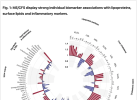
The largest drivers of biomarker variation were mostly consistent with established biological mechanisms including inflammation (C-reactive protein explaining 20.5% of biomarker variance; neutrophil count, 7.1%) via GlycA, kidney function (urate, 22.3%; cystatin C, 21.3%) via plasma creatinine, testosterone (16.2%) via plasma creatinine and serum urea (15.3%) via valine. These traditional blood biochemistry measurements similarly explained the same set of biomarkers in the entire study population (Supplementary Figs.
9 and
10 and Supplementary Data
12).
These findings increase my suspicion about the accuracy of the ME/CFS characterisation in the UK biobank. Many ME/CFS studies have looked at C-reactive protein and not found it to be high.
The 28 selected features for the LightGBM model, which was selected as the optimum model
(from Fig 4) (negative or positive association, effect size, individual p value, vs healthy controls from Supp Data 14 )
Frequency of tiredness/lethargy (positive, 1.35, ***)
Sleep duration (positive, 0.47,***)
Whole body pain (positive, 3.82, ***)
Headache pain (positive, 0.96, ***)
Female (data not given for comparison with healthy controls)
Alcohol consumption (negative, -1.26, ***) (note: only options were 'never or previous' and 'current')
Smoker (negative association,-0.21, *)
IPAQ (Physical Activity) High (negative,-0.76, ***)
Nucleated Red Blood Cell % (positive, 0.01, NS)
Nucleated Red Blood Cell Count (negative, -0.01, NS)
Facial pain (positive, 1.82, ***)
Stomach/abdominal pain (positive, 1.37, ***)
Hip pain (positive, 1.05, ***)
PUFA% (negative, -0.16, ***)
Total P (negative, -0.28, ***)
Leucine (positive, 0.03, NS)
Age at recruitment (data not given for comparison with healthy controls)
Acetone (negative, -0.10, **)
S-LDL-P (positive, 0.16, ***)
S-LDL-TG (positive, 0.27, ***)
Systolic Blood Pressure (negative, -0.07, *)
Acetoacetate (negative, -0.03, NS)
Frequency of depressed moods (positive, 0.73, ***)
Nap during Day (positive, 1.01, ***)
L-VLDL-Free cholesterol Very Low Density Lipoproteins (positive, 0.14, ***)
Sleeplessness/Insomnia (positive, 0.78, ***)
Immature Reticulocyte Fraction (positive, 0.20, ***)
M-VLDL-P (positive, 0.20, ***)
I think applying the 'Age at recruitment to the UK Biobank' will be a particularly hard feature to translate to clinical use. It doesn't look as though any of the tested and selected blood biomarkers had much effect on whether a person was in the ME/CFS or non-diseased group; the presence of various sorts of pain were a lot more discriminating.
Only XXL-VLDL-TG % was uniquely associated with ME/CFS (Supplementary Fig.
6), with the remaining 196 associations also present in other conditions.
TG is triglycerides. That feature was not selected to be one of the 28 features in the favoured model. The P value was not very significant at 0.037 (Supp material 6 Females only). I think that p value is comparing the ME/CFS group against the non-diseased group.
This metabolomics analysis presents a lipoprotein profile for ME/CFS, highlighting significant associations of the disease with VLDL subclasses and size. These findings pinpoint a triglyceride and cholesterol transport problem, potentially arising from enzyme dysregulation, such as lipoprotein lipase (LPL). Interestingly, our retrospective analysis connects a recent study revealing a 2-fold overexpression of microRNA-29a in ME/CFS, which may inhibit LPL translation. The resulting inhibition of LPL activity leads to decreased clearance of VLDL particles and reduced degradation of circulating triglycerides. Surface lipids including total cholines, phosphatidylcholines, sphingomyelins, and phosphoglycerides were significantly decreased in the UKB ME/CFS cohort. These results are consistent with prior research, suggesting potential membrane destabilisation, altered cell signalling and dysregulated immune cell function. Our study contributes further evidence with a TG/PG association showing increased core lipid content relative to surface area, which may reduce membrane fluidity.
That's interesting.
Cholesterol handling is of particular importance to steroid hormones given that it serves as the exclusive precursor for all steroidogeneses. The steroid hormone cortisol is currently the most reliable biomarker in ME/CFS research, with lower levels in ME/CFS evidenced at the level of meta-analysis 59. This observation aligns with recent findings in Long Covid, a condition sharing similarities with ME/CFS, wherein reduced cortisol levels have also been identified as a major distinguishing feature, potentially contributing to the pathogenesis [61].
But that's disappointingly very wrong. Reference 59 is a 2014 paper on Chronic Fatigue Syndrome by Nijhof et al.
Reference 61 is 'Protracted stress-induced hypocortisolemia may account for the clinical and immune manifestations of Long COVID. 2022'
This ME/CFS cohort reflected an older population, with an average age of 55, and the youngest participant was aged 40. ME/CFS can occur at any time across the lifespan, with two major onset peaks in adolescence and late 30s, which are not captured in this study
That makes no sense. The age of the people in the UK Biobank cohort does not exclude the possibility that ME/CFS participants had ME/CFS onsets in adolescence and in their late 30s.