Comparing ME/CFS following mononucleosis with Long COVID, 2026, Jason et al

It's a lot more complicated than that, though there is some of it. What we want more than anything is to simply ignore the personal and work on solving problems. It's actually not limited to ME/CFS, we see this elsewhere, substantial criticism of problematic research is usually pushed back as personal attacks by academics. Which is really weird for us, to be honest. It's super personal for us, our lives entirely depend on it, and yet we set it aside entirely because we don't have a choice.

All the seemingly 'personal' problems we appear to have with some researchers have exactly zero to do with them as people. It's their work that we criticize, and we do the same for everyone. It's the only way things will move forward, and it sure seems to make a lot of people oddly uncomfortable. Believe me, when we see work that is garbage, we plainly say it, and no one is saying that about Jason and his team. It just needs improvements, like all research does, and we've seen it all. We are a rare place of complete honesty and no bullshit politics.

No one is a proxy for anything. We just want good research, and we absolutely emphasize and recognize it when it happens, but meaningful research is rare, and not just in this field. Most academics will make no contributions throughout their whole career, and that's just the way science works. What matters most is to focus on the substance, on improving on what exists. This is technically how science and academia are supposed to work, and it's often that, but we're a rare place that just doesn't care about niceties, we've found that being too polite and deferential will get us nowhere. It's where we are, right now: nowhere. We'd like to get out of this awful place.
In advocacy work to try to influence policy we are instructed to pick no more than three "asks" when we get a chance to talk directly to lawmakers. I've been thinking a lot about this conversation and how we might collect "asks" from ME/CFS patients that are reasonable (not just, "I want a cure") and something that will help the researchers who are often not directly involved with patients to see what matters. Actually Dr. Jason did experience ME/CFS although he eventually recovered, so he is probably more attuned to the needs than most. And I have lived with it for over 50 years, so it's a driving force for me.

I was thinking about buying presents for people at Christmas and how we often buy someone what we would like, but we don't usually ask them what they want. Maybe we need more of a Santa list for researchers. Many ME/CFS organizations do this some extent, but the focus is almost always on raising funds for research. And that is self-serving in academia in many ways because getting a grant and publishing a study enhances your career even if nothing substantial was gained from the money spent (like the $8 million, 60+ author NIH "effort preference" study conclusion). I am on this particular team because I have not seen that self-serving attitude but rather genuine compassion and the desire to use their skills to advance understanding that will improve quality of life, but maybe there needs to be a constant re-assessment of what matters so the objectives stay finely tuned.
 
What is very frustrating to me as an ME/CFS patient when I fill out a questionnaire is the interpretation of a question. I find myself talking back to it and saying things like, "Well, do you mean on a good day or a bad day?" Saying "in the last 6 months" doesn't begin to touch on the variability. I have talked to my team about this and they recognize it is a challenge because with quantitative statistics you're trying to categorize something as an absolute that is really a moving target for many of us.

Sigmund Olafsen from Norway had a blog post yesterday saying that qualitative analysis is also crucial for understanding the complexity and the true burden of living with ME/CFS. Qualitative data analysis is one of my focuses and I hope to to more interview-based studies in the future. Narratives are very powerful and while you can find many on the support groups, it won't be accepted in the medical profession unless it is done using strict methodology, IRB guidelines, and peer-reviewed publications.
We are not asking for naratives to be used or quantified though.

As per usual with ME/CFS, it doesn’t follow a neat pattern, it doesn’t fit into any of the boxes we have.

If the existing framework of methodology, IRB guidelines, peer-reviewed publications are making it impossible to research the illness well, then you’d be doing less harm by not researching it at all. If you can openly research that which may contribute to patient care and pathology and treatment, good.

If not, if these matters constrain useful research so much than effort would be better spent lobbying for change of methodology, IRB guidelines and journals.
 
Last edited by a moderator:
but maybe there needs to be a constant re-assessment of what matters so the objectives stay finely tuned.

That is what people on S4ME (and for a while on a previous forum) have been doing for over a decade. And a number of important projects have come into being at least in part because of that. Discussions here get fed back into advisory boards, funding reviews and even proposed international guidelines on outcome measures. You should join in!!
 
Last edited by a moderator:
I was remembering my old job the other day thinking about a project we did and the Gantt charts lol. All the interdependencies. Basic project managment.

Why are interdependencies so alien to medical research? If you see ME/CFS symptoms as interdependencies it’s makes it so simple.
 
I'm borderline moderate severe, depending which description is used. I scored myself currently on SF36 PF at 5. Anyone with very severe ME/CFS would score zero.

I have been trying out some of the other questionnaires used.

Beck Depression Inventory I scored 23 which is classed as moderate depression

Beck Anxiety Inventory I scored 22 which is classed as moderate anxiety

I am neither depressed nor anxious, apart from situational anxiety when I need to do something that is likely to set me back.

The questions include ones about physical symptoms and functional capacity. These questionnaires should not be used on people with physical illnesses such as ME/CFS and LC, as they will falsely diagnose people with anxiety and depression.

Here are the scores on the Beck inventories for the 5 groups in the study:

Depression
Severe ME/CFS 21.1
Moderate ME/CFS 13.9
Long Covid 17.9
IM control 4.0
LC control 9.0

Anxiety
Severe ME/CFS 17.7
Moderate ME/CFS 10.0
Long Covid 16.9
IM control 3.5
LC controlv7.0
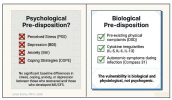
This is from a presentation I did a few weeks ago for my team. Several of their studies used data the had baseline scores for mental and physical symptoms before students contracted mono and then they followed the percentage that developed ME/CFS. I have never been treated for depression and anxiety, and like you, if it does occur it is transient and situational.

1776883020508.png
 
What is very frustrating to me as an ME/CFS patient when I fill out a questionnaire is the interpretation of a question. I find myself talking back to it and saying things like, "Well, do you mean on a good day or a bad day?" Saying "in the last 6 months" doesn't begin to touch on the variability. I have talked to my team about this and they recognize it is a challenge because with quantitative statistics you're trying to categorize something as an absolute that is really a moving target for many of us.

Sigmund Olafsen from Norway had a blog post yesterday saying that qualitative analysis is also crucial for understanding the complexity and the true burden of living with ME/CFS. Qualitative data analysis is one of my focuses and I hope to to more interview-based studies in the future. Narratives are very powerful and while you can find many on the support groups, it won't be accepted in the medical profession unless it is done using strict methodology, IRB guidelines, and peer-reviewed publications.
We have been saying for years that most of the questionnaires like SF36PF inflicted on pwME are inappropriate because ME/CFS fluctuates, but I think more importantly because the effects of exertions across a day or days are cumulative so repetition and what else you do are more important that whether you can do an activity. Hence support for FUNCAP.

I think if Jason's team want to stay relevant and produce more valuable work they will move away from standard questionnaires to specialised ones like FUNCAP. They should also, as I demonstrated with my post about the BECK inventories, stop using psych questionnaires to pretend they are diagnosing anxiety and depression and other psych factors when they clearly aren't.

I'm not sure qualitative research gets us much further. It depends what sort you mean. We see swathes of poor quality and flawed attempts. I've rarely if ever seen a good one. They usually spend far too little time learning about the pwme's life and ìllness, ask leading questions based on preconceptions, and then scramble together several pwME's experience according to some fashionable social science theorising and jargon. Maybe you'll prove me wrong.

I think the way to go is longitudinal tracking over years of lots of pwME's wearables data with some regular manageable recording of symptoms, functional capacity and cognitive function, along, where possible, with biobanked specimens collected from home at intervals of say 6 months.
 
Last edited by a moderator:
They should also, as I demonstrated with my post about the BECK inventories, stop using psych questionnaires to pretend they are diagnosing anxiety and depression and other psych factors when they clearly aren't.

Yup. It's a different speciality, not relevant to ME/CFS.

Where ME/CFS patients are struggling with their mental health, psychology and counselling services are available to them in exactly the same way they are in any other long term condition. They're not included in assessments of the severity of Parkinsons or MS or RA, and it makes no sense for them to be anywhere near ME/CFS either. Primary depression should have been excluded as the cause of symptoms before the ME/CFS diagnosis was made.
 
This is from a presentation I did a few weeks ago for my team. Several of their studies used data the had baseline scores for mental and physical symptoms before students contracted mono and then they followed the percentage that developed ME/CFS. I have never been treated for depression and anxiety, and like you, if it does occur it is transient and situational.

View attachment 31907
I’m sorry I don’t understand what Il-5/6/13 means

I don’t understand how the cytokine irregularities are measured is it by a lab test?
 
Last edited by a moderator:
Genuine questions-

What was the value of this study anticipated to be?
what was it about the possibilities that got a team so fired up as to invest their time in it?
I told Dr. Jason I was discussing his study on an ME/CFS group and asked if he could address your question. He wrote this for me to share with you:

I want to emphasize that this study is possible because we have a very rare scientific resource: biological samples and self-report data from thousands of college students collected before anyone became ill with mononucleosis. In most ME/CFS and post-viral illness research, investigators can only study people after illness onset, making it difficult to understand what factors may contribute to why some individuals recover while others develop prolonged illness.

Because these data were collected prospectively, before the viral trigger occurred, they provide a unique opportunity to examine possible factors that may influence vulnerability, resilience, and illness progression following infection. We have only begun with our biological investigation of our sample. This kind of pre-illness data is extraordinarily uncommon and may offer insights that retrospective studies cannot.

The goal of this work is not to question the reality or seriousness of the illness, but to better understand mechanisms that could ultimately inform prevention, earlier identification, and improved treatment. We undertook this study precisely because opportunities like this are so rare, and because they may help generate new knowledge about a disease we all want to understand much better. The study is motivated by the possibility of uncovering mechanisms involved in illness onset; knowledge that could help advance earlier identification, prevention strategies, and ultimately treatment.

One of the central questions patients themselves have raised for decades is: why do some people become chronically ill after an infection while others do not? This study is directly aimed at that question. Because we have rare prospective data collected before illness onset, we can investigate this in a way that few studies in the world can.
 
I told Dr. Jason I was discussing his study on an ME/CFS group and asked if he could address your question. He wrote this for me to share with you:

I want to emphasize that this study is possible because we have a very rare scientific resource: biological samples and self-report data from thousands of college students collected before anyone became ill with mononucleosis. In most ME/CFS and post-viral illness research, investigators can only study people after illness onset, making it difficult to understand what factors may contribute to why some individuals recover while others develop prolonged illness.

Because these data were collected prospectively, before the viral trigger occurred, they provide a unique opportunity to examine possible factors that may influence vulnerability, resilience, and illness progression following infection. We have only begun with our biological investigation of our sample. This kind of pre-illness data is extraordinarily uncommon and may offer insights that retrospective studies cannot.

The goal of this work is not to question the reality or seriousness of the illness, but to better understand mechanisms that could ultimately inform prevention, earlier identification, and improved treatment. We undertook this study precisely because opportunities like this are so rare, and because they may help generate new knowledge about a disease we all want to understand much better. The study is motivated by the possibility of uncovering mechanisms involved in illness onset; knowledge that could help advance earlier identification, prevention strategies, and ultimately treatment.

One of the central questions patients themselves have raised for decades is: why do some people become chronically ill after an infection while others do not? This study is directly aimed at that question. Because we have rare prospective data collected before illness onset, we can investigate this in a way that few studies in the world can.
Ok did it answer why do some become ill after infection (of Mono) and develop ME, or Covid and develop LC, others don’t?

Am I right in summarising you looked at biology before and after infection?

In what ways did the biology change?
What caused the change in some and not others?
Was it the same cause if you got mono then developed ME as per Covid and LC or were they different causes?

Is the findings scaleable or repeatable given the unusual circumstances of the before and after samples?
 
Last edited by a moderator:
I’m sorry I don’t understand what Il-5/6/13 means

I don’t understand how the cytokine irregularities are measured is it by a lab test?
This is from the methodology of the study:
"Blood specimens were collected at every stage: serum and plasma at baseline (Stage 1), and serum, plasma, and viable white blood cells at Stages 2 through 4. During Stages 3 and 4, participants also underwent full medical examinations."

We have longitudinal data on college students that included a blood draw at several stages including baseline (not sick), mono infection, 6 months post-mono, and now a 7-year follow-up. It included a cytokine panel with over 20 different items to analyze for any differences before infection and in the group that developed ME/CFS. Two in particular that were observed as deficient at baseline (perhaps indicating a predisposing risk factor) were the interleukins 5, 6, and 13 (IL-5, IL-6, and IL-13). These are on the TH2 side of the immune system or the adaptive response, not the acute phase response. I am working on analyzing the TH1 cytokine response during and after infection to see if there is any information that might be helpful.

This is a summary:

And this was the recently published study:

This previously published study (before the 7-year follow-up) discusses the cytokines I mentioned:

We know there are many possible causes for developing ME/CFS and a mono infection is just one of them, but as Dr. Jason said in the other comment, it's very rare to have this kind of longitudinal data and we are hoping it will provide clues for further investigations.

I personally have gotten regular cytokine panels done over the last 12 years and I was able to figure out that I have a deficiency in the cytotoxic protein perforin which can be suppressed by ongoing viral activity. Every time I would catch a virus, the numbers would change quite drastically, and if everything settled down, then I would have less severe symptoms. For me it was multiple viruses starting with mono but also including West Nile Virus, Parvo B19, Coxsackie B4, and recently a shingles reactivation which really spiked interferon gamma. There may just be a subset of people who have similar responses, but it's worth studying.
 
Last edited:
Ok did it answer why do some become ill after infection (of Mono) and develop ME, or Covid and develop LC, others don’t?

Am I right in summarising you looked at biology before and after infection?

In what ways did the biology change?
What caused the change in some and not others?
Was it the same cause if you got mono then developed ME as per Covid and LC or were they different causes?

Is the findings scaleable or repeatable given the unusual circumstances of the before and after samples?
I don't have the Long COVID data, I'm only working with the mono data, but see my other response for some of that information.
 
This is from the methodology of the study:
"Blood specimens were collected at every stage: serum and plasma at baseline (Stage 1), and serum, plasma, and viable white blood cells at Stages 2 through 4. During Stages 3 and 4, participants also underwent full medical examinations."

We have longitudinal data on college students that included a blood draw at several stages including baseline (not sick), mono infection, 6 months post-mono, and now a 7-year follow-up. It included a cytokine panel with over 20 different items to analyze for any differences before infection and in the group that developed ME/CFS. Two in particular that were observed as deficient at baseline (perhaps indicating a predisposing risk factor) were the interleukins 5, 6, and 13 (IL-5, IL-6, and IL-13). These are on the TH2 side of the immune system or the adaptive response, not the acute phase response. I am working on analyzing the TH1 cytokine response during and after infection to see if there is any information that might be helpful.

This is a summary:

And this was the recently published study:

This previously published study (before the 7-year follow-up) discusses the cytokines I mentioned:

We know there are many possible causes for developing ME/CFS and a mono infection is just one of them, but as Dr. Jason said in the other comment, it's very rare to have this kind of longitudinal data and we are hoping it will provide clues for further investigations.

I personally have gotten regular cytokine panels done over the last 12 years and I was able to figure out that I have a deficiency in the cytotoxic protein perforin which can be suppressed by ongoing viral activity. Every time I would catch a virus, the numbers would change quite drastically, and if everything settled down, then I would have less severe symptoms. For me it was multiple viruses starting with mono but also including West Nile Virus, Parvo B19, Coxsackie B4, and recently a shingles reactivation which really spiked interferon gamma. There may just be a subset of people who have similar responses, but it's worth studying.
but is all this in relation to the study this thread is about?

I’m not sure this answered the two questions I asked that you, can you answer with a sentence please?
 
Last edited by a moderator:
I don't have the Long COVID data, I'm only working with the mono data, but see my other response for some of that information.
What did the paper you worked on conclude? That is the topic of this thread!
 
Last edited by a moderator:
but is all this in relation to the study this thread is about?

I’m not sure this answered the two questions I asked that you, can you answer with a sentence please?
Do you mean these two questions?

What was the value of this study anticipated to be?
what was it about the possibilities that got a team so fired up as to invest their time in it?


I gave you Dr. Jason's answers for those.
 
What is very frustrating to me as an ME/CFS patient when I fill out a questionnaire is the interpretation of a question. I find myself talking back to it and saying things like, "Well, do you mean on a good day or a bad day?" Saying "in the last 6 months" doesn't begin to touch on the variability. I have talked to my team about this and they recognize it is a challenge because with quantitative statistics you're trying to categorize something as an absolute that is really a moving target for many of us.

Sigmund Olafsen from Norway had a blog post yesterday saying that qualitative analysis is also crucial for understanding the complexity and the true burden of living with ME/CFS. Qualitative data analysis is one of my focuses and I hope to to more interview-based studies in the future. Narratives are very powerful and while you can find many on the support groups, it won't be accepted in the medical profession unless it is done using strict methodology, IRB guidelines, and peer-reviewed publications.
I don't quite follow how this relates to my point. I think you're saying you don't like the SF36PF because your physical function fluctuates a lot, is that right?

I can understand that some people's function fluctuates a lot making that individual's exact SF36 PF score at a single timepoint a bit of a nonsense. But at group level that gets smoothed out. You cannot get a mean SF36 PF score of 77 out of a group that has severe ME/CFS, no matter how much variability some individuals experience.

Moreover, much of that variability falls away if you actually assess severity, e.g. as DecodeME did above.

My point is that "severe" already has a meaning in the field, so you can't measure one thing (how many sets of criteria a person fulfills) and label it as something else (severity of ME/CFS), and then make conclusions about how severity impacts prognosis. What seems to impact prognosis is whether people fulfill CCC/IOM criteria or not, in other words, whether they have ME/CFS or not.

Why this matters (my interpretation)? Long COVID gets exponentially more funding for research, so if similarities between the two can be documented, it will help get more funding to study ME/CFS as a related condition.
I really worry that the desire for more funding is incentivising the inflation of prevalence and severity, with no regard for the consequences.

The use of the term "severe ME/CFS" to mean "anyone who fulfills CCC/IOM criteria", instead of "completely housebound or bedbound", and broadening this into the much larger field of long COVID, has the consequence of minimising the severity of severe ME/CFS in the eyes of researchers and clinicians around the world.

That step was not necessary to achieve the goals of the research.
 
Last edited by a moderator:
I told Dr. Jason I was discussing his study on an ME/CFS group and asked if he could address your question. He wrote this for me to share with you:

I want to emphasize that this study is possible because we have a very rare scientific resource: biological samples and self-report data from thousands of college students collected before anyone became ill with mononucleosis. In most ME/CFS and post-viral illness research, investigators can only study people after illness onset, making it difficult to understand what factors may contribute to why some individuals recover while others develop prolonged illness.

Because these data were collected prospectively, before the viral trigger occurred, they provide a unique opportunity to examine possible factors that may influence vulnerability, resilience, and illness progression following infection. We have only begun with our biological investigation of our sample. This kind of pre-illness data is extraordinarily uncommon and may offer insights that retrospective studies cannot.

The goal of this work is not to question the reality or seriousness of the illness, but to better understand mechanisms that could ultimately inform prevention, earlier identification, and improved treatment. We undertook this study precisely because opportunities like this are so rare, and because they may help generate new knowledge about a disease we all want to understand much better. The study is motivated by the possibility of uncovering mechanisms involved in illness onset; knowledge that could help advance earlier identification, prevention strategies, and ultimately treatment.

One of the central questions patients themselves have raised for decades is: why do some people become chronically ill after an infection while others do not? This study is directly aimed at that question. Because we have rare prospective data collected before illness onset, we can investigate this in a way that few studies in the world can.
Feedback to Jason:
This is a marketing answer. It sounds like something a business consultant would cook up. It could have been one sentence:
We collected data on a cohort of students that started before they got infected with EBV, and wanted to see if we could find any possible clues to why someone stays ill while others don’t.
 
Last edited by a moderator:
This is from a presentation I did a few weeks ago for my team. Several of their studies used data the had baseline scores for mental and physical symptoms before students contracted mono and then they followed the percentage that developed ME/CFS. I have never been treated for depression and anxiety, and like you, if it does occur it is transient and situational.

View attachment 31907
Is it accurate to say that there were no significant baseline differeces in those measures between those who recovered and those who developed ME/CFS? Or is it that there were no significant baseline differeces in those measures between those who recovered and those who fulfilled one set of criteria, and no significant baseline differeces in those measures between those who recovered and those who fulfilled more than one set of criteria?

In the thread on that paper, @ME/CFS Science Blog argued that "if the 49 ME/CFS patients were taken as a whole and compared to the recovered control group, many of the baseline values would show a statistically significant difference":
Coming back at this paper. Participants were assessed before mononucleosis (time1) during mono (time2) and 6 months after mono (time 3).

The authors reported no statistically significant result at time 1 for anxiety (BAI questionnaire) and depression (BDI-II) but I think this is because they arbitrarily split the ME/CFS group into two. I believe that if the 49 ME/CFS patients were taken as a whole and compared to the recovered control group, many of the baseline values would show a statistically significant difference as the difference are quite obvious (see calculations below).

The main finding seems to be that patients who reported more fatigue, depression, stress, anxiety and other DSQ-symptoms before getting mono were likely to be diagnosed with ME/CFS, 6 months after mono. One interpretation could be that if your baseline level of symptoms is already high, you are more likely to meet ME/CFS diagnostic criteria after getting a serious infection.

When testing for predictors of ME/CFS it might therefore be important to control for these baseline symptoms in regression analysis or exclude patients who were already fatigued. I believe this is the approach that the Lifelines cohort used and they found that anxiety and depression were not a predictor of (self-reported) ME/CFS. One can debate what is the most suitable approach because it is quite an interesting finding in itself that baseline symptoms are a predictor. A lot depends on what you put as variables in the regression analysis. It is quite unfortunately that we have so little longitudinal data and that none of the raw data is publicly available.

Calculations and estimations
Here are my calculations. For the BAI-anxiety questionnaire at timepoint 1, I calculated the weighted mean, weighted standard deviation (using this formula) and sample size of the two ME/CFS groups combined.
Mean = 8.33
Sd = 7.44
N = 49

For the control group the values are:
Mean = 3.88
Sd = 4.57
N = 60

When I did a independent t-test for this difference, I got a significant result (t = 3.65, p = 0.00047).

Similarly for the BDI-II (depression) at time 1, the combined ME/CFS groups looks like this:
Mean = 9.86
Sd = 7.71
N = 49

For the control group the values are:
Mean = 5.43
Sd = 4.50
N = 60

Here I get a t-value of 3.56 and p-value of 0.00066.

The result for the PSS-stress questionnaire gave the following data. For the combined ME/CFS group:

Mean = 6.92
Sd = 3.14
N = 49

For the control group the values are:

Mean = 5.58
Sd = 2.74
N = 60

This gave a t-value of 2.34 and a p-value of 0.021.

If @ME/CFS Science Blog is correct about that, and @Simon M is correct that the group that met only one set of criteria contained individuals who were no sicker than they were pre-IM (see series of posts starting here), then things become very hard to interpret. Are anxiety and depression predicting the diagnosis of ME/CFS because of a genuine link, or because people with premorbid physical and/or mental health issues are being diagnosed with ME/CFS after an infection even though they don't have new onset or significantly worse symptoms?
 
Last edited by a moderator:
Welcome @Janet, your participation here is most welcome. Jason et al’s work is very important, and I think most here recognise the value of having an established group of subjects studied from before the onset of their post viral journey. It is something that should also have been done [more widely] early on in the Covid pandemic, as many of us called for.

It may be that people meeting a number of diagnostic criteria have a greater certainty of diagnosis, given ME/CFS is currently defined only by symptoms and the fact that there has been a disconcertingly high percentage of misdiagnosis, potentially up to 40% in some previous studies. So it may be useful to have some indicator of diagnostic confidence, or even a way of distinguishing those that have core symptoms and those that may previously have been included in older CFS diagnoses, who predominantly display chronic fatigue but do not meet more recent definitions of ME/CFS.

There even may be value in knowing more about people with chronic fatigue but not ME/CFS as we now understand it, who potentially now get totally abandoned by serious researchers. Certainly this is relevant to understanding the range of post viral conditions. But it is important that this is clarified from the outset and not confounded with the idea of severity, which most clinical guidelines and most other researchers relate to degree of impaired functioning.

It may be that the core ME/CFS group is on average more impaired than the looser chronic fatigue group, but this may only be a correlation found in larger groupings but is not a necessary or causal relationship. Since my onset associated with an acute EBV infection (glandular fever) I have met the all various diagnostic criteria that would place me in the Jason et al ‘severe’ category but in terms impaired functioning over thirty years I have at various times fluctuated between mild, moderate, severe and very severe as defined by such as the NICE guidelines. So there is the confusion that at times concurrently I have been both mild and ‘severe’, both moderate and ‘severe’ and both ‘severe’ and very severe. This is undoubtedly an unnecessary source of confusion that would most easily be avoided by Jason et al’s ‘severe’ grouping being relabelled.

Similarly, I would argue that there is a confusion in labelling between PEM as defined by such as the DePaul questionnaire and what patients now understand by PEM. Such as the DePaul questionnaire focuses on fatiguability. Many if not most researches who have tried to create an operationalised definition of PEM focus primarily on exertion having a more rapid or more dramatic development of fatigue. However this may be unhelpful as such increased fatiguability is present in many other conditions from flue, to stroke to cancer. Such is like say headache, a non specific feature, and to define PEM in this way enables people like Live Landmark and others to claim ME/CFS does not exist as a distinct entity as PEM so defined does not distinguish it from many other conditions.

More recent definitions of PEM explain it not as an exaggeration of the normal fatigue process but as an aberrant response to exertion including a feeling of malaise, reemergence of old symptoms, emergence of new symptoms, counter intuitive changes over time, etc. See our PEM fact sheet for more discussion. This is includes rapid fatiguability but is not just that, so such as the DePaul questionnaire results may correlate to more recent understandings of PEM, but does not have the discriminatory power needed for research purposes. I acknowledge that more work needs to be done defining PEM to create a useful tool for research purposes, but that should not be impossible.

[ sorry continued editing after posting. Mainly corrected typos but did also add the reference to Covid in the first paragraph.]
 
Last edited by a moderator:
Back
Top Bottom