Paul Hwang's WASF3 paper is a n=1 paper though.Not be harsh but to just be honest about the area that I understand to the assay level of detail, the papers cited in the impaired mitochondrial function section don't make a case for mitochondrial problems in ME/CFS.
The Tomas work (in spite of having become the de facto mitochondrial citation) was always explicable by PBMC proportion shifts and has more recently failed replication multiple times.
The muscle work in Long COVID is cited as preprint and has not had replication attempts which is particularly important for muscle studies due to higher risk of sampling artefacts & activity or nutritional confounders.
Why not cite Paul Hwang's WASF3 paper? It is easily the best available evidence relating to changes in respiration.

You are using an out of date browser. It may not display this or other websites correctly.
You should upgrade or use an alternative browser.
You should upgrade or use an alternative browser.
Review An Overview of Severe Myalgic Encephalomyelitis, 2026, Vink & Vink-Niese

jnmaciuch
Senior Member (Voting Rights)
Several experiments were only n=1, but the 2023 PNAS paper includes muscle biopsies from a small cohort validating the levels of a few of the identified proteinsPaul Hwang's WASF3 paper is a n=1 paper though.

DMissa
Senior Member (Voting Rights)
Thanks Jess, this is what I had in mind. And perhaps more importantly the demonstration of a putative mechanism by inductive experiments in models in addition to the patient measurements (which is almost never done in the field).Several experiments were only n=1, but the 2023 PNAS paper includes muscle biopsies from a small cohort validating the levels of a few of the identified proteins
I will take a small cohort of rigorously selected samples interrogated by a chain of inductive reasoning that makes biological sense over a larger study that is confounded at the design, technical and biological levels.
Perhaps a more salient point emerges from this... none of the evidence in this area is strong enough to be pointed to as a feature of the illness. (Spoken as someone who groans when he remembers his PhD papers in the area).
In any case this is a tiny part of this paper, but if we don't discuss these things we may perpetuate misconceptions about what we do and don't know, and I think we would all agree that having clarity on this is a major priority. This is intended from a position of good will
Last edited:

Jonathan Edwards
Senior Member (Voting Rights)
Of note for some of the commentators here, the conclusion from the 3 reviewers:
“This is not so much a review article as a whole textbook on ME/CFS! It is extremely comprehensive, covers every area of the illness, from clinical features, epidemiology, reactions of the medical profession” and is “supported by an extensive and appropriate body of literature.”
But is this not just symptomatic of the low level of critical thinking in the field as a whole?
It could also be that it is the other way around and that that applies to some of the comments on this site and not to the comments by the reviewers, or not?But is this not just symptomatic of the low level of critical thinking in the field as a whole?
DMissa
Senior Member (Voting Rights)
As someone who peer reviews 15+ papers a year I can promise you that s4me discussion is more effectively critically and detail-oriented than 9/10 peer reviews. I got 7 reviews back total on my last paper. It was eventually clear to me that 2/7 of them read the paper properly. I initially thought otherwise but later realised 3/7 of the others blatantly put it through chatgpt and pasted the response in, 1/7 read the abstract and threw a tantrum that was factually incorrect, and 1/7 was talking about a literature review of synthetic materials in flight simulators, not a study of cells from people with ME/CFS. This was all in journals with good standing. Had I not discovered this forum I’d be a quarter of the scientist I am.It could also be that it is the other way around and that that applies to some of the comments on this site and not to the comments by the reviewers, or not?
Last edited:
The study is from Dr. Brian Walitt and his effort preference study with a very small number of patients of whom 4 recovered spontaneously, and what they write there is about mice.Several experiments were only n=1, but the 2023 PNAS paper includes muscle biopsies from a small cohort validating the levels of a few of the identified proteins
DMissa
Senior Member (Voting Rights)
Yes, samples from intramural. No, not mice. That's a separate result. The point is that the Hwang paper presents a methodical and cohesive story. The sequential combination of results is the important part. Wallitt being on the Hwang paper doesn't mean it should be discarded.The study is from Dr. Brian Walitt and his effort preference study with a very small number of patients of whom 4 recovered spontaneously, and what they write there is about mice.
(Figure 5 in the Hwang paper for those wanting to look)
This is going off the rails. The more important point was that the papers cited do not tell us that ME/CFS features a mitochondrial defect (although probably none do, but DecodeME and the WASF3 paper are interesting avenues for follow-up).
Last edited:

hotblack
Senior Member (Voting Rights)
I’ve not got through the full paper yet, hoping the html version will be available soon and work with text to speech, but from what I’ve read I did want to add a comment.
Firstly thanks to @Mark Vink for getting involved with the discussion, it’s always great to see authors here.
For obvious reasons I really like the focus on severe and v severe me/cfs and the descriptions of this, the impacts and issues raised are great. It could be a really good advocacy document and is better than plenty of what we see on this front. There’s clearly been a lot of work put in and aspects are thorough.
Agree with other comments on the 2-day cardiopulmonary exercise testing though. It seems odd to call this out specifically in the conclusions when there are question marks over the value of it. Particularly in severe patients who are the focus here.
Overall there seems to be mixed purposes at times, which causes some problems for both. Split into two pieces, an opinion or advocacy piece and a literature review may have been more effective? A sign I think more of the common difficulty we have in the field with urgent needs and not a great deal of good evidence to back up those needs rather than anything else.
I think we have discussions on most/all of the papers referenced ? Maybe if the author has time or is interested they could look at them? I’m sure members would be happy to help dig them out.
Firstly thanks to @Mark Vink for getting involved with the discussion, it’s always great to see authors here.
For obvious reasons I really like the focus on severe and v severe me/cfs and the descriptions of this, the impacts and issues raised are great. It could be a really good advocacy document and is better than plenty of what we see on this front. There’s clearly been a lot of work put in and aspects are thorough.
Agree with other comments on the 2-day cardiopulmonary exercise testing though. It seems odd to call this out specifically in the conclusions when there are question marks over the value of it. Particularly in severe patients who are the focus here.
Overall there seems to be mixed purposes at times, which causes some problems for both. Split into two pieces, an opinion or advocacy piece and a literature review may have been more effective? A sign I think more of the common difficulty we have in the field with urgent needs and not a great deal of good evidence to back up those needs rather than anything else.
I think we have discussions on most/all of the papers referenced ? Maybe if the author has time or is interested they could look at them? I’m sure members would be happy to help dig them out.

Thank you @Mark Vink for your extensive efforts in producing this article. I note that it is not intended as a systematic review that assesses the validity of research findings, but rather an overview of what little research there is that focused on severe, very severe and extremely severe ME/CFS.
That approach carries a risk, as others have pointed out, that studies that haven't been replicated are included, leading perhaps to greater credence given to some biomedical findings that is warranted at this stage. You acknowledge that in the abstract:
"Biomedical research into this disease has been scarce and underfunded for decades"
However, there is much of value here, drawing together research demonstrating the harm being done to people with very severe ME/CFS who are not given adequate medical and nutritional support, and the harm caused by incorrect psychologisation of ME/CFS by many doctors.
That approach carries a risk, as others have pointed out, that studies that haven't been replicated are included, leading perhaps to greater credence given to some biomedical findings that is warranted at this stage. You acknowledge that in the abstract:
"Biomedical research into this disease has been scarce and underfunded for decades"
However, there is much of value here, drawing together research demonstrating the harm being done to people with very severe ME/CFS who are not given adequate medical and nutritional support, and the harm caused by incorrect psychologisation of ME/CFS by many doctors.
Jonathan Edwards
Senior Member (Voting Rights)
It could also be that it is the other way around and that that applies to some of the comments on this site and not to the comments by the reviewers, or not?
Lots of comments here lack critical thinking - that is not in doubt - but you bet that by the end of a week the critical thinking has pitched up and members have sorted out the wheat from the chaff. I am repeatedly criticised for not being critical enough about things and learn a huge amount. I think it would be hard to argue that anyone much gets away with uncritical thinking here!
jnmaciuch
Senior Member (Voting Rights)
Without sharing too many details from my own recent experience that might be identifiable…. seconding this 100%. Any naive faith I had in the peer review process is long gone.As someone who peer reviews 15+ papers a year I can promise you that s4me discussion is more effectively critically and detail-oriented than 9/10 peer reviews. I got 7 reviews back total on my last paper. It was eventually clear to me that 2/7 of them read the paper properly. I initially thought otherwise but later realised 3/7 of the others blatantly put it through chatgpt and pasted the response in, 1/7 read the abstract and threw a tantrum that was factually incorrect, and 1/7 was talking about a literature review of synthetic materials in flight simulators, not a study of cells from people with ME/CFS. This was all in journals with good standing. Had I not discovered this forum I’d be a quarter of the scientist I am.
hotblack
Senior Member (Voting Rights)
Not something I have direct experience of but I think just reading the posts from any number of academics on (social network of your choice) with similar experiences gives a pretty good indication of people’s faith in the system,Without sharing too many details from my own recent experience that might be identifiable…. seconding this 100%. Any naive faith I had in the peer review process is long gone.

Sly Saint
Senior Member (Voting Rights)
I think when I read somewhere and some time ago that reviewers had only read the abstract it demonstrated just how ridiculous the system was particularly when there is no obligation to declare any limitations of, or deviations from the protocol.Any naive faith I had in the peer review process is long gone.

Murph
Senior Member (Voting Rights)
Paul Hwang's WASF3 paper is a n=1 paper though.
I continue to think Hwang's work is the best paper I've seen in me/cfs.
1. It wasn't untargeted, it's a succesful replication of an earlier finding that wasf3 is involved.
2. It's a big multifaceted study, done by an outsider, using cancer resources. No ego or preconceived notions were on the line, but a lot of money and mice were!
3. It finds a really logical pattern in skeletal muscle: high perk, low bip. Perk is the fire alarm of the endoplasmic reticulum, Bip is the fire brigade. Basically the ER is screaming for the unfolded protein response to be turned on, and isn't getting enough relief.
4. This pattern-matches nicely. Explains why we can feel kinda okay so long as lie perfectly still - don't stress those muscle cells! Explains Hanson's anomalous post-exercise pattern where mecfs bodies don't appear to do anything differently at all after exercise. Recovery systems we would expect to be activated aren't. (UPR is part of the exercise recovery system).
5. It is well-established the herpesviridae hijack this system to prevent the UPR being turned on - they want that protein folding machinery running for their own purposes. Fits a hit-and-run infection model.
Next two pics show the perk bip wasf3 western blots from the paper and the supplementaries.
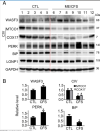
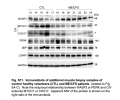
I am very eager for follow-up studies! I wonder if Drs Missailidis and Maciuch might know whether there are cheaper ways to look for patterns in perk and bip other than biopsies and western blots?
Last edited:
jnmaciuch
Senior Member (Voting Rights)
Western blots are already about as bare-bones as you can get, that’s what many trainees start out learning in the lab. I suppose you could do qPCR for the gene transcript but you’d want to know if the protein is being translated anyways. If you wanted to avoid biopsy you could see if any of the pattern overlaps in circulating cells but I’m not sure there’s much reason to think there would be overlap. @DMissa might know of something else you could do, I am much more dry lab than wet lab.I am very eager for follow-up studies! I wonder if Drs Missailidis and Maciuch might know whether there are cheaper ways to look for patterns in perk and bip other than biopsies and western blots?
(also just to clarify I am a PhD student unlike Daniel, few more years until I can claim Dr)
Last edited:
DMissa
Senior Member (Voting Rights)
I agree that it's very good, probably top 5.I continue to think Hwang's work is the best paper I've seen in me/cfs.
Unless something is present in urine or circulation and is on routine pathology panels the most cost effective way to measure a particular protein will probably be a western, assuming you have a reliable western working. They can be a pain in the rear.I am very eager for follow-up studies! I wonder if Drs Missailidis and Maciuch might know whether there are cheaper ways to look for patterns in perk and bip other than biopsies and western blots?
As for what to sample (whether biopsy is needed or not) it depends on where the protein is expressed and how the tissue being sampled may relate to the questions being asked of the disease.
Fibroblasts are unlikely to have some disease-specific ME/CFS thing going on but they express a wide variety of stuff, including immune system stuff, and you can grow up a lot of biomass for extracting protein etc from just one small sample without needing to immortalise or otherwise transform the line. So they are useful for systemic suspicions. The problem is that they vary a lot with age, are confounded easily by differential growth rates in culture because they tell each other to go to sleep when they become crowded, they "get older" quickly in culture, and things like that. So it would be good to see replication in fibroblasts to rule out technical artifacts but also in other types of cell types that are also feasible to sample and measure.
We have done work with fibros that I mentioned in a public talk didn't show much in terms of respiration so I'm not sure whether the specific results will replicate. That data should hopefully be published this year or something.