Review An emerging role for calcium signalling in innate and autoimmunity via the cGAS-STING axis, 2019, Mathavarajah et al

hotblack

Senior Member (Voting Rights)
An emerging role for calcium signalling in innate and autoimmunity via the cGAS-STING axis

Mathavarajah, Sabateeshan; Salsman, Jayme; Dellaire, Graham

Abstract
Type I interferons are effector cytokines essential for the regulation of the innate immunity. A key effector of the type I interferon response that is dysregulated in autoimmunity and cancer is the cGAS-STING signalling axis.

Recent work suggests that calcium and associated signalling proteins can regulate both cGAS-STING and autoimmunity. How calcium regulates STING activation is complex and involves both stimulatory and inhibitory mechanisms.

One of these is calmodulin-mediated signalling that is necessary for STING activation. The alterations in calcium flux that occur during STING activation can also regulate autophagy, which in turn plays a role in innate immunity through the clearance of intracellular pathogens. Also connected to calcium signalling pathways is the cGAS inhibitor TREX1, a cytoplasmic exonuclease linked to several autoimmune diseases including systemic lupus erythematosus (SLE).

In this review, we summarize these and other findings that indicate a regulatory role for calcium signalling in innate and autoimmunity through the cGAS-STING pathway.

Web | DOI | Cytokine & Growth Factor Reviews
 
I have a gazillion tabs open with papers and tbh I can’t remember if this was one @jnmaciuch mentioned or something I found while going down a rabbit hole when first getting into this topic. But I couldn’t find it posted so thought it worth sharing as an overview
 
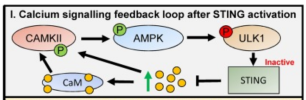
I can't remember if I ever brought up this specific paper but I'm glad you tagged me here because this figure reminded me of something I'd forgotten:
1763149474941.png

In healthy cells, this seems to be the main loop preventing calcium flux from leading to IFN signaling via cGAS-STING. It's mediated by phosphorylated AMPK, which was found to be abnormal in a couple small studies of muscle cells from Julia Newton's group (though these should be taken with a grain of salt due to small sample size/inclusion criteria, etc.).

Phosphorylation of AMPK was found to be downregulated during infection primarily by a specific interferon stimulated gene, TDRD7 (thread here). And this paper by the same group found that TDRD7 is dependent on STAT1 signaling. Which is part of the complex that mediates a large portion of the interferon response, but can be independently upregulated due to currently unknown epigenetic mechanisms (discussed here and here). So, long story short, if enough cells are skewed by this unknown mechanism that regulates baseline STAT1, and the downstream targets of STAT1 interfere with AMPK phosphorylation, then the cell loses the primary mechanism that prevents normal calcium flux from leading to an interferon response via STING. Theoretically, anyways.
 
Just commenting to potentially tie this together with comments in this theead on daratumumab

There seems to be other roles for CD38, some of which may be applicable to ME/CFS. It can change calcium signalling for example.

Also see the NCBI page on CD38 which says
The protein encoded by this gene is a non-lineage-restricted, type II transmembrane glycoprotein that synthesizes and hydrolyzes cyclic adenosine 5'-diphosphate-ribose, an intracellular calcium ion mobilizing messenger.

And lists this from gene ontology
involved_in positive regulation of cytosolic calcium ion concentration

So, presumably if Dartumumab acts on CD38 it would, by doing so, inhibit this process and reduce cytosolic calcium so (from the paper in this thread) affect cGAS-STING and have an impact on Type I Interferon production. Which may be relevant to ME/CFS if we think there is a role for these (discussed in this thread amongst other places)
 
Last edited:
A bit more of an explanation and some sources, first on CD38 and calcium
CD38 is a transmembrane glycoprotein that is expressed on myeloma cells and also, at lower levels, on normal lymphoid cells, myeloid cells, and some nonhematopoietic tissues.3 CD38 functions in various ways; for example, it acts as a receptor involved in triggering activation and proliferation signals, as an adhesion molecule, and also as an ectoenzyme.

Functioning as a receptor, CD38 engages the specific cell surface ligand CD314and elicits an intracellular signaling cascade that activates T lymphocytes, which results in the secretion of interleukin 6, granulocyte-macrophage colony-stimulating factor, interferon-γ, and interleukin 10 cytokines.5 As an ectoenzyme, CD38 catalyzes the conversion of NAD+ and NADP+ into cyclic adenosine diphosphate ribose, adenosine diphosphate ribose, and NADP+. The production of these substrates plays a role in the regulation of intracellular calcium signaling and in the modulation of the immune response.3 Inhibition of CD38 activity is followed by increased intracellular NAD+ levels.6
Daratumumab in multiple myeloma

So CD38 is a protein on the surface of some cells and can act like a receptor or be used as an enzyme in producing cyclic ADP-ribose (cADPR), which itself mobilises calcium from intracellular stores.

This is why when something like daratumumab acts on CD38, it reduces CD38 availability to be used as an enzyme in this second process of production of cADPR, so reduces calcium availability in the cytoplasm of the cell.
 
Last edited:
The picture for exactly what the effect of this reduced calcium availability has is less clear. There’s an effect, but does it support or inhibit cGAS-STING, does this increase or decrease IFN production, all seems to vary.

But the paper in this thread and those below show levels are important.

Evidence for a role of calcium in STING signaling

Structural insights into distinct filamentation states reveal a regulatory mechanism for bacterial STING activation

Maybe this is important in specific cells? Maybe immune but maybe elsewhere too? Or different effects in different immune cells? Difficult to know but it seems that Daratumumab could have a dose and perhaps duration/timing dependant and maybe cell specific impact on cGAS-STING and IFN production. So potentially important. And my guess is this could be some of what we’re seeing Fluge and Mlla working through. I’ve learnt a lot and hope it’s useful for others.
 
Back
Top Bottom