Why can't good ME/CFS researchers get more funding?

Jaybee00

Senior Member (Voting Rights)
This conversation has been split from Whitney Dafoe Updates


It would be nice if 2026 was the year when everyone whose voice counts in the field of ME/CFS stood up and said it was time for fringe medicine and poor quality research to be left behind. I find myself surrounded by people who claim to be campaigning for people with ME/CFS but who are supporting all the wrong things.

How did “Polybio” become a multi million dollar research foundation “based on viral persistence”? How did David P become an overnight world expert on ME/CFS despite no background in immunology? How did AP become the scientific director of the premier LC center in the USA? Why has Nancy K’s Center in Florida been doing research for decades with nothing to show for it except for various yoga programs. What expertise does Rengade Research have?

There has been too much focus on the BPS stuff and not enough on bad science research.
 
Last edited by a moderator:
How did “Polybio” become a multi million dollar research foundation “based on viral persistence”? How did David P become an overnight world expert on ME/CFS despite no background in immunology? How did AP become the scientific director of the premier LC center in the USA? Why has Nancy K’s Center in Florida been doing research for decades with nothing to show for it except for various yoga programs. What expertise does Rengade Research have?

There has been too much focus on the BPS stuff and not enough on bad science research.
Related question: is there any reason we can't aim for Polybio levels of funding for good quality ME/CFS research?
 
Related question: is there any reason we can't aim for Polybio levels of funding for good quality ME/CFS research?

This is sort of a good question, and partially the answer depends on the phrase “good quality”.

I mean the research funded by a organization will reflect the biases/culture/interest of the core group.

For example, AP believes LC ME/CFS is caused by viruses or other microorganisms. So she looks for research/ers to address this, even though a recent Ron Davis paper said there are less viruses in patients. But for them, good quality means more research in this vein.

If you gave a chunk of money to Jonathan Edwards he has said he would funnel funding to Ponting’s group for more basic/genetic work. So for people in this group “good quality” might mean spending years and years elucidating basic mechanisms before attempting any clinical trials.

Give funds to me and I would fund clinical trials with aggressive treatments and I wouldn’t fund any basic/genetic research, because I believe existing treatments like CAR T , Teclistamab, etc., will probably treat ME/CFS.

OMF probably has a decent/balanced portfolio of projects, but I do wish they had more clinical trials, even small ones.
 
Last edited:
If you gave a chunk of money to Jonathan Edwards he has said he would funnel funding to Ponting’s group for more basic/genetic work. So for people in this group “good quality” might mean spending years and years elucidating basic mechanisms before attempting any clinical trials.
Give funds to me and I would fund clinical trials with aggressive treatments and I wouldn’t fund any basic/genetic research, because I believe existing treatments like CAR T , Teclistamab, etc., will probably treat ME/CFS.
I've said before, I think this is a false binary. We need the basic research and the clinical trials. With sufficient funding we wouldn't have to choose. Good quality research would entail doing both stuff like the anti-cd38 trials and SequenceME.
 
I've said before, I think this is a false binary.

Yep.

It's an inaccurate picture in any case, isn't it? Surely Chris is a geneticist, not an academic physician; if so, he wouldn't be trialling prospective treatments even if his department were as rich as Croesus. And I can't remember Jo ever saying anything about not being able to do clinical trials until the underlying mechanisms are fully elucidated.
 
No in fact I think he said in his hypothesis thread that therapeutic experiments might be crucial to proving or disproving it (but I've already misquoted him once lately so don't take my word for it!)
I was probably thinking of this in the Zhang thread, so I was kind of in the right ballpark!

Well, one possible option is the sort of Fluorospot test we have seen recently reported as showing an increase in gamma interferon production by CD8 cells when in contact with macrophages. The test shows signals as they are passed from one cell to the next at a microscopic level if you allow the cells to interact.

The other thing is that if you can infer indirectly what is likely to be happening you can try a therapeutic experiment - block the signal you think is working out of sight. That is what I did for RA. I had no way of seeing the submicroscopic event of TNF release in response to Fc receptor binding actually in the RA joint. But I worked out it must be going on so I tried taking away the antibodies that I thought were binding to the receptor. And it worked rather well.
 
How did “Polybio” become a multi million dollar research foundation “based on viral persistence”? How did David P become an overnight world expert on ME/CFS despite no background in immunology? How did AP become the scientific director of the premier LC center in the USA? Why has Nancy K’s Center in Florida been doing research for decades with nothing to show for it except for various yoga programs. What expertise does Rengade Research have?
Actually that's pretty simple: they fill a void, and the void is so vast that at least some people will throw money at anything so the barrier to entry is very low.

All which is simply a downstream effect of medicine's almost universal disdain for what they have been taught to think as non-issues of no relevance to scientific medicine. The void is so vast that if the best available researchers stepped in, they would occupy the space. I'm not saying that we're stuck with the worst, far from it, biopsychosocial ideologues are still far worse and it's not even close, this is just what happens when a field is very small.

Talent, even intelligence, work at scale, by brute force. There literally need to be billions of us for there to be a few hundred people with the skills and drive to make significant progress at anything. When that field is massively diminished, by being depressed on political and ideological grounds, the pool of talent and resources massively shrink, and for the most part resources matter far more than talent anyway. This is just what a field starved of resources looks like.
 
Actually that's pretty simple: they fill a void, and the void is so vast that at least some people will throw money at anything so the barrier to entry is very low.

The void is so vast that if the best available researchers stepped in, they would occupy the space.
That's sort of what I'm getting at. We have good researchers in Edinburgh, good researchers in Fluge and Mella, some very good researcher members of this forum I could name.

If we could get them collectively even half of Polybio's funding it would change things significantly.

I just wonder if it's possible for better research than viral persistence to raise anything like those kind of funds? Make the case to the community to fund good science over biobabble. When the current crop of viral persistent trials fail as imo they probably will, that might be the moment to propose an alternative.
 
The fringe research outfits will close shop once real pharma gets involved.

Does multiple myeloma/multiple sclerosis have these fringe research groups involved—no I don’t think so.

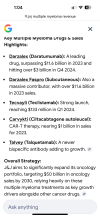
JNJ loves multiple myeloma research cause it makes billions from it (Tecli and Dara). And they can spend millions to develop better meds/improve their patents.
 

Attachments

  • IMG_7744.png
    IMG_7744.png
    296.3 KB · Views: 13
Back
Top Bottom