Dolphin
Senior Member (Voting Rights)
When High Scores Hide Realities: Enhancing Patient Survey Data Through Joint Display
Meaghan Brierley, PhD Fatemeh Vakilian, MA, MSc Mahnoush Rostami, MSc Health Systems Knowledge and Evaluation, Acute Care Alberta, Edmonton, Alberta, Canada
ABSTRACT
PURPOSE
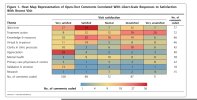
Patient surveys often include closed- and open-ended responses that are usually reported separately, and links between them rarely explored, limiting interpretive depth. We outline a strategy that integrates quantitative and qualitative survey data in a joint display which enables combined analysis and findings to inform and improve programs for patients.
METHODS
Data were drawn from a patient experience survey implemented in Alberta’s long COVID Inter-professional Outpatient Program (IPOP). A joint display of Likert-scale satisfaction ratings and themed open-text feedback was developed to examine connections between the structured responses and qualitative insights.
RESULTS
We integrated quantitative survey satisfaction ratings with themes from the qualitative analysis of open-text comments in a joint display. Examining these data sets together added an analytical layer and uncovered nuanced experiences not evident in Likert-scale responses alone. By aligning satisfaction scores with themes, the joint display surfaced contradictory and paradoxical findings that would otherwise be hidden.
CONCLUSIONS
Aligning Likert-scale responses with thematic analysis of open-text reveals subtleties that may be obscured by scores alone. Understanding the narratives behind ratings is essential to evaluate health care programming, particularly when surveys are the primary mechanism for incorporating patient voices into service planning and delivery.
Ann Fam Med 2026;24:153-158. https://doi.org/10.1370/afm.250474