What the epidemiology of glandular fever might tell us about ME/CFS

Kitty

Senior Member (Voting Rights)
This thread was split from a translation thread, with the discussion prompted by a member's observation that glandular fever/mono is not commonly known in China.


Chinese people, at the the older generations, have a practice where they would test out the temperature of the food with their mouths before feeding it back to their infants...as a result, most children are infected with EBV at a very young age.

That's fascinating!

Not the most sanitary of practices I reckon!

Human species might well have fed their partly weaned infants mouth-to-mouth for a couple of million years, so I guess it can't be that bad. I'd never thought it as having potential benefits in building immunity, though.

I can't read even a single character of Mandarin Chinese, by the way, so I can't help with your translation!
 
Last edited by a moderator:
(Copied post: content not relevant to this split thread has been greyed)

but researchers have not yet found genes linked with the illness.
Well, in light of DecodeME, should we still include this line?

Maybe the fact sheet will be updated once DecodeME is peer-reviewed and published, but it could be argued to reference the preprint now given its strength?

Fascinating on mono/glandular fever being unknown. EBV-driven malignancy is common in China, especially nasopharyngeal carcinoma and gastric adenocarcinoma. There will be genetic and environmental explanations for this, though early life exposure to EBV may be a risk factor.

It's possible the window of EBV exposure in relation to immune development protects or favours development of different types of cancer through life: eg mucosal vs haematological malignancy.
 
Last edited by a moderator:
Fascinating on mono/glandular fever being unknown. EBV-driven malignancy is common in China, especially nasopharyngeal carcinoma and gastric adenocarcinoma. There will be genetic and environmental explanations for this, though early life exposure to EBV may be a risk factor.

I wondered if the pattern of ME/CFS—age of onset and incidence—might be different as a result. There'd be genetic differences between populations, but China's cities and Hong Kong would compare to many other industrialised parts of the world.

The epidemiology seems to be pretty rubbish in most places though, and China might be no different. It wouldn't be a straightforward exercise.
 
I wondered if the pattern of ME/CFS—age of onset and incidence—might be different as a result.
To be honest I’ve never heard of Mono/EBV where I live. I don’t think it’s a “thing”.

Like obviously the disease exists but maybe similar to china nearly everyone has it early? To me the whole kissing virus you got in college which knocked you out for a couple months was something I only ever heard about in US TV Shows. Until I got ME.

But also I lived in chaotic generation that got lockdown in our late teens and COVID and all that so that might confound things here.
 
Last edited:
About mono/glandular fever: it is the same in Hungary. I never heard of it until I got mono myself in my early thirties (leading to my ME/CFS). I don't remember any high school/college kids I knew who had it. Whenever I tell my story, I need to explain to people what mono is, they don't know. People here really have no idea unless they had it themselves. Doctors of course know about it. I had a couple of American expat friends, they also knew about it, some had it themselves. But the locals don't really.

I also find it interesting when I read comments here on S4ME about how it is widely known that mono/glandular fever can take months to recover from because of the post-viral symptoms. It is like everyone is aware of that. No one is here, people have no idea. There is very little awareness even about acute mono. I also suspect cultural reasons behind this, little kids getting infected with EBV at a younger age, when it is not such a big deal, so mono in your teens and later is rare.
 
I also suspect cultural reasons behind this, little kids getting infected with EBV at a younger age, when it is not such a big deal, so mono in your teens and later is rare.
These possible cultural differences in the timing of EBV infections could be useful in ME/CFS epidemiology. For example, is the seemingly greater prevalence in teenage years due to EBV or some other factors, possibly including something intrinsic to the person at that age rather than exposure to infections. @Simon M
 
Last edited:
these possible cultural differences in the timing of EBV infections could be useful in ME/CFS epidemiology. For example, is the seemingly greater prevalence in teenage years due to EBV or some other factors, possibly including something intrinsic to the person at that age rather than exposure to infections. @Simon M
Is this cultural or geographical, relating to the prevalence of mono?

But there is good evidence that mono is more common in teens, and as we know mono is a trigger for ME/CFS, it seems logical that higher rates of mono are linked to higher rates of ME/CFS in teens. But people may also be more vulnerable to ME/CFS from other causes at similar ages.

At least in the UK, EBV is the major cause of mono (I think all the other causes are herpes/DNA viruses). And for these, infection when younger is asymptomatic or leads to mild symptoms. I don't know if people understand why later infection is associated with more severe symptoms, i.e. mono, but that's what is observed.

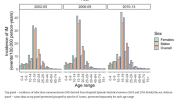
Here is some data for hospital cases for mono in the UK, showing clear peaks in the teens.

1764179430343.png
The same study (Kuri 2020) shows EBV seropositivity shooting up as people age. Given that symptoms tend to be mild when young, mono peaks in the teens as after that there are increasingly few people who are EBV negative, and so able to get EBV-mono.

But this seems a bit of a detour from a thread about Mandarin translations of fact sheets!
 
Is this cultural or geographical, relating to the prevalence of mono?
Well, cultural differences of, for example maternal preparation of food for young children by chewing it, might result in geographical differences in the distributions of age of infection with EBV.

But this seems a bit of a detour from a thread about Mandarin translations of fact sheets!
Yes, a topic for an epidemiology thread discussion. I just thought you might be interested in the comments on this thread, i.e. the idea of differences in the age of EBV infection possibly as a reason for different patterns in age of ME/CFS onset in different countries.
 
Last edited:
Well, cultural differences of, for example maternal preparation of food for young children by chewing it, might result in geographical differences in the distributions of age of infection with EBV.


Yes, a topic for an epidemiology thread discussion. I just thought you might be interested in the comments on this thread, i.e. the idea of differences in the age of EBV infection possibly as a reason for different patterns in age of ME/CFS onset in different countries.
I certainly am, thanks. Unfortunately, there is precious little reliable data (and often no data at all) on rates of mono in different countries. We probably have better data in the UK than anywhere else, and it's not brilliant here
 
I don't know if people understand why later infection is associated with more severe symptoms, i.e. mono
This is still off topic, but I heard Prof Dorothy Crawford on the radio years ago. She argued that children (unlike teenagers) do not usually get glandular fever because they only get a small dose of EBV from social contact. Teenagers, she continued, may get a much larger dose of the virus from sexual kissing. Viral dose may have much relevance to glandular fever severity and thus risk of ME/CFS.
 
That's an interesting comment @Ferry. So aspects of timing and quantity of the pathogen challenge might tend result in some specific combination of immune responses.

Although, a small child might receive a large dose of pathogen relative to their size (eg lung capacity, blood volume, surface area). Edit: and maternal chewing of food to prepare it for a young child surely would result in substantial pathogen transfer if the mother is infectious?
 
Last edited:
Although, a small child might receive a large dose of pathogen relative to their size (eg lung capacity, blood volume, surface area). Edit: and maternal chewing of food to prepare it for a young child surely would result in substantial pathogen transfer if the mother is infectious?
The immune system also changes a lot from infancy to adolescence and then to post pubescence. Especially in the adaptive compartment, which EBV targets. So different timing of EBV exposure could also have different outcomes for that reason
 
Last edited:
The immune system also changes a lot from infancy to adolescence and then to post pubescence. Especially in the adaptive compartment, which EBV targets. So different timing of EBV exposure could also have different outcomes for that reason

I agree. Much as I am very fond of Dorothy (she worked with my mother on EBV, helped me with early rituximab work, and her sister and husband are my brother and sister in law's best friends) I suspect she is wrong about this!
 
The immune system also changes a lot from infancy to adolescence and then to post pubescence.

Yes, when a friend got infected (probably by her toddler bringing it home from nursery) I remember reading that teenagers and older adults are likely to produce an exaggerated response to it, whereas in young children it's much more typical.

I think the theory went that the harder-hitting symptoms in teens are caused by that overenthusiastic response, not by the virus. But not all teens react that way, which is why there are still some asymptomatic cases.

If I've remembered that correctly, it's perhaps not surprising that an exaggerated immune response can result in things going haywire in some people.
 
Is the suggestion that the epidemiological variation relates to acute infections (ie glandular fever/mono) rather than to under lying levels of the EBV virus present in the in the general communities?

Though my acute episode of glandular fever in my mid thirties was the illest I had ever been up to that point in my life, it was not severe enough to require hospitalisation. Is there any suggestion that the long term associations of EBV, including ME/CFS, MS or the relevant cancers are directly impacted by the severity of any initial acute infections?
 
Is the suggestion that the epidemiological variation relates to acute infections (ie glandular fever/mono) rather than to under lying levels of the EBV virus present in the in the general communities?
Yes. There's an idea that the symptomatic glandular fever (mono) of a first EBV infection in adolescence or later is a significant trigger of ME/CFS, whereas the less symptomatic first EBV infection of very young children is not. It would be interesting to look at ME/CFS prevalence and onset age data in different countries to see if there is a relationship with average age of first EBV infection. I guess things like epidemics of Covid-19 and Q fever might confuse the picture.

And, assuming that there is less ME/CFS when first EBV infections occur in very young children, then why might that be?

We've thought about the possibility that it might be related to the quantity of virus introduced in a short time, because virus loads from social contact like sharing utensils and coughing might be a lot lower than from mouth kissing. That's possible, but, in places where mothers pre-masticate food for their infants, that would surely result in high viral load transfers too. And it seems that in places where that occurs, young children don't get glandular fever.

And, I think we are concluding that the very different immune systems of people from their first years to adolescence and onwards is a more likely reason for different symptoms resulting from an initial EBV infection at different ages, and for changes in the tendency of the EB virus to cause ME/CFS.

If that assumption about the immune system differences accounting for the different propensity of the EB virus to cause ME/CFS is right, then it would be interesting to think about how the immune system response to EBV is different when someone is aged 5 versus aged 15.
 
Primary Epstein-Barr virus infection with and without infectious mononucleosis 2019

Most people are infected with Epstein-Barr virus (EBV) during childhood or adolescence, resulting in a persistent, mostly latent EBV infection. The primary EBV infection often manifests as infectious mononucleosis (IM), especially in adolescence [1,2]. Globally EBV is causally linked to nearly 200000 incident cancers and 18000 deaths from multiple sclerosis annually [3,4], with IM elevating the risk of Hodgkin lymphoma and multiple sclerosis for unknown reasons [5–7]. Functions of EBV antibody levels as predictors of disease risk is an active field of research, see [8] and references therein.

At the same time it is unclear why upon primary EBV infection some individuals present with IM, while others do not [9]. Disease severity and duration correlate much better with e.g. CD8+ cell counts than with the viral kinetics itself and the expansion of the CD8+ cell count is controlled in asymptomatic EBV infection despite virus loads similar to those experienced in symptomatic EBV infection [1,2,10–14]. Hence current understanding suggests that IM is caused by overreaction by the immune system, rather than EBV infection per se (viremia or B-cell expansion). There now seems to be broad agreement that a massive expansion of the number of EBV-specific CD8+ cells is a characteristic of IM, while changes in the proportions of other cell populations seem less well-established [1,2,10–13,15,16]. Clinically, IM is typically characterized by fever, pharyngitis, lymphadenopathy and fatigue. The IM symptoms are believed to be caused mostly, if not entirely by the exaggerated CD8+ response [2,15,16]. Presumably IM is the same disease in teenagers as in children, because the immunological response to EBV infection is recognizably the same [10,17].

Conclusions
The change in attack rate at typical ages of puberty onset suggests that the immunologic response to EBV drastically changes over a relatively short age-span. We speculate that these changes are an integrated part of normal sexual maturation. Our findings may inform further etiologic research into EBV-related diseases and vaccine design.

The mechanisms underlying the age-dependent variation in IM attack rate have remained elusive, but proposed explanations include corresponding variations in mode and dose of infection and in host immune response [2,11,15,44]. The host immune response may vary by age for at least two reasons: 1) NK cell responses may assume greater importance, and perhaps be more effective, in combating virus infections early in life [15], and/or 2) adolescents infected with EBV may recruit large numbers of cross-reactive memory T cells previously created in response to other viral infections, which may more easily be activated but be less efficient in controlling the infection than primary responses from recruited naϊve T cells [44]. However, in light of the very rapid change in IM attack rate, we do not consider cross-reactivity of memory T cells to be a likely major contributor to this change. Similarly Balfour et al. found no evidence of influenza-EBV dual specific CD8+ T cells in their study cohort to support this explanation [9,11]. Likewise both simulations [44] and observational studies [2,12,45] suggest that the initial viral load, and hence dose or mode of delivery is of little importance for IM risk.

Our results, including the fact that the adolescent attack rate peak among females occurs at a slightly younger age than the corresponding peak in males, instead point to IM susceptibility as somehow being subject to mechanisms that involve growth and/or sex hormones whose levels change as part of sexual maturation. In this regard, it is noteworthy that both estrogen and androgens are known to influence immune responses via epigenetic mechanisms, see [46] and references therein.
 
Last edited:
Is the suggestion that the epidemiological variation relates to acute infections (ie glandular fever/mono) rather than to under lying levels of the EBV virus present in the in the general communities?

Though my acute episode of glandular fever in my mid thirties was the illest I had ever been up to that point in my life, it was not severe enough to require hospitalisation. Is there any suggestion that the long term associations of EBV, including ME/CFS, MS or the relevant cancers are directly impacted by the severity of any initial acute infections?
There is quite a lot of evidence that severity of illness is important in the risk of ME/CFS post infection:
1. The Dubbo study (EBV, Q fever and Ross River Virus, RRV) found that the severity of initial infection was the only predictor of CFS at 6 months.
2. Peter White found that days of bed rest at initial illness was the only predictor of subsequent CFS.
3, Other specific infections linked to ME/CFS are also severe, including: Covidp-19/Long Covid and Flu variant in 2009 (there is a Norwegian paper on this). Q-fever and RRV (Dubbo) are also nasty infections (Q fever can be fatal). However, most cases of post-infectious ME/CFS do not have an identified infectious agent.
 
Back
Top Bottom