The association between hair cortisol levels, Epstein-Barr virus infections and chronic fatigue in adolescents, 2026, Kongsnes, Wyller et al

Dolphin

Senior Member (Voting Rights)

Research Article

The association between hair cortisol levels, Epstein-Barr virus infections and chronic fatigue in adolescents​

Berit Elise Bergem Kongsnes
,
Tarjei Tørre Asprusten
,
Vegard Bruun Bratholm Wyller
&
Maria Pedersen
Article: 2638303 | Received 20 Nov 2025, Accepted 23 Feb 2026, Published online: 02 Mar 2026

Abstract​

Chronic fatigue after Epstein-Barr virus (EBV) infection is a significant health problem among adolescents, yet its underlying mechanisms remain unclear.

This study investigated whether preinfection hair cortisol levels predict chronic fatigue following acute EBV infection and examined the associations between hair cortisol and concurrent fatigue during acute infection, six months postinfection, and in healthy controls.

This study is part of the CEBA project (Chronic Fatigue following Acute Epstein–Barr Virus Infection in Adolescents).

Hair samples for cortisol measurements were obtained from 192 adolescents aged 12–20 years during acute EBV infection and again six months later, and from 66 age- and sex-matched healthy controls.

Fatigue was measured by the total score on the Chalder Fatigue Questionnaire.

Group comparisons were performed using nonparametric tests, and associations were examined with linear regression analyses.

Adolescents with EBV infection had significantly higher preinfection hair cortisol levels (median 5.12, IQR: 3.27–8.76) compared with healthy controls did (median 3.90, IQR: 2.61–6.19) and with their own levels six months later (median 3.74, IQR: 2.46–6.52).

A trend toward a positive association between preinfection hair cortisol and fatigue during acute infection, became significantly negative six months later.

No associations were found among controls.

Preinfection hair cortisol concentration did not predict chronic fatigue six months after acute EBV infection.

Elevated preinfection hair cortisol may reflect stress-related vulnerability to infection, and the shifted from a positive to a negative association over time, suggests that HPA-axis alterations are more likely a consequence rather than a cause of chronic fatigue.

Keywords:

 
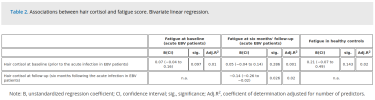
However, elevated hair cortisol levels prior to EBV infection were not associated with an increased risk of developing chronic fatigue (see Table 2). This is, to some extent, surprising, as the bio-psycho-social model of chronic fatigue suggests that stressors may lead to allostatic overload and persistent symptoms (Engel, Citation1997; McEwen, Citation2004).

Given previous findings indicating that patients with postinfective fatigue show signs of chronic stress, it would be intuitive to assume that such stress precedes and contributes to the development of fatigue (Pedersen et al., Citation2019; Sandler et al., Citation2021).

Nevertheless, our results align with observations from other infections; for example, Kalfas et al. found no association between preinfective hair cortisone concentrations and postinfectious fatigue following COVID-19 (Kalfas et al., Citation2024).
 
However, the level of cortisol six months after the acute EBV infection was negatively associated with the level of fatigue measured at the same time (Table 2).
this finding strongly suggests a shift in cortisol regulation as fatigue becomes chronic.

For the association they did find (higher fatigue at follow-up correlates to lower hair cortisol at follow-up) the correlation looks to be fairly small (R²=0.02). Unadjusted p=0.026.

1772893408759.png
 
Last edited:
The mindless idea that cortisol=stress as defined in the biopsychosocial model is ridiculous. Why is nonsense like this taken seriously? This is medieval alchemy level of oversimplistic reasoning. Oh, I'm sorry, I meant intuition, because apparently they can go with that without being laughed out of rooms.

I have no idea what is going on with the quoted text in comment #2. It was expected that cortisol should be elevated, because the model demands, somehow absurdly framed as 'intuitive', but it's also not surprising given that it aligns with prior results which found no such thing.

Up isn't down, it's all directions at once. Spin the wheeeeeel!
 
Lower hair cortisol and diminished parasympathetic responsiveness may reflect a state of chronic stress, as postulated by the “sustained arousal” theory of chronic fatigue (Wyller et al., Citation2009). However, contrary to that theory, our findings suggest that symptomatic fatigue precedes these physiological changes rather than resulting directly from them. Thus, rather than sustained arousal or stress being the primary cause of fatigue (as the sustained arousal model and some biopsychosocial accounts propose), our data indicate that the development of fatigue and its associated symptoms may lead to subsequent sustained arousal/stress.

In case anyone were wondering: this data was collected in 2015 and 2016. I wonder why it took them so long to publish it?!

Edit: the clinical trials page says the trial was completed in mid 2017, and Wyller was in charge. This data directly contradicts his main hypothesis. He has received funding for numerous studies since 2017, citing his hypothesis.
 
Last edited:
When fatigue persists for more than three months for adolescents, it is classified as chronic (Jordan et al., 2006). The most severe form, chronic fatigue syndrome (CFS), is characterized by disabling fatigue without a clear cause, accompanied by symptoms like cognitive difficulties, sleep disturbances, pain and so forth (Fukuda et al., 1994; Institute of Medicine, 2015; Jason et al., 2006).
It's interesting that they seem to consider CFS as mainly severe fatigue, and don't mention PEM. I suppose it's included in "and so forth".

CFS affects approximately 1.46% of the global population and 0.4%–2.4% of adolescents (Lim et al., 2020).
The 1.46% seems to be based on the average prevalence of Fukuda CFS from the meta-analysis by Lim et al, which seems like a less reliable figure than the meta-analysis prevalence. The average prevalence gives equal weight to all studies no matter the sample size, while the meta-analysis takes sample size into account.
Lim 2000 said:
The majority of the prevalence data (34 of total 56 data) were based on the CDC-1994 definition in our study, which found a mean prevalence of 1.46% and a meta-analysis result of 0.89% (Tables 2 and 3).
I'm having trouble finding what the claim of 0.4%-2.4% prevalence in adolescents is based on.
 
Within the CEBA cohort, participants were also evaluated for heart rate variability at each assessment point. As previously reported, we observed a similar shift in the association between autonomic measures and the level of fatigue: no association was present at baseline, but at six months, measures indicative of reduced parasympathetic responsiveness to controlled breathing were associated with higher fatigue levels (Pedersen et al., 2019). Lower hair cortisol and diminished parasympathetic responsiveness may reflect a state of chronic stress, as postulated by the “sustained arousal” theory of chronic fatigue (Wyller et al., 2009).
I'm not sure about the association of [edit: "reduced parasympathetic responsiveness to controlled breathing] with fatigue in the same cohort, but might the association of lower hair cortisol with fatigue be better explained by lower physical activity in people who are fatigued?

Objectively assessed physical activity is associated with increased hair cortisol content in young adults (2013, Stress)
A regression analysis revealed that participants with higher VPA [vigorous physical activity] had elevated hair cortisol concentrations even after taking into account age, gender and perceived stress (β = 0.33, p < 0.05, ΔR2 = 0.106).
 
Last edited:
For the association they did find (higher fatigue at follow-up correlates to lower hair cortisol at follow-up) the correlation looks to be fairly small (R²=0.02). Unadjusted p=0.026.

View attachment 31009
Those results are incredibly bad, if you are trying to prove that hair cortisol tells you anything about fatigue.

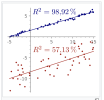
If the R squared is the R squared value that I'm familiar with, then the picture below is an example from Wikipedia of two R2 values. R2 is a measure how well the number on one axis predicts the number on the other axis. An R2 of 1.00 means the prediction is perfect - all of the points lie on the regression line.
An R2 of 0.0 means that the data on the x axis explains absolutely none of the variation on the y axis - the data points are just scattered around randomly. This picture shows an R2 of 98.92% and 57.13%.
Screenshot 2026-03-10 at 4.49.54 PM.png
The slope of the regression line tells us how strong of an effect there is. A line with a slope close to 0 means that changes in the x axis feature don't affect the y axis feature much.


Here's the data from that Table 2
Followup is 6 months after the acute infection. The following are for people who had an EBV infection.

Hair cortisol levels before infection vs fatigue during the infection
R2 of 0.01 (i.e. 1%!). That is virtually nothing.
The slope of the regression line is 0.07 - that is close to no slope, and the confidence interval ranges from a positive to a negative slope.
And the p value is 0.097 - not at all significant.
That is two sets of values that have no relationship to each other.

Hair cortisol levels before infection vs fatigue at followup
The R2 was even worse, 0.001 (0.1%). That really is nothing.
The slope of the regression line is even flatter, 0.05, and again, the confidence interval ranges from a positive to a negative slope.
And the p value is worse too - 0.286, not even in the same country as significance.
Again, two sets of values that have no relationship to each other. It could hardly be clearer.

Hair cortisol levels at followup vs fatigue at followup
R2 of 0.02 (2%).
The slope of the regression line is fairly flat: -0.14. The confidence interval range is all in negative territory, but only just.
The unadjusted p value is mildly significant, 0.026
So, there's a tiny bit of evidence here that higher hair cortisol at followup predicts lower fatigue in the people who had an EBV infection, 6 months after the infection. Just maybe there are a handful of people who have a high level of fatigue and no longer need such a moderately high level of cortisol to cope with active sport. BUT - the R2 value tells us the data is all over the place. The result could easily just be noise.

It's a big shame they didn't show the charts with the regression lines on them. Any reasonable person looking at those results would have to say that there is quite a lot of evidence that hair cortisol and fatigue have nothing to do with each other. These results basically could not have been worse in terms of bolstering the idea that high levels of cortisol cause chronic fatigue.
 
Last edited:
The most severe form, chronic fatigue syndrome (CFS), is characterized by disabling fatigue without a clear cause, accompanied by symptoms like cognitive difficulties, sleep disturbances, pain and so forth (Fukuda et al., Citation1994; Institute of Medicine, Citation2015; Jason et al., Citation2006).
I saw @forestglip highlighted the 'so forth'. That's hilarious, it's as if the authors just couldn't be bothered deciding what else to write. Looks like a problem with effort preference to me.
 
Dysregulation of hormones within the hypothalamus–pituitary–adrenal (HPA) axis has been observed in individuals with CFS (Deumer et al., Citation2021). Studies measuring salivary cortisol have shown that adolescents with CFS lack the natural post-waking rise in cortisol levels (Nijhof et al., Citation2014; Roerink et al., Citation2018). However, this pattern normalizes with effective treatment (Nijhof et al., Citation2014). ... These findings are interesting in regard to possible etiology of CFS.

I wanted to highlight the very misleading although perhaps not strictly incorrect statements made here. The authors claim that
studies have shown that adolescents with CFS lack the natural post-waking rise in cortisol levels
I made a thread for the Nijhof 2014 paper. There's a paywall, but from the abstract, it is not correct to say that there is a lack of the natural post-waking rise. The abstract does not claim this. The post-waking rise might be on average slightly lower in the CFS young people (or perhaps the researchers just didn't time the measurement correctly given the different waking times of the young people with CFS). It is not absent.


The authors of this 2026 paper also suggest that the pattern of the lack of natural post-waking rise in cortisol levels
normalises with effective treatment
and only cite the Nijhof paper. The Nijhof paper found that
Nijhof paper said:
After treatment recovered patients had a significant rise in salivary cortisol output attaining normalization, whereas non-recovered patients improved slightly, but not significantly.
There is no evidence that the treatment made patients recover and so was responsible for the change in cortisol wakening response.

Rather than the treatment resulting in recovery, two other possibilities are more likely
1. there is natural recovery, and recovered young people return to work or school. An increased cortisol wakening response is a response to that increased morning activity.
2. there is a temporary effort to return to work or school, due to the therapy telling the young people that they can think their way back to good health and that they need to revert to normal waking hours. An increased cortisol wakening response is a response to the increased morning activity, but it is not sustainable.

Therefore, possibility 2 makes it technically possible that the treatment (CBT?) made the young people try to be more active in the morning and this changed their cortisol wakening response. So, the treatment might possibly be effective at temporarily changing the morning cortisol response, but there is no evidence that the treatment is effective at producing sustainable recovery.
 
This study is a part of the CEBA-project (Chronic fatigue following acute Epstein Barr Virus-infection in adolescence; ClinicalTrial ID: NCT02335437) (Pedersen et al., Citation2019).

ClinicalTrial ID: NCT02335437 - no updates since 2017, no results lodged.

That Pedersen et al, 2019 reference is
Pedersen, M., Asprusten, T. T., Godang, K., Leegaard, T. M., Osnes, L. T., Skovlund, E., Tjade, T., Øie, M. G., & Wyller, V. B. B. (2019a). Predictors of chronic fatigue in adolescents six months after acute epstein-barr virus infection: A prospective cohort study

Reading our thread on that awful paper, I see that that paper is the main report on the study. There's a problem in that about half of the participants are classed as having chronic fatigue at 6 months, and the conclusions about this group tend to be presented as being about Chronic Fatigue Syndrome. The numbers are something like 195 participants, 91 with chronic fatigue at 6 months, 27 meeting Fukuda criteria and 20 meeting CCC criteria.

That 2019 paper made a big deal about people who go on to have chronic fatigue at 6 months being anxious earlier in their illness, labelling it as having 'negative emotions'. The chronic fatigue participants also reported more pain in the first weeks. This latest paper makes it clear that people who are fatigued at 6 months were almost all fatigued in the first weeks. It seems quite possible that people who hadn't recovered at 6 months were worried in the early weeks of their illness for good reason, because they felt awful and weren't recovering.

The thing I find really interesting is that the null cortisol finding was kept out of the main paper. There is no mention of cortisol in that paper. I guess it didn't support this picture of the stressed young people worrying their way to chronic fatigue. It is proof that these researchers cherry picked the measures they wanted to report on in that 2019 paper, in order to create a story that supported them continuing with BPS therapies.

The main paper concludes
Development of fatigue after acute EBV infection is to a larger extent predicted by baseline variables related to symptoms and functions than to baseline variables reflecting infectious and immune processes.
Essentially they are saying, there's no biology here, it's just anxious people thinking their way into a downward spiral of fatigue and inactivity. I guess they genuinely believed that and believed that they were right to leave out anything that might call their conclusions into question. But, they have certainly harmed a lot of people along the way.
 
Did they genuinely believe that?
Reading that main paper, the authors' belief that the young people were thinking their way into disability comes across as genuine. I guess we can't know exactly what each of the researchers believed.

I can imagine that if the researchers wanted to get the message out that people don't have to be disabled, that they could be well if only they would do as the BPS people say, that it might seem reasonable to cut out the measures that complicate the story.

I think it would be an interesting question to ask the authors - why the cortisol measures weren't included in the main paper? I think they measured a huge number of things. Has all of the data been made available?
 
The slope of the regression line is 0.07 - that is close to no slope
Note that the slope depends on what units they used. For this one, I think it's(change in Chalder fatigue score)/(change in hair cortisol (picograms per milligram of hair)). (How much does the fatigue score change for a change of 1 picogram cortisol/milligram hair.)

If they had used nanograms instead of picograms, the slope would be 1000 times larger, or 70. So it's not really meaningful unless we have a good idea of how much a picogram of cortisol in a milligram of hair is.
 
@Hutan Did they genuinely believe that?
And believe that they were right to leave out anything that might call their conclusions into question?
Likely more of a case of Sinclair's "It is difficult to get a man to understand something, when his salary depends on his not understanding it". It's a bit more complex in that they their lives, and salary, would be largely identical if they had spent their career doing anything else, but they have chosen to do this, and it set them on the path where they had to keep pretending in the foundational lies of their career. It's no different than someone who worked for the tobacco companies hiding evidence of the harm of their product. They could all have done something else, but they chose that, and they stick to it.

Guaranteed that if this gets pointed out, nothing would happen to anyone. So it's more of a case where it's just too easy to lie and bullshit because there is a widespread need for this ideology to be true, having run out a body count in the tens of millions over decades with nothing to show for it. There have been few wars in history more destructive than this. In fact, there might not even be. The only difference is the destruction is limited to human lives and our contributions, rather than things and buildings. Lives are cheap. Things and buildings being destroyed is what bothers people. Stonks go up, lives go down, can't explain that.
 
In case anyone were wondering: this data was collected in 2015 and 2016. I wonder why it took them so long to publish it?!

Edit: the clinical trials page says the trial was completed in mid 2017, and Wyller was in charge. This data directly contradicts his main hypothesis. He has received funding for numerous studies since 2017, citing his hypothesis.
This bothers me because I noticed it at first but assumed I must have missed something and didn't bother digging further. But this is the only plausible explanation. This claim keeps being repeated as a fact. No doubt Wyller and his colleagues will not have stopped saying it, and won't even stop after this publication. Several studies in Long Covid were done based on this being a "widely known fact"(TM).

But the only plausible explanation is that they sat on it because it contradicted their prior beliefs. I guess they must have had a contractual obligation to publish the results, or they would have simply not bothered, and instead waited the maximum they could, and will be protected for it.

Even if we managed to get a signed confession that this is what happened, nothing would happen. None of the people involved would be in any kind of trouble. It would likely not stop any more physicians from asserting this, even if they were shown the signed confession. Because there are no consequences. Because the systems they work in are fine with fraudulent claims that, in their flawed opinion, save money in exchange for lives they deem worthless.

The problem with thriving cheaters is always with the systems that allow them to thrive. It would be impossible to even escalate this anywhere, because no one in those systems care about this illness or the people it affects. Human slop is so much worse than AI slop, it doesn't even compare.
 
The thing I find really interesting is that the null cortisol finding was kept out of the main paper. There is no mention of cortisol in that paper. I guess it didn't support this picture of the stressed young people worrying their way to chronic fatigue. It is proof that these researchers cherry picked the measures they wanted to report on in that 2019 paper, in order to create a story that supported them continuing with BPS therapies.
In this paper, they state that the samples had been frozen for a while. It’s unknown when the samples were analysed. For all we know, they might have been analysed a year ago.
Another potential limitation is that hair samples were collected several years prior to analysis. However, all samples were stored at −80 °C until analysis, and hair cortisol is considered a biologically stable biomarker, reducing the likelihood that long-term storage affected the results.
Although there has been some pressure recently by funders to require researchers to finish all projects that are past their due data before receiving more funding, so perhaps this is Wyller & Co cleaning out from under the carpet where they’ve tried to make all of their negative results disappear..
 
Back
Top Bottom