Task-Evoked Pupillary Dynamics Are Altered in Post-COVID Syndrome
BACKGROUND/OBJECTIVES
Post-COVID syndrome (PCS) is frequently associated with persistent cognitive complaints such as fatigue and impaired concentration, yet objective markers related to cognitive dysfunction are lacking. Pupillary oscillation metrics have emerged as non-invasive indicators of task-related cognitive load and autonomic regulation. This study investigated the Index of Pupillary Activity (IPA) and the Low/High Index of Pupillary Activity (LHIPA) in a large cohort of patients with PCS compared with healthy controls.
METHODS
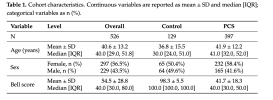
In this cross-sectional study, 526 participants (397 PCS patients, 129 controls) performed a standardized virtual reality-based stereoscopic task at three disparity levels: 275 arcsec (high difficulty), 550 arcsec (medium difficulty), and 1100 arcsec (low difficulty), using a head-mounted display with integrated eye tracking. Continuous pupillometry data were recorded, and IPA and LHIPA were calculated. Linear mixed-effects models with random intercepts for participants were applied, adjusting for age, sex, and task difficulty.
RESULTS
Both IPA and LHIPA were significantly lower in PCS patients than in controls at all three task difficulty levels in post hoc model-based contrasts. In adjusted mixed-effects models, PCS was also associated with lower overall IPA (β=−0.111, 95% CI −0.160 to −0.062, p<0.001) and lower overall LHIPA (β=−0.164, 95% CI −0.253 to −0.074, p<0.001). Lower task difficulty was associated with higher values of both metrics: for IPA, β=0.164 at 550 arcsec and β=0.287 at 1100 arcsec (both p<0.001); for LHIPA, β=0.161 at 550 arcsec and β=0.254 at 1100 arcsec (both p<0.001), relative to 275 arcsec. Thus, both indices showed an inverse association with task difficulty. Age was negatively associated with both metrics, whereas male sex was positively associated with both. No significant interaction between cohort and task difficulty was observed.
CONCLUSIONS
PCS was associated with reduced IPA and LHIPA during a standardized stereoscopic task. These findings indicate altered task-related pupillary dynamics in PCS and may reflect altered cognitive-load processing and autonomic regulation. LHIPA, and with caution also IPA, may contribute to the objective assessment of task-related pupillary alterations in PCS.
Web | DOI | PDF | Medical Sciences | Open Access
Smit, Alexander; Fleischmann, Philipp; Knauer, Thomas S; Mardin, Christian Y; Michelson, Georg; Zott, Julia; Güttes, Moritz; Sarmiento, Helena; Ilgner, Miriam; Jakobi, Marie; Rech, Jürgen; Hohberger, Bettina
BACKGROUND/OBJECTIVES
Post-COVID syndrome (PCS) is frequently associated with persistent cognitive complaints such as fatigue and impaired concentration, yet objective markers related to cognitive dysfunction are lacking. Pupillary oscillation metrics have emerged as non-invasive indicators of task-related cognitive load and autonomic regulation. This study investigated the Index of Pupillary Activity (IPA) and the Low/High Index of Pupillary Activity (LHIPA) in a large cohort of patients with PCS compared with healthy controls.
METHODS
In this cross-sectional study, 526 participants (397 PCS patients, 129 controls) performed a standardized virtual reality-based stereoscopic task at three disparity levels: 275 arcsec (high difficulty), 550 arcsec (medium difficulty), and 1100 arcsec (low difficulty), using a head-mounted display with integrated eye tracking. Continuous pupillometry data were recorded, and IPA and LHIPA were calculated. Linear mixed-effects models with random intercepts for participants were applied, adjusting for age, sex, and task difficulty.
RESULTS
Both IPA and LHIPA were significantly lower in PCS patients than in controls at all three task difficulty levels in post hoc model-based contrasts. In adjusted mixed-effects models, PCS was also associated with lower overall IPA (β=−0.111, 95% CI −0.160 to −0.062, p<0.001) and lower overall LHIPA (β=−0.164, 95% CI −0.253 to −0.074, p<0.001). Lower task difficulty was associated with higher values of both metrics: for IPA, β=0.164 at 550 arcsec and β=0.287 at 1100 arcsec (both p<0.001); for LHIPA, β=0.161 at 550 arcsec and β=0.254 at 1100 arcsec (both p<0.001), relative to 275 arcsec. Thus, both indices showed an inverse association with task difficulty. Age was negatively associated with both metrics, whereas male sex was positively associated with both. No significant interaction between cohort and task difficulty was observed.
CONCLUSIONS
PCS was associated with reduced IPA and LHIPA during a standardized stereoscopic task. These findings indicate altered task-related pupillary dynamics in PCS and may reflect altered cognitive-load processing and autonomic regulation. LHIPA, and with caution also IPA, may contribute to the objective assessment of task-related pupillary alterations in PCS.
Web | DOI | PDF | Medical Sciences | Open Access