Social media surveys of people who recovered from COVID vaccine injury and Long COVID

glennchan

Established Member
I'm pretty sure Glenn Chan was the author of this video. I'm immediately suspicious of its findings because it lists ivermectin. Since it doesn't help in acute Covid and there's no evidence for it in long Covid, it tests the study's methodology similar to a placebo.
 
I'm pretty sure Glenn Chan was the author of this video. I'm immediately suspicious of its findings because it lists ivermectin. Since it doesn't help in acute Covid and there's no evidence for it in long Covid, it tests the study's methodology similar to a placebo.

Yes, I did the research and put together the video.

If I may politely ask... can we steer these conversations back on track? As you know... ME/CFS, Long COVID, etc. are all very serious conditions that turn people's lives upside down. We have an opportunity to put patients first and to engage in scientific discussions so that patients may someday find effective treatment and get their lives back. There is no need to engage in ad hominem attacks. Thank you.

Maybe you have some thoughts on fasting, exercise (at different intensities e.g. light versus intense), graded exercise therapy, etc.
 
On graded exercise therapy, the answer is clear. Despite repeated attempts in large and small clinical trials with all sorts of variations in methodology, the conclusion is:

1. GET does not lead to any significant benefit to patients, regardless of how ME or CFS is defined. People don't get fitter, healthier or more able to go to work than people with no treatment.

2. People with ME or CFS or Long Covid that includes Post-exertional Malaise., also known as post exertional symptom exacerbation, who undertake graded exercise therapy get sicker, in some cases permanently.

Therefore GET is ineffective, and for people with PEM it is harmful.
 
As you know... ME/CFS, Long COVID, etc. are all very serious conditions that turn people's lives upside down. We have an opportunity to put patients first and to engage in scientific discussions so that patients may someday find effective treatment and get their lives back.
I agree we need scientific discussion. That's what this forum is for, and you are welcome to join the discussion.

However, scientific discussion also requires honest appraisal of the validity and reliability of data, and of whether a set of data has been collected in a way that can yield useful information or may mislead. And if the data looks worthless, to say so honestly.

As an example of what I mean - we have a members only subforum here called Members Polls. Any member can set up a poll in that section to find out whether, for example, members have tried particular treatments and whether they found them helpful, or what particular range of symptoms we have. We deliberately make these polls 'members only' for good reason. They are not, and cannot be, useful as scientific evidence, because the treatments are not being tested against placebos in clinically controlled settings, and we are a self selecting sample, unlikely to be representative of all pwME. So we make it clear that the poll results should not be made public, or claimed to be scientific evidence. They are simply a tool for helping discussion and sharing experiences among our members.

I would put the results of a poll like yours of 27 members of a FB group on a similar footing. It's in scientific terms of even less value than a few anecdotes, which themselves are at rock bottom on the scientific stakes.

There is someone on Twitter at the moment who has set up a big survey of pwME and pwLC with a vast array of questions about treatments people are trying. Again, this is a completely unscientific way of finding out about the efficacy of treatments, and carries the real risk of harm from people reading the poll results and being encouraged to experiment with some potentially harmful treatments. It's the Wild West out there, with even supposedly responsible clinicians spreading all sorts of ill informed treatment recommendations based on no more than their own very limited experience or hearsay.

That is what we set up this forum to fight against.


So, I'm sorry, Glen, I appreciate that you have put effort into this, and have good intentions, but what you have done is not science.
 
Yes, I did the research and put together the video.

If I may politely ask... can we steer these conversations back on track? As you know... ME/CFS, Long COVID, etc. are all very serious conditions that turn people's lives upside down. We have an opportunity to put patients first and to engage in scientific discussions so that patients may someday find effective treatment and get their lives back. There is no need to engage in ad hominem attacks. Thank you.

Maybe you have some thoughts on fasting, exercise (at different intensities e.g. light versus intense), graded exercise therapy, etc.
My apologies if my comment was unclear. I didn't intend it as an ad-hominem attack. I meant the two comments to be separate. First I said "I'm pretty sure Glenn Chan was the author of this video." because it's important for people to know they're interacting with the author. I didn't mean to imply that I doubt the video's veracity because you created it.

The second part is where I express doubt in the video's findings. I'm highly skeptical that ivermectin would do anything for people with LC because the scientific consensus is that achievable concentrations in vivo don't meaningfully inhibit the virus's reproduction. Nor is it established that actively replicating virus causes LC symptoms. Thus if people report ivermectin helped them, I see a high probability it's a placebo effect rather than an actual effect. If a study tested many therapies and found homeopathy was one of the most effective I'd be immediately suspicious too. From CBT/GET studies we know people will convince themselves their symptoms are less intense, or attribute natural improvement to the treatment, if they do something they expect to work.
 
There is someone on Twitter at the moment who has set up a big survey of pwME and pwLC with a vast array of questions about treatments people are trying. Again, this is a completely unscientific way of finding out about the efficacy of treatments, and carries the real risk of harm from people reading the poll results and being encouraged to experiment with some potentially harmful treatments. It's the Wild West out there, with even supposedly responsible clinicians spreading all sorts of ill informed treatment recommendations based on no more than their own very limited experience or hearsay.

I find it disturbing that you would attack people like @organichemusic for a honest attempt at gathering data. She is engaged in legitimate scientific exploration and there is no reason to attack people like her or to malign such work as carrying 'a real risk of harm'.

While survey data is not as reliable as a double-blind clinical trial, to describe such surveys as "completely unscientific" is not justified scientifically. Surveys, passive surveillance of drug safety, retrospective observational studies, etc. are regularly used in medicine and science to collect data in a lower-cost manner.
 
Last edited:
An honest attempt at gathering data has to include making sure the results are not misleading.
If the basics of scientific method are not clear to you @glennchan you might do well to steer clear of all of this. I suspect pretty much everybody on this forum is going to disregard everything you say now, having come out with that.
 
engaged in legitimate scientific exploration and there is no reason to attack people like her or to malign such work as carrying 'a real risk of harm'.

While survey data is not as reliable as a double-blind clinical trial, to describe such surveys as "completely unscientific" is not justified scientifically. Surveys, passive surveillance of drug safety, retrospective observational studies, etc. are regularly used in medicine and science to collect data in a lower-cost manner.

I would say the question is less about surveys and more about sampling methods. There is a huge issue if you ask a group of people what treatments they thing work especially if that is already a selected group. Their is a risk of bias both in the selection of the group but also in the "what they think works" in that this will tend to get positive answers. Even asking about experience with a given intervention of interest may still remain biased as people may well be more likely to push things they like (whether they had a positive effect or they tried them when they were improviing) - where as many are less likely to talk about failed tries and perhaps negative effects.

So methodology is key in how data is collected.

You don't talk about how your sample of 27 people were collected - although I would conclude from the number of things tried that the group tried a lot of stuff (which makes it really hard to interpret as well). Were things tried separately, in combination, what about delayed effects.

What about a comparison with people who tried nothing. I.e. what is the p(improve|nothing) vs p(improve|<try1, try2....>) etc and then of course you need p(same| ...) and p(worse| ,...) but it is still hard to attribute anything with such small numbers with any real certainty.

There is interesting work around drug repurposing for example where researchers are using AI techniques to trawl medical records so that they can form huge random sample sets and get a picture of positive/negative/null effects.

Then
 
While survey data is not as reliable as a double-blind clinical trial, to describe such surveys as "completely unscientific" is not justified scientifically. Surveys, passive surveillance of drug safety, retrospective observational studies, etc. are regularly used in medicine and science to collect data in a lower-cost manner.
Observation is a legitimate part of the scientific process. So someone could think to themselves, I seem to feel better when I eat celery, for example. They might chat with 27 of their friends, and some of them might say 'yeah, I too seem to feel better when I eat celery'. So far so good, what you have is an observation that might be interesting. It is, however, not evidence that celery does anything useful. There is a problem if that idea is presented as anything other than an observation. There is a major problem if the treatment is expensive or risky or stops people getting effective help, and it is promoted as useful on the basis of a few anecdotes.

Yes, a survey that isn't part of a blinded controlled trial can be an interesting observation. Being large (thousands of people) and having a sound methodology would make it more interesting. We see many surveys where questions can be written in such a way as to bias answers, for example. There also needs to be care with the selection of the participants - are they all from the celery growers association? If a survey finds that a large percentage of people suddenly were cured, and were able to resume their old lives, and were still well months later, that would be a lot more interesting than several people reporting having a bit more energy.

But we've seen over and over how people can convince themselves that something helps, if they think it will. There is the Mendus study of CoQ10 for ME/CFS for example. Many people who received the labelled MitoQ CoQ10 supplement reported that it improved their energy, their sleep, their cognition. However, there was also a part of the study where people received unmarked pills - some the CoQ10 and some just an inert pill, a placebo pill. In this part of the study, the CoQ10 result looked just like the placebo result. Therefore, CoQ10, or at least that particular formulation with that particular dosage, did not help ME/CFS. It's a great demonstration of how people can convince themselves that a well-marketed treatment works.

So, you can chat with 27 friends, and conclude that some people think a treatment helps. We do that often here. But it isn't scientifically sound evidence that it does help.

We have threads for quite a lot of the treatments mentioned in the survey you linked. You might like to find them, read them, and add your own observations. If there is a treatment that you think is interesting and that we don't have a thread on, you could start a new thread.
 
I find it disturbing that you would attack people like @organichemusic for a honest attempt at gathering data. She is engaged in legitimate scientific exploration and there is no reason to attack people like her or to malign such work as carrying 'a real risk of harm'.
I think it's important to understand the difference between attacking a person, which I have not, and would not do, and raising concerns about the scientific validity and usefulness or otherwise of any 'research' they choose to undertake.

It's not about honest endeavour, it's about what data is being collected. There is a saying that crops up in every basic statistics course - gigo - garbage in, garbage out. My contention is that this type of data collection provides such flawed information that any analysis based on the data will produce garbage.
 
Last edited:
Hi @glennchan thank you for your posts — I agree with above commentary. I also hope we're soon getting beyond the era where patients are forced to do what they can to fill the void due to systemic medical and societal disinterest. As above, we do discuss things under a mantle of lower evidence levels and conjecture as @Trish notes (eg in members-only area) and that is appropriate — it's fine to explore and hypothesise.

I don't think anything is ad hominem above, but I'm sure it might feel that way! I would encourage you to continue the wider discussion here. I'll add something that I think may be interesting that follows on from your post and survey. You may have a better understanding of this background than me (I'm reading in areas far removed from my remit), so do feel free to post new threads.

I'm highly skeptical that ivermectin would do anything for people with LC because the scientific consensus is that achievable concentrations in vivo don't meaningfully inhibit the virus's reproduction. Nor is it established that actively replicating virus causes LC symptoms. Thus if people report ivermectin helped them, I see a high probability it's a placebo effect rather than an actual effect.

I think Ivermectin has not been shown to be effective in LC (eg see this preprint thread), but I'm not sure it's purely the anti viral reproduction properties that people are interested in. Rather, its effects on autophagy/mitophagy promotion and various cell signalling pathways (many it might seem!). Of course this may (or not) impact viral reproduction, but there may be wider effects. Research into its potential for repurposing seems to be mainly looking at cancer.

For acute Covid, in A cellular and molecular biology-based update for ivermectin against COVID-19: is it effective or non-effective? (2023), note the conclusion commented —

However, we hypothesize that ivermectin is capable of increasing the replication capacity of SARS-CoV-2 by enhancing autophagy. Although ivermectin has anti-inflammatory properties, it can induce pathological complications and inflammatory responses during COVID-19 treatment by increasing stimulation of the P2X7 receptor and its downstream signaling pathways. Furthermore, despite its role in altering metabolic processes, it may induce ROS

See
Ivermectin accelerates autophagic death of glioma cells by inhibiting glycolysis through blocking GLUT4 mediated JAK/STAT signaling pathway activation (2022)
Ivermectin inhibits tumor metastasis by regulating the Wnt/β-catenin/integrin β1/FAK signaling pathway (2022)
Progress in Redirecting Antiparasitic Drugs for Cancer Treatment (2021)
Progress in Understanding the Molecular Mechanisms Underlying the Antitumour Effects of Ivermectin (2020)
Ivermectin confers its cytotoxic effects by inducing AMPK/mTOR-mediated autophagy and DNA damage (2020)
Ivermectin induces autophagy-mediated cell death through the AKT/mTOR signaling pathway in glioma cells (2019)
Selective Autophagy of Mitochondria on a Ubiquitin-Endoplasmic-Reticulum Platform (2019)
Ivermectin Induces Cytostatic Autophagy by Blocking the PAK1/Akt Axis in Breast Cancer (2016)
 
I find it disturbing that you would attack people like @organichemusic for a honest attempt at gathering data. She is engaged in legitimate scientific exploration and there is no reason to attack people like her or to malign such work as carrying 'a real risk of harm'.

While survey data is not as reliable as a double-blind clinical trial, to describe such surveys as "completely unscientific" is not justified scientifically. Surveys, passive surveillance of drug safety, retrospective observational studies, etc. are regularly used in medicine and science to collect data in a lower-cost manner.
We really don't need at this stage of the ME/CFS game to be arguing about what is or is not justified scientifically, a process of data gathering that isn't amenable to testing within a falsifiable hypothesis isn't data of scientific value. That the process can be used to gather data of scientific value is irrelevant, though it must be said that there are vast numbers of dubious papers that are reliant on survey data alone. And that something can be scientific, doesn't mean that every case of its use is by definition scientific, to argue otherwise takes us into syllogistic fallacy.

As regards the discussion here: https://www.s4me.info/threads/surve...id-treatment-survey-by-longcovidpharmd.31828/ no one attacked the pseudonymous Twitter account holder in personal terms. The methodology the account is following is flawed and the use of an unsubstantiated professional title is a claim to undue authority. Whatever the aims of the account holder their approach is neither professional nor scientific, no one should be reserved in pointing that out.
 
Merged thread

Data on how 87 people recovered from Long COVID, post-vax, and ME/CFS

Full post here - https://forum.sickandabandoned.com/...vered-from-long-covid-post-vax-and-me-cfs/546

First off, thank you to the 1456 or so of you who contributed your data!
:star_struck:
Your contributions helped put together a dataset on what people have tried, what the recovered reported as working, etc.

Highlights:

  • Almost everything has been tried. If people are discussing a treatment on social media, there are probably many people who tried that treatment. You don’t need to do crazy experimentation because somebody else has (or will) put their body on the line for you.
  • I’ve compiled a list of almost 110 treatments that were reported as helping the most. It is possible that these treatments are effective (though it is not proven that they are). You may want to avoid treatments not on the list as there is very little evidence to support their use (if the goal is recovery rather than symptom relief).
Other highlights:

  • Some hyped treatments like IVIG, stellate ganglion block, etc. don’t appear to be that promising.
  • The response rates are very low. The implication of this is that you will need to plan on trying many, many treatments if you are hellbent on recovery. (*Note: it is unclear if we have found any effective treatments. A survey can’t determine that.)
  • Around a fifth of the recovered did not attribute their recovery to any treatment. If you simply do nothing, you may recover.
The data fleshes out what to expect and what a recovery plan might look like (assuming that we have identified effective treatments).

Full post here - https://forum.sickandabandoned.com/...vered-from-long-covid-post-vax-and-me-cfs/546

---
I don't check this forum often so this isn't the best place to ask me questions.
 
Last edited by a moderator:
I'll attempt to post the reset of the document below.
---

Treatments with plausible effectiveness

The survey asked:
What was the one treatment (or combination of treatments) that helped you the most?
I’ve compiled a list of every treatment mentioned in the answers (among those who recovered). Some people listed multiple treatments in their answer so there are almost 110 treatments listed for the 87 recoveries. See sheet #5 in this spreadsheet.
If a treatment isn’t on that list, you can simply let other patients be the guinea pigs. History suggests that there will be enough people who try crazy things given how many chronic illness patients there are out there (e.g. Facebook and Reddit support groups for Long COVID often have tens of thousands of members).
To see if a treatment is actually on that list, check for alternate names. I didn’t include alternate names like the marketing name of a drug, generic name, etc. To find some alternate names, see the guide to using the PES survey’s data dump. The data dumps also have information on a treatment’s popularity. Some treatments appear on the list simply because they were popular; it could turn out that they are worse than randomly trying a treatment (more on that later).
I’ve included brief (but incomplete) notes on treatment safety and RCT data. In some cases, RCT data strongly suggests that a treatment doesn’t work; in those cases you should ignore the survey data, which is less reliable. I would be cautious about ‘positive’ RCT data because the people behind the RCT may be dishonest, manipulating results, etc. It is not uncommon for researchers to report the opposite of what their data found.
Because survey data is far less reliable than you might expect, I recommend against trying anything risky based on survey data.

‘Recovery stories’ embedded in the survey data

See sheet #4 in the spreadsheet for raw-ish answers to the “what helped the most?” question, which can be seen as ‘recovery stories’. The first 10 rows look like this:
Long COVIDTime
Long COVIDTime
Long COVIDTime. Avoid alcohol and caffeine. Eat low carb. Light excercise. Advil for flare ups. My long lasting condition is pericarditis.
Long COVIDTime, fasting, ivermectin, black seed oil, honey, probiotics, vitamin D, copper, raw camel milk, colostrum, light exercise, massage therapy, magnesium, sunlight, de-stress, antiinflammatory diet
Long COVIDTime
Long COVIDTime and rest
Long COVIDRest
Long COVIDExercise and time
Long COVIDNo answer
Long COVIDNo answer
[th]
Chronic illness​
[/th][th]
Paraphrased answer to What was the one treatment (or combination of treatments) that helped you the most?​
[/th]​

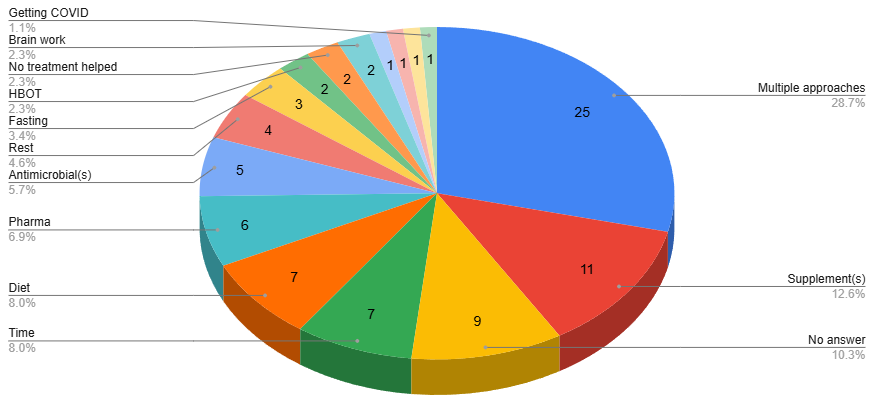
Summary of the ‘recovery stories’ / free-form answers

Treatments that helped the most were all over the place, even after I manually grouped the responses into general categories.
image
image877×404 34.2 KB


Multiple approaches = somebody discussing multiple treatments when they answered the question.
Full data available in sheet #3 here.
The combination of
  • No answer
  • No treatment helped
  • Time
is arguably the most common answer.

The cause of Long COVID (and other chronic illnesses)?

Many popular theories about the cause (and therefore treatment) of Long COVID are represented, even though it is unlikely that multiple conflicting theories are all true.
  • Persistent microbes → Antimicrobials, HBOT
  • SARS-CoV-2 persistence → Paxlovid, antimicrobials, ?ivermectin?
  • Cytokines → Maraviroc, statins
  • Microclots → Triple therapy/anticoag
  • Mind-body → Brain work/retraining, exercise
  • etc.

What worked, but adjusted for how many times a treatment was tried

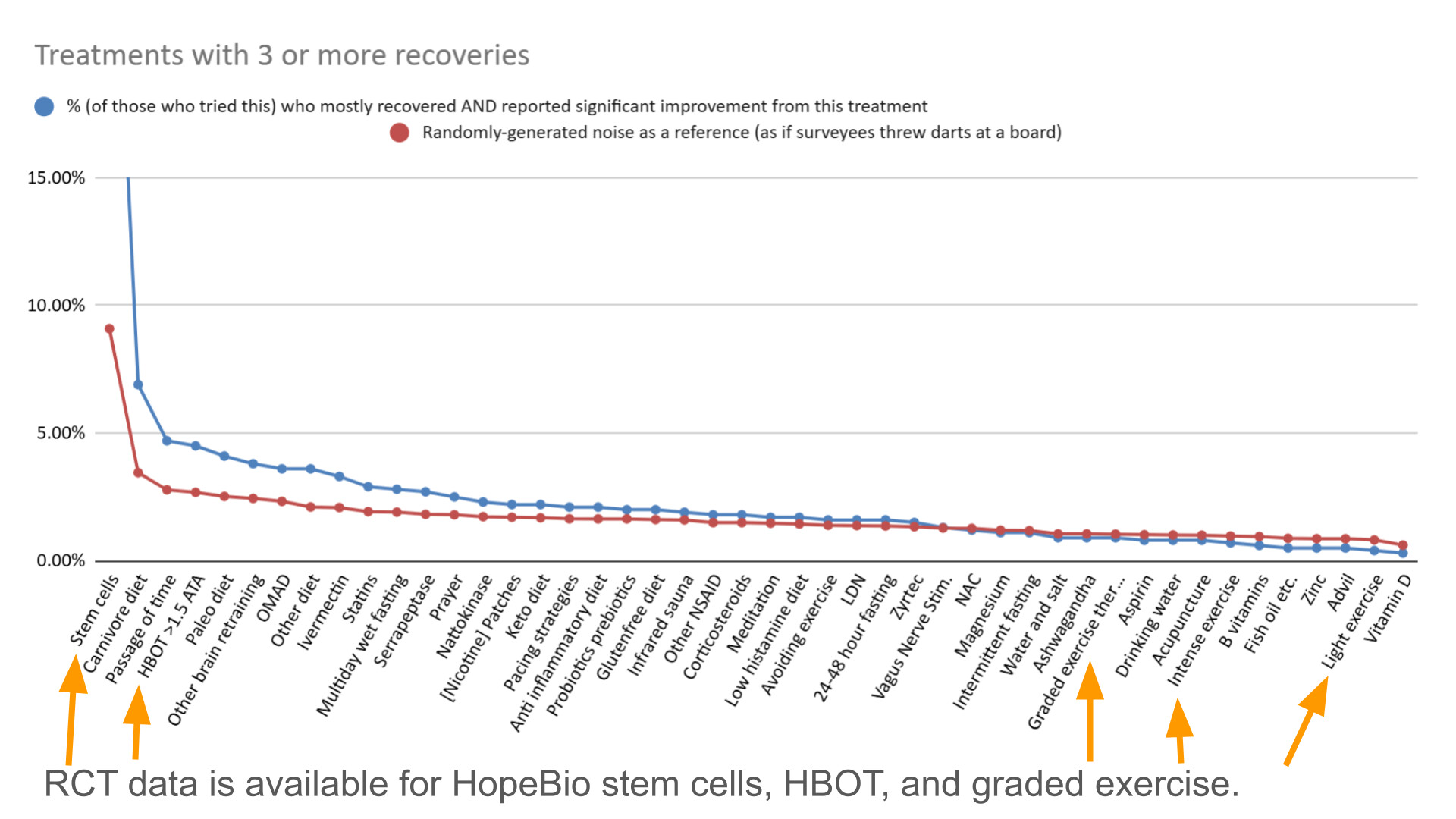
Another way of analyzing the data is to look at the intersection of people who recovered AND treatments that were rated highly. This will compensate for a treatment appearing frequently simply because a lot of people tried it.
The red line is what you could get from surveyees randomly picking answers. Any of the blue dots that appear above the red line may be better than random. You can search the full data in sheets #1 and #2 here.
PES treatments with 3 or more recoveries
PES treatments with 3 or more recoveries1920×1080 205 KB

The #1 treatment in this chart, stem cells, is a mirage. Of the 3 people who reported significant improvement:
  • One of them likely didn’t do stem cells at all. (For privacy reasons I can’t say why. However, researchers can sometimes figure out the identities of surveyees based on time of submission and/or the content of free-form responses.)
  • One of them did Hope Biosciences stem cells, which failed their clinical trial.
So, please don’t do anything risky based on survey data- there are survey research limitations that cannot be overcome.
#3 is not a real treatment. I simply asked all participants about the passage of time. Somehow it outperforms almost everything else (!). We can infer that treatment response rates are, at best, very low.

Is exercise a mirage?

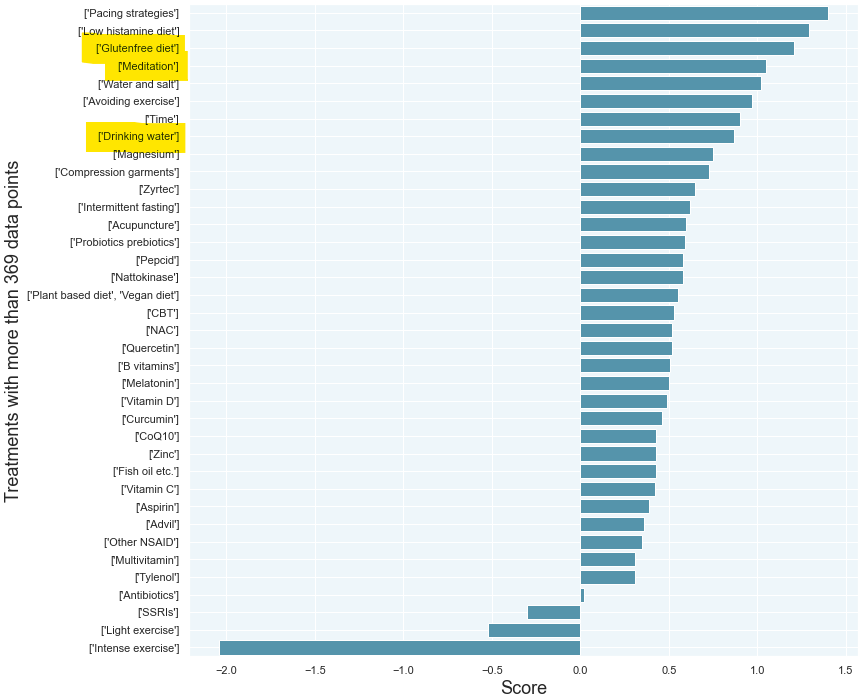
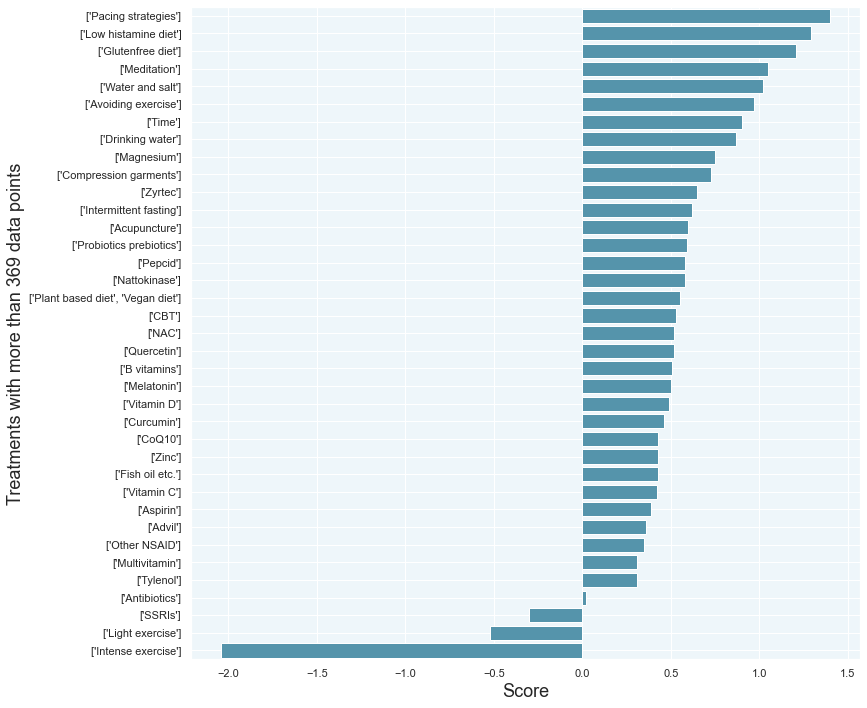
Exercise also has RCT data available (e.g. PACE for ME/CFS and other RCTs for Long COVID), though I believe that the available ‘research’ is highly questionable. The survey data suggests that interventions related to exercising less (avoiding exercise, pacing strategies) outperform the exercise-related interventions. Exercise also seems to underperform randomly selecting a treatment.
Patients frequently report negative experiences with exercise. It may cause more harm than good.

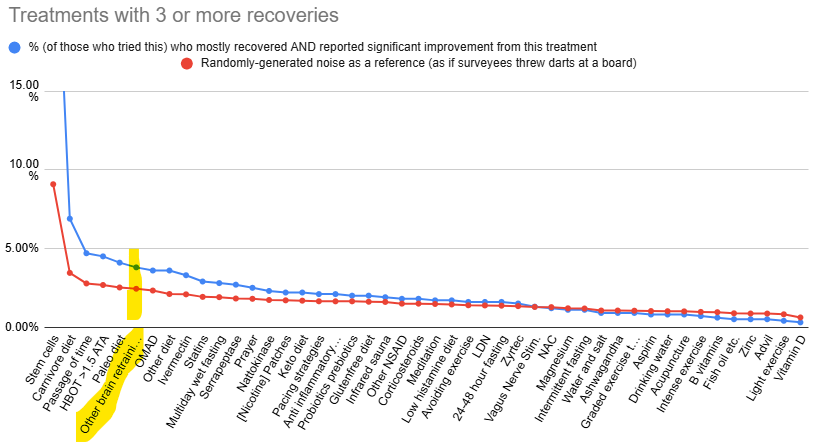
Brain retraining??

It appears to outperform, but that could be an artifact of survey design.
image
image821×445 50.2 KB

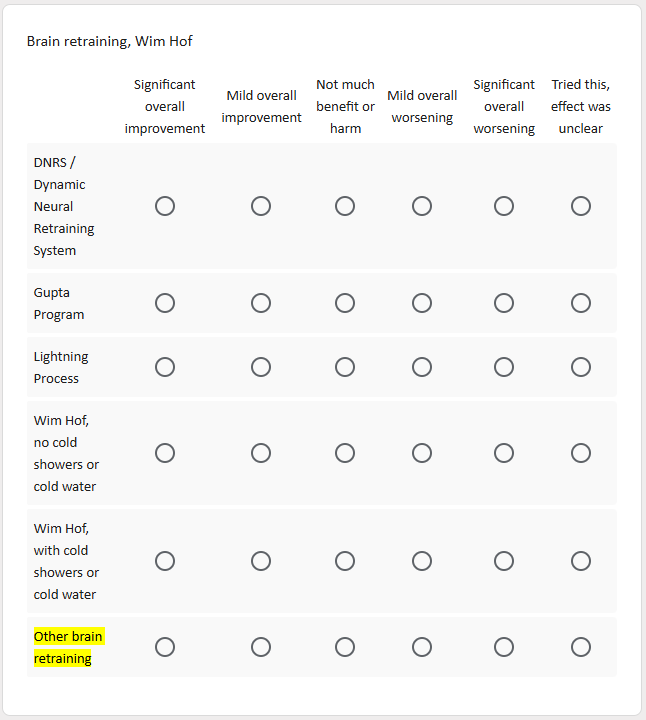
‘Other brain retraining’ refers to brain retraining other than DNRS, Gupta, and Lightning Process. (It’s not clear what type of brain retraining they did, though some people mentioned Sarno in the free-form responses.)
image
image646×720 10.6 KB

Suppose that surveyees tried multiple brain retraining methods. They might simply report results for the most successful of those methods. This would make it seem better than it is.
Also note that brain retraining was sliced up into sub-categories. This increases the chance that a sub-category will outperform- with 4 brain retraining choices instead of 1, there are 4 ‘shots on goal’ instead of 1.

The whole truth

Social media platforms prioritize engaging content over accurate content. For the fuller, more nuanced truth:

Closing thoughts

The current reality is that patients are trying treatments with very little evidence to guide their medical care. Survey data is helpful, but we have to be mindful about its limitations.
The survey data is useful for separating treatments with plausible efficacy and ones with questionable efficacy. While it appears that the survey data identifies promising treatments, the Long COVID RCTs for Hope Biosciences stem cells and Paxlovid have failed. Therefore, they likely cause more harm than good as the treatments have known problems and the RCTs weren’t able to find a benefit. HBOT on the other hand has mixed results. Overall, this suggests that many treatments won’t live up to their promise. So, it’s not a good idea to do anything risky based on survey data (or social media hype).
At the end of the day, we need more research to uncover the cause of chronic illness. Then, we can make meaningful progress on getting recovery rates up.
 
Last edited by a moderator:


While there are recovery stories on Reddit (see this summary and here) and Youtube, some of these stories seem to have people who are not recovered. This is because people define recovered differently- somebody who can’t work may still see themselves as recovered. (People define things differently.)
The non-recovered tend to report outcomes differently, causing certain treatments to be rated higher than they otherwise would be: prayer, low histamine diet, meditation, etc.
This survey had both freeform and non-freeform answers. Freeform answers allow participants to name treatments not on the survey. Because of this, we can see that the majority of ‘successful’ treatments were among the 235 treatments surveyed.
The freeform question also focuses the answers onto the treatments that helped the most. This reduces the ‘spam’ from people saying that a long list of supplements helped.
The survey included ‘janky’ treatments such as prayer (not shown below), meditation, gluten-free diet, drinking water before getting up in the morning*, etc. Unless we look at only recovered patients, those treatments score among the top.

By including things that maybe shouldn’t work (and things the survey designer doesn’t take seriously), we can get a better picture as to how patients report their treatment outcomes.
*While drinking water is a recommendation for the treatment of POTS, not everyone who answered the question had POTS.
The full methodology of the survey is described in the video and slides here.
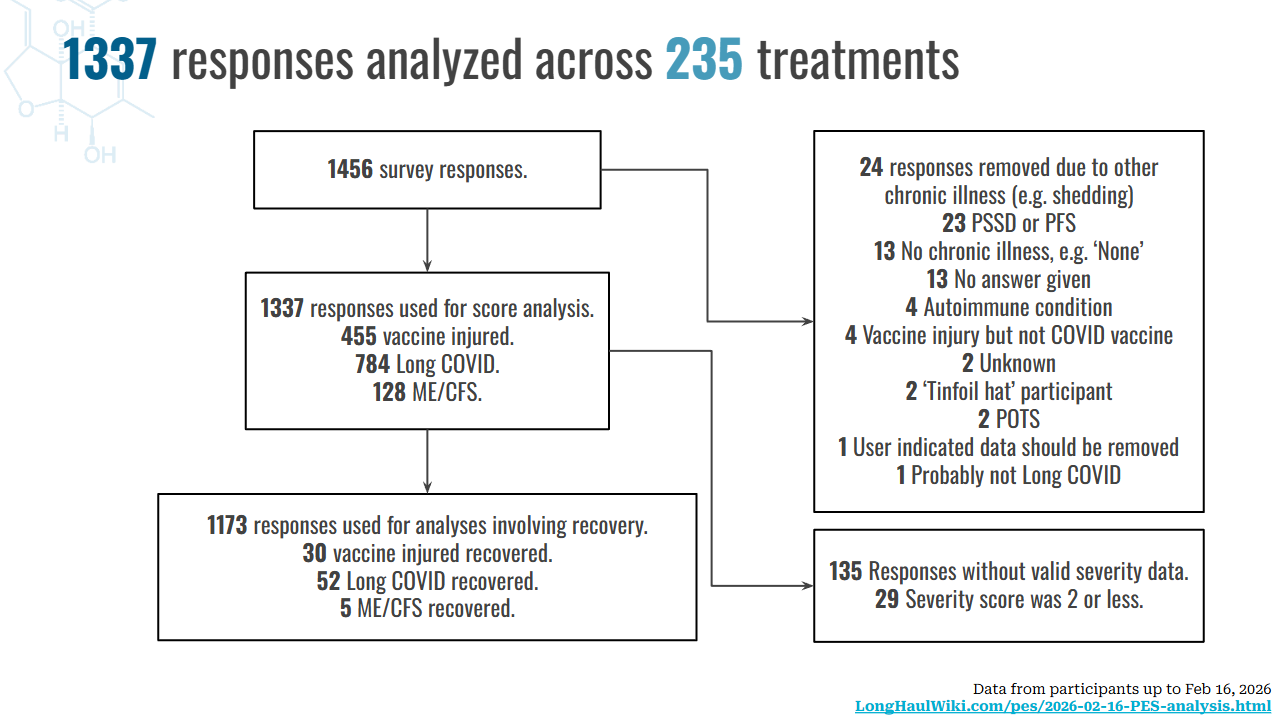
The flowchart for the Feb 16, 2026 dataset is as follows:
image
image1276×718 79.6 KB

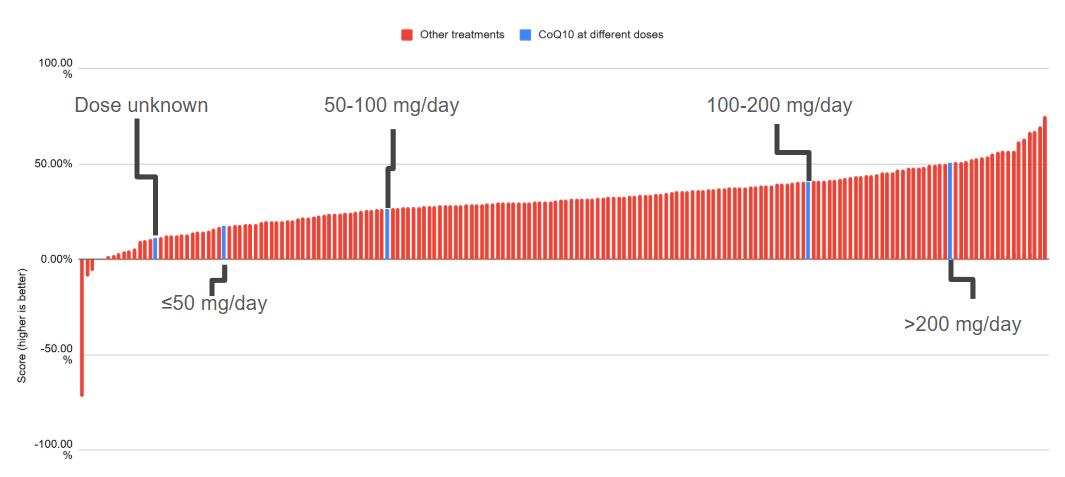
When chronic illness surveys measure treatment outcomes, they seem to mainly measure things unrelated to health outcomes. For example, in the TREATME survey data, an unknown dose of CoQ10 somehow falls outside the range of every other possible dose.

image
image1065×477 36.7 KB

A deeper dive on what surveys measure is available here.
Some people answer surveys differently than other people. Some people have a ‘everything works’ style. Others say that nothing worked (except for prayer).
Because I don’t have a financial conflict of interest and I don’t grift, I can just say things that other researchers won’t say.
Many (or all) patients don’t know how they recovered. We can see this clearly with the survey data on Hope Biosciences stem cells, which failed its RCT. It turns out that one survey participant likely had erroneous beliefs about HopeBio stem cells helping the most.
If the patients don’t know what helped, then it’s clear that surveys can’t measure positive health outcomes. Surveys measure other things, like the logical connections that patients draw in their minds. Some patients will constantly tinker with how they do a treatment, e.g. by changing their dosage up and down. Eventually their tinkering will coincide with their health fluctuating in a positive direction. This may be why a few people report that everything that they tried works. There’s a logic to what they’re reporting.
If the patients don’t know what treatments are helping, then doctors should stop their medical experimentation. If patients are coming back to them and saying that something ‘helped’, then there will be more medical decisions based on information that isn’t true.
The survey data clearly shows a bias towards ‘everything is helpful’. If you randomly pick a treatment, it’s almost certainly the case that patients, on average, view that treatment favorably.
image
image867×708 20.7 KB

This would lead practitioners down a path where they can believe in any of the Long COVID theories out there. If doctors treat patients for viral persistence (e.g. Paxlovid), they will see some ‘success’. If they treat for cytokines (e.g. maraviroc), they will see some ‘success’. But in reality, it’s just dangerous medicine. When we think we know what we’re doing but we actually don’t… that’s when we really get into trouble. We’d be safer getting our medical advice from Dr. Dre, Dr. Seuss or Dr. Pepper.
But patients want to chase recovery instead of medical care that isn’t harming them. So it’s hard to help people understand how science and medicine actually works when the truth is bitter. Patients are constantly being scammed by researchers who will say anything to raise funds (and keep their job), doctors who chase fame and money, etc. But those people rise to the top because they tell patients what they want to hear. So, if you can, please fight this by upvoting messages that you don’t necessarily want to hear. Sick people deserve actual science and progress towards a cure. The bumps in the road may be unpleasant but we need to take those bumps to get to a cure. Thank you.
:mending_heart:

[td]Long COVID[/td][td]Time, fasting, ivermectin, black seed oil, honey, probiotics, vitamin D, copper, raw camel milk, colostrum, light exercise, massage therapy, magnesium, sunlight, de-stress, antiinflammatory diet[/td]
[/TR]
[TR]
[td]Long COVID[/td][td]Time[/td]
[/TR]
[TR]
[td]Long COVID[/td][td]Time and rest[/td]
[/TR]
[TR]
[td]Long COVID[/td][td]Rest[/td]
[/TR]
[TR]
[td]Long COVID[/td][td]Exercise and time[/td]
[/TR]
[TR]
[td]Long COVID[/td][td]No answer[/td]
[/TR]
[TR]
[td]Long COVID[/td][td]No answer[/td]
[/TR]
[/TABLE][/FONT][/SIZE]

Summary of the ‘recovery stories’ / free-form answers

Treatments that helped the most were all over the place, even after I manually grouped the responses into general categories.
image
image877×404 34.2 KB


Multiple approaches = somebody discussing multiple treatments when they answered the question.
Full data available in sheet #3 here.
The combination of
  • No answer
  • No treatment helped
  • Time
is arguably the most common answer.

The cause of Long COVID (and other chronic illnesses)?

Many popular theories about the cause (and therefore treatment) of Long COVID are represented, even though it is unlikely that multiple conflicting theories are all true.
  • Persistent microbes → Antimicrobials, HBOT
  • SARS-CoV-2 persistence → Paxlovid, antimicrobials, ?ivermectin?
  • Cytokines → Maraviroc, statins
  • Microclots → Triple therapy/anticoag
  • Mind-body → Brain work/retraining, exercise
  • etc.

What worked, but adjusted for how many times a treatment was tried

Another way of analyzing the data is to look at the intersection of people who recovered AND treatments that were rated highly. This will compensate for a treatment appearing frequently simply because a lot of people tried it.
The red line is what you could get from surveyees randomly picking answers. Any of the blue dots that appear above the red line may be better than random. You can search the full data in sheets #1 and #2 here.
PES treatments with 3 or more recoveries
PES treatments with 3 or more recoveries1920×1080 205 KB

The #1 treatment in this chart, stem cells, is a mirage. Of the 3 people who reported significant improvement:
  • One of them likely didn’t do stem cells at all. (For privacy reasons I can’t say why. However, researchers can sometimes figure out the identities of surveyees based on time of submission and/or the content of free-form responses.)
  • One of them did Hope Biosciences stem cells, which failed their clinical trial.
So, please don’t do anything risky based on survey data- there are survey research limitations that cannot be overcome.
#3 is not a real treatment. I simply asked all participants about the passage of time. Somehow it outperforms almost everything else (!). We can infer that treatment response rates are, at best, very low.

Is exercise a mirage?

Exercise also has RCT data available (e.g. PACE for ME/CFS and other RCTs for Long COVID), though I believe that the available ‘research’ is highly questionable. The survey data suggests that interventions related to exercising less (avoiding exercise, pacing strategies) outperform the exercise-related interventions. Exercise also seems to underperform randomly selecting a treatment.
Patients frequently report negative experiences with exercise. It may cause more harm than good.

Brain retraining??

It appears to outperform, but that could be an artifact of survey design.
image
image821×445 50.2 KB

‘Other brain retraining’ refers to brain retraining other than DNRS, Gupta, and Lightning Process. (It’s not clear what type of brain retraining they did, though some people mentioned Sarno in the free-form responses.)
image
image646×720 10.6 KB

Suppose that surveyees tried multiple brain retraining methods. They might simply report results for the most successful of those methods. This would make it seem better than it is.
Also note that brain retraining was sliced up into sub-categories. This increases the chance that a sub-category will outperform- with 4 brain retraining choices instead of 1, there are 4 ‘shots on goal’ instead of 1.

The whole truth


While there are recovery stories on Reddit (see this summary and here) and Youtube, some of these stories seem to have people who are not recovered. This is because people define recovered differently- somebody who can’t work may still see themselves as recovered. (People define things differently.)
The non-recovered tend to report outcomes differently, causing certain treatments to be rated higher than they otherwise would be: prayer, low histamine diet, meditation, etc.
This survey had both freeform and non-freeform answers. Freeform answers allow participants to name treatments not on the survey. Because of this, we can see that the majority of ‘successful’ treatments were among the 235 treatments surveyed.
The freeform question also focuses the answers onto the treatments that helped the most. This reduces the ‘spam’ from people saying that a long list of supplements helped.
The survey included ‘janky’ treatments such as prayer (not shown below), meditation, gluten-free diet, drinking water before getting up in the morning*, etc. Unless we look at only recovered patients, those treatments score among the top.

By including things that maybe shouldn’t work (and things the survey designer doesn’t take seriously), we can get a better picture as to how patients report their treatment outcomes.
*While drinking water is a recommendation for the treatment of POTS, not everyone who answered the question had POTS.
The full methodology of the survey is described in the video and slides here.
The flowchart for the Feb 16, 2026 dataset is as follows:
image
image1276×718 79.6 KB

When chronic illness surveys measure treatment outcomes, they seem to mainly measure things unrelated to health outcomes. For example, in the TREATME survey data, an unknown dose of CoQ10 somehow falls outside the range of every other possible dose.

image
image1065×477 36.7 KB

A deeper dive on what surveys measure is available here.
Some people answer surveys differently than other people. Some people have a ‘everything works’ style. Others say that nothing worked (except for prayer).
Because I don’t have a financial conflict of interest and I don’t grift, I can just say things that other researchers won’t say.
Many (or all) patients don’t know how they recovered. We can see this clearly with the survey data on Hope Biosciences stem cells, which failed its RCT. It turns out that one survey participant likely had erroneous beliefs about HopeBio stem cells helping the most.
If the patients don’t know what helped, then it’s clear that surveys can’t measure positive health outcomes. Surveys measure other things, like the logical connections that patients draw in their minds. Some patients will constantly tinker with how they do a treatment, e.g. by changing their dosage up and down. Eventually their tinkering will coincide with their health fluctuating in a positive direction. This may be why a few people report that everything that they tried works. There’s a logic to what they’re reporting.
If the patients don’t know what treatments are helping, then doctors should stop their medical experimentation. If patients are coming back to them and saying that something ‘helped’, then there will be more medical decisions based on information that isn’t true.
The survey data clearly shows a bias towards ‘everything is helpful’. If you randomly pick a treatment, it’s almost certainly the case that patients, on average, view that treatment favorably.
image
image867×708 20.7 KB

This would lead practitioners down a path where they can believe in any of the Long COVID theories out there. If doctors treat patients for viral persistence (e.g. Paxlovid), they will see some ‘success’. If they treat for cytokines (e.g. maraviroc), they will see some ‘success’. But in reality, it’s just dangerous medicine. When we think we know what we’re doing but we actually don’t… that’s when we really get into trouble. We’d be safer getting our medical advice from Dr. Dre, Dr. Seuss or Dr. Pepper.
But patients want to chase recovery instead of medical care that isn’t harming them. So it’s hard to help people understand how science and medicine actually works when the truth is bitter. Patients are constantly being scammed by researchers who will say anything to raise funds (and keep their job), doctors who chase fame and money, etc. But those people rise to the top because they tell patients what they want to hear. So, if you can, please fight this by upvoting messages that you don’t necessarily want to hear. Sick people deserve actual science and progress towards a cure. The bumps in the road may be unpleasant but we need to take those bumps to get to a cure. Thank you.
:mending_heart:
 
Last edited by a moderator:
I don't like pouring cold water when someone has made a lot of effort, but, I'm sorry, @glennchan, all this shows is that doing social media surveys of what people think led to recovery is a waste of everyone's time. You say yourself several times the data is unreliable in various ways, so why do it?

And it's not appopriate or responsible to make comments like this:

"The response rates are very low. The implication of this is that you will need to plan on trying many, many treatments if you are hellbent on recovery."

The implication, surely, is that there is no treatment that has been shown to be effective, so the most logical approach is don't waste your money and risk your health experimenting with potentially dangerous treatments. We knew that already.
 
Back
Top Bottom