Open Research study on ME/CFS and rest

Dolphin

Senior Member (Voting Rights)
V, Ph.D, MSWV, Ph.D, MSW • Research & Policy Research & Policy • Edited • 2 days ago • Edited • Visible to anyone on or off LinkedIn
Follow

Hi, my name is Victoria and I am a researcher and person with ME/CFS! I am sharing an opportunity to participate in a research study on ME/CFS and rest.

The study is open to people with ME/CFS and medical or healthcare providers who are currently practicing or conducting research, and have had at least one patient or participant with ME/CFS.

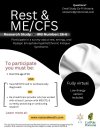
Here is a flyer for more information, and you can find the short survey at https://restandmecfs.com

For any questions, please reach out to empwrtc@protonmail.com.
1770188488740.jpg
alt text:

This is a flyer for the Rest & ME/CFS research study, IRB number 26-6. It says "participate in a survey about rest, energy, and Myalgic Encephalomyelitis/Chronic Fatigue Syndrome". In the upper right corner it says Questions? Email Study Co-PI Victoria:
empwrtc@protonmail.com. Below the header is interwoven circles, one is black with text that says Fully Virtual, low-
 
Also highlighted here:
 
My mind's still trying (and failing) to get around the idea of finding a medical practitioner who'd be interested enough in the place of rest in disease management to take part.

In ME/CFS, at least. In other chromic illnesses with a fatigue or fatiguability component, it seems to be regarded as common sense.
 
The survey is quite short and mostly boxes to fill in in your own words. It starts with some demographic questions - ethnicity, age, gender, how long ill.

The rest are mostly boxes to fill in if you want to.

People with Myalgic Encephalomyelitis may hear the word “rest” from peers, medical providers, and family members.
When you think of the word rest, what comes to mind as a person with ME/CFS? This can be emotions, your definition of rest, or a memory.

Can you describe what rest feels like to you? Whether it is during a “crash” or period of time in which your symptoms are worse, or not during a “crash” — when your symptoms may be more stable.

What supports if any, are needed for you to rest and why?

If you would like, please describe what Post-Exertional Malaise (PEM), or, Post-Exertional Neuroimmune Exhaustion (PENE) feels like to you.

What supports, if any, help to prevent Post-Exertional Malaise or "PEM"? (Please explain if these are different from the supports needed to rest, and why).

What barriers if any prevent you from resting and why?

When you cannot rest, what happens?
(Physically, mentally, or in other aspects of your life)

Do you feel like your friends or family understand rest and energy limitations, as it relates to ME/CFS?
Yes
No
Sometimes
Other

Is there anything else you’d like to share about your demographic information or identity, ME/CFS, and/or rest? If so please include it here.
___________________
 
Clinicians survey

Starts with some demographics, then these questions, some with open boxes to fill in:

People with Myalgic Encephalomyelitis may frequently hear the word “rest” from peers, medical providers, and family members.
How does rest show up in your work with people who have ME/CFS? This can include your observations or thoughts about rest, a definition or conceptualization of rest, or how you use or think about "rest" in your practice or research.

What barriers prevent you from adequately accommodating or providing care for patients with ME/CFS in your clinical setting?

If you're a researcher, what barriers exist that prevent you from adequately accommodating, recruiting, or retaining research participants with ME/CFS?

Select all that apply.
What barriers prevent you from adequately accommodating or providing care for patients with ME/CFS in your clinical setting? If you're a researcher, what barriers exist that prevent you from adequately accommodating, recruiting, or retaining research participants with ME/CFS? Press next to skip. Select all that apply.
No substantial professional education or training on ME/CFS
Lack of funding
Lack of adequate staff
Lack of communication with people who have ME/CFS
Lack of adequate facilities or tools (buildings, rooms, equipment)
I have no issues accommodating, researching, or otherwise professionally caring for people with ME/CFS
Other

What type of accommodations do you offer in your clinic, business, or place of research to support or assist people with ME/CFS?

Have you heard of the "Pacing" framework?
Yes
No

Are you familiar with the term PEM (Post-Exertional Malaise) and/or PENE (Post Exertional Neuroimmune Exhaustion)?
Yes
No

What barriers prevent you from adequately accommodating patients or research participants who experience PEM? Check all that apply.
Lack of education or training on PEM
Lack of funding or institutional support
Lack of adequate staff
Lack of communication with people who have ME/CFS
Lack of adequate facilities or tools (buildings, rooms, equipment)
I have no issues accommodating people experiencing PEM
Other

Are you familiar with the use of Graded Exercise Therapy (GET), Graded Activity Management (GAM), or Graded Activity Therapy (GAT) for ME/CFS?
Yes
No
Prefer not to disclose

Please add anything here you wish to add, that wasn't covered in the survey. Press "submit" to end the survey.
 
I attempted to fill in the patients' survey. I found it accessible in the sense of being short and free to skip questions, and not too much to read, but I found it hard to think what they were getting at in some of the questions, so I would do one, then realise my answer was actually more relevant for another.

I find questions about my emotions intrusive and not relevant to my illness, so I focused on symptoms and practical difficulties.

Also we have seen from some other survey based studies with open ended questions by social scientists that they manipulate what people write to fit with preconceived theoretical constructs, which I think is abuse of patients' trust. I hope that won't happen in this case.

I have no idea what useful information they can get from this study. I can't see any practical use for it.

I'm interested to hear what others think.
 
I deactivated my Linkedin profile, so I can't see it there but I saw it advertised on Patient-Led Research Collaborative Fb page. The page description says:
We are a group of Long COVID patients & patients of associated illnesses researching #LongCOVID.
and the post for this project starts with "PLRC member Victoria...".

I don't follow PLRC closely but I didn't think they were into BPS, so I hope the data won't be interpreted in that framework.

I can't get excited about a survey study, though.

I don't see what we can learn from this project that we don't know already. Maybe she writes it up nicely, so it could be used for advocacy or sharing with people who'd like to know how the illness affects us.
 
Last edited:
Here's the information sheet with more info, linked from the restandmecfs.com website: https://drive.proton.me/urls/RE5AGP2W3W#ghfXfevCCoou
As a sidenote appreciate them using proton which actually has decent privacy.
I hate having to basically hand over my data to google to see stuff on google drive. So cool to see researcher taking that issue seriously.
I don't see what we can learn from this project that we don't know already. Maybe she writes it up nicely, so it could be used for advocacy or sharing with people who'd like to know how the illness affects us.
Agreed
I don't follow PLRC closely but I didn't think they were into BPS, so I hope the data won't be interpreted in that framework.
Generally they have been quite good in my view. But that doesn’t guarantee this project will be.
 
Back
Top Bottom