Prospective RCT on the Efficacy of CPAP and Adaptive Servo-Ventilation in the Treatment of Chronic Complex Insomnia, 2019, Krakow et al.

nataliezzz

Senior Member (Voting Rights)
Prospective Randomized Controlled Trial on the Efficacy of Continuous Positive Airway Pressure and Adaptive Servo-Ventilation in the Treatment of Chronic Complex Insomnia
Barry Krakow, Natalia D. McIver, Victor A. Ulibarri, Jessica Krakow, Ronald M. Schrader
https://www.thelancet.com/journals/eclinm/article/PIIS2589-5370(19)30104-X/fulltext (PDF available)

Background

Complex insomnia, the comorbidity of chronic insomnia and obstructive sleep apnea (OSA), is a common sleep disorder, but the OSA component, whether presenting overtly or covertly, often goes unsuspected and undiagnosed due to a low index of suspicion. Among complex insomniacs, preliminary evidence demonstrates standard CPAP decreases insomnia severity. However, CPAP causes expiratory pressure intolerance or iatrogenic central apneas that may diminish its use. An advanced PAP mode—adaptive servo-ventilation (ASV)—may alleviate CPAP side-effects and yield superior outcomes.

Methods

In a single-site protocol investigating covert complex insomnia (ClinicalTrials.gov identifier: NCT02365064), a low index of suspicion for this comorbidity was confirmed by exclusion of 455 of 660 eligible patients who presented during the study period with overt OSA signs and symptoms. Ultimately, stringent inclusion/exclusion criteria to test efficacy yielded 40 adult, covert complex insomnia patients [average Insomnia Severity Index (ISI) moderate–severe 19.30 (95% CI 18.42–20.17)] who reported no definitive OSA symptoms or risks and who failed behavioral or drug therapy for an average of one decade. All 40 were diagnosed with OSA and randomized (using block randomization) to a single-blind, prospective protocol, comparing CPAP (n = 21) and ASV (n = 19). Three successive PAP titrations fine-tuned pressure settings, facilitated greater PAP use, and collected objective sleep and breathing data. Patients received 14 weeks of treatment including intensive biweekly coaching and follow-up to foster regular PAP use in order to accurately measure efficaciousness. Primary outcomes measured insomnia severity and sleep quality. Secondary outcomes measured daytime impact: OSA-induced impairment, fatigue severity, insomnia impairment, and quality of life. Performance on these seven variables was assessed using repeated measures ANCOVA to account for the multiple biweekly time points.

Findings

At intake, OSA diagnosis and OSA as a cause for insomnia were denied by all 40 patients, yet PAP significantly decreased insomnia severity scores (p = 0.021 in the primary ANCOVA analysis). To quantify effect sizes, mean intake vs endpoint analysis was conducted with ASV yielding nearly twice the effects of CPAP [−13.2 (10.7–15.7), Hedges' g = 2.50 vs −9.3 (6.3–12.3), g = 1.39], and between mode effect size was in the medium-large range 0.65. Clinically, ASV led to remission (ISI < 8) in 68% of cases compared to 24% on CPAP [Fisher's exact p = 0.010]. Two sleep quality measures in the ANCOVA analysis again demonstrated superior significant effects for ASV compared to CPAP (both p < 0.03), and pre- and post-analysis demonstrated substantial effects for both scales [ASV (g = 1.42; g = 1.81) over CPAP (g = 1.04; g = 0.75)] with medium size effects between modes (0.54, 0.51). Measures of impairment, residual objective sleep breathing events, and normalized breathing periods consistently demonstrated larger beneficial effects for ASV over CPAP.

Interpretation

PAP therapy was highly efficacious in decreasing insomnia severity in chronic insomnia patients with previously undiagnosed co-morbid OSA. ASV proved superior to CPAP in this first efficacy trial to compare advanced to traditional PAP modes in complex insomnia. Future research must determine the following: pathophysiological mechanisms to explain how OSA causes chronic insomnia; general population prevalence of this comorbidity; and, cost-effectiveness of ASV therapy in complex insomnia. Last, efforts to raise awareness of complex insomnia are urgently needed as patients and providers appear to disregard both overt and covert signs and symptoms of OSA in the assessment of chronic insomnia.
 
For context, prevalence of OSA in the adult population based on 11 epidemiological studies was 22% in men and 17% in women, though some studies oversampled suspected OSA patients or habitual snorers (oversampling habitual snorers will obviously skew the results as people with OSA are much more likely to snore than people without OSA), so we can probably assume that the prevalence of OSA is actually a bit lower.

Inclusion and exclusion criteria for this study:
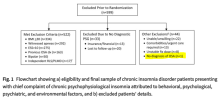
Primary inclusion criteria were adult chronic insomnia disorder patients who believed their sleep problems were due to psychological, psychiatric, behavioral, or environmental factors and affirmed classic features of insomnia (racing thoughts at bedtime, clock-watching, anxiety and fear in the bedroom, poor sleep hygiene, lying awake in bed, “losing sleep over losing sleep” aka psychophysiological conditioning, or regular use of OTC or prescription sleep aids). Patients echoed common presentations of chronic insomnia observed at mental health, primary care, and sleep clinics [1,3]; none believed sleep breathing symptoms or disorders caused or contributed to their insomnia prior to being objectively diagnosed with sleep-disordered breathing. Main exclusion criteria (Fig. 1) focused on obvious risks for a sleep breathing disorder: obesity, excessive daytime sleepiness, witnessed apneas, and past evaluations at sleep centers. Patients without psychological features of insomnia [1] were excluded. Co-morbid sleep disorders, notably restless legs syndrome (RLS) and periodic limb movement disorder (PLMD), were major exclusion criteria, but due to their inconsistent diagnostic manifestations, some of these patients needed to be excluded post-randomization [57] (see Section 2.5). Last, due to recent controversies on the use of ASV in congestive heart failure patients [58], cardiac patients were excluded.

After excluding 599 patients with the above factors (and some others - see chart below), only 1/62 chronic insomnia patients who underwent polysomnography (PSG) did not meet criteria for OSA/UARS (UARS criteria in this study was AHI <5, RDI [i.e. AHI + RERA* index] >15). 21 out of the remaining 60 patients were excluded after randomization (to CPAP/ASV) for various reasons including treatment intolerance, work/school schedules, medical issues, etc. Of the 40 final patients, 90% had OSA and 10% UARS (recall that this is after excluding people with OSA signs/symptoms/risk factors like obesity, witnessed apneas, and self-rated excessive daytime sleepiness, and the prevalence of OSA in the general population is ~20%)

*RERA = respiratory effort-related arousal: a sequence of breaths ≥10 seconds with a reduction in airflow resulting in an arousal that does not meet criteria for a hypopnea

"OSA" was used to refer to both OSA and UARS in this study (technically, the diagnosis of UARS has been absorbed under OSA in the International Classification of Sleep Disorders – Third Edition - ICSD-3)

ESS = Epworth Sleepiness Scale; RLS/PLMD = restless legs syndrome/periodic limb movement disorder

1768895503367.png
 
Last edited:
Many people seem to readily accept the notion that obstructive sleep-disordered breathing/obstructive sleep apnea (OSA) can cause sleepiness, but seem resistant to the notion that it can cause other symptoms like fatigue/pain/insomnia/etc... I would agree that it can cause sleepiness, but it's worth asking yourself: by what mechanism? If you think sleep fragmentation by (apnea/hypopnea-related) arousals is the primary driver of sleepiness in OSA patients, where is the data showing a strong correlation between AHI/arousal index and sleepiness? (sleep medicine should have loads of it by now if there were a strong correlation...)

So that's why I'm sharing this study (and of course, many people with ME/CFS have insomnia). You can't have objective sleepiness and insomnia at the same time (well, I suppose you could have objective sleepiness during the day and insomnia at night...but you get my point). I think it's pretty clear from this study that sleep-disordered breathing (or perhaps more precisely, the brain's response to it) can cause insomnia, and I think it's pretty clear from other studies that it can also cause sleepiness; for example, the first group of UARS patients identified were objectively sleepy (although most UARS patients do not have a primary complaint of sleepiness):
the first study where UARS was formally described (see below) by Dr. Christian Guilleminault and colleagues at Stanford was in a group of hypersomnolent patients with mild sleep-disordered breathing not meeting criteria for obstructive sleep apnea (OSA) whose hypersomnolence was objectively improved by CPAP based on multiple sleep latency testing (MSLT).
Since these sleep doctors were initially only focused on sleepiness as a symptom of sleep-disordered breathing (unfortunately, the majority still are), this hypersomnolent group was the first group of UARS patients identified/described. However, most UARS patients do not have a primary complaint of sleepiness. Dr. Guilleminault (who was not affiliated with Dr. Gold, by the way; he passed away in 2019) said this in 2004: Today, the clinical picture of UARS is better defined. We have learned that patients usually seek treatment with a somatic functional syndrome rather than sleep-disordered breathing or even a disorder of excessive daytime sleepiness (Upper airway resistance syndrome--one decade later)

So how can UARS/OSAS present so differently in different people (even with opposite symptoms: i.e. sleepiness in some individuals and insomnia in others)? I don't think we have all the answers, but see the UARS thread and the AI summary of the UARS theory; if these symptoms are primarily driven by a stress response in the brain to inspiratory flow limitation during sleep, then perhaps the stress response (and its downstream effects) can manifest quite differently for different individuals? What are your thoughts?
 
Last edited:
Back
Top Bottom