Postural orthostatic tachycardia syndrome: when dysautonomia misleads: a mechanistic argument for compensatory orthostatic tachycardia, 2026, Chopra

.I am also a bit doubtful that bulging superficial veins would matter much. My guess is that the blood volume in the legs depends much more on deep veins, which are invisible. After a hot bath it is common to have prominent superficial veins and high skin colour but that doesn't seem to affect heart rate.

And, as we have discussed at length here, OI in ME/CFS does not seem to be that well correlated to POT.
Speaking for myself, the bulging veins are wildly out of proportion with what might be expected - yes, everyone, particularly as they age, will get some degree of visual difference with a small amount of blood pooling and veins dilating based on posture, temperature, etc, but this is not what I am talking about.

Again, speaking only for myself, the change in venous appearance and function was dramatic, rapid, and corresponded 1:1 with my deterioration. Nor is it merely superficial: ultrasound was able to document significant reflux in the deep veins. The same dramatic changes and valve failures are visible pretty much everywhere throughout my body: arms, legs, lower abdomen... I would be shocked if these failures were not truly system wide. At the time that I had the scan on my legs performed, the technician told me that, post-covid, she sees several people 40 or younger per week with similarly faulty blood vessels - no idea if that is accurate or not, obviously.

If what you say is true, and this isn't a common feature of ME/CFS (or LC, or whatever), the fact that, for me, these manifestations were so dramatic and so perfectly mirrored my deterioration, then I think I need to seriously question whether ME/CFS is actually what I'm dealing with.

But I have ventured far off topic. Thanks for the response. If I can organize my thoughts I shall see about starting a new thread (or locating an appropriate old thread).
 
I also have blood pooling and my feet turn purple. Initially I didn't realise how bad it was until I tried to wear my fancy shoes to see a doctor. They were too small. I've had POTS/OI issues since the infection which triggered ME/CFS and the aforementioned appointment was soon after.
 
Nor is it merely superficial: ultrasound was able to document significant reflux in the deep veins. The same dramatic changes and valve failures are visible pretty much everywhere throughout my body: arms, legs,

This is where it all gets so hard to judge. I don't think autonomic failure would lead to valve failure. A proportion of people have valve failure - I guess a big enough proportion for quite a few people with ME/CFS to have it by chance. I wouldn't be surprised if the effects of OI on daytime posture led to a tendency for that to lead to more obvious signs of venous stasis in people with ME/CFS but it wouldn't imply dysautonomia.

I am not doubting what you report but this is an area of medicine where popular explanations are often wrong.
 
But I have ventured far off topic. Thanks for the response. If I can organize my thoughts I shall see about starting a new thread (or locating an appropriate old thread).
Yes, I wonder if mods would be willing to move these posts to a new thread, or they could be combined with this quite old thread for instance? (I'm never sure if I should just start posting in the new thread or if that makes it more work somehow.)

I have looked into this several times before because, like DHagen, it was a very clear physical change for me. (I think it's going to be hard to explain how obvious it is if you haven't experienced it. On the outside it just looks like veins at the far end of normal dilation. But one has a sense of when and how much their veins expand. I am very familiar with it happening after hot showers, during hot days etc., and I'm used to the difference raising or lowering your limbs can make. I had never experienced veins bulging this widely, to the point of being itchy and uncomfortable, and I wasn't used to them doing it continually all day, while I was just sitting around in a normal temperature room).

I'm not claiming this is a general symptom. Or caused by histamine or whatever's popular. I'm not really claiming anything other than it was so visceral a change I can't help but be curious about it.

Anyway, these were a few reports I found in the past by people who seem to think they might've experienced something similar.
Interestingly, I saw this more on the LC and other possibly related subreddits (EDS, dysautonomia) than the cfs subreddit (could just be due to subreddit size). Mine were at their worst when I first got sick and are less extreme now (though that might be due to stimulants). I saw a few people mention a similar trend in the LC threads. But for you, @DHagen, it sounds like it's been constantly at the same level since it started?
 
Thank you for sharing these. Yes, the fourth picture in your first link and the woman's arm in the second look a lot like my arms/hands most of the time. If anything, my veins are more obvious and my legs are certainly worse (I do have one area on my left shin that is a little coiled/knotted looking and could be a "real" varicose vein, the others are just very inflated in appearance), and I also have a few around my hips/abdomen below the navel.
Interestingly, I saw this more on the LC and other possibly related subreddits (EDS, dysautonomia) than the cfs subreddit (could just be due to subreddit size). Mine were at their worst when I first got sick and are less extreme now (though that might be due to stimulants). I saw a few people mention a similar trend in the LC threads. But for you, @DHagen, it sounds like it's been constantly at the same level since it started?
Interesting. I did not experience this (or at least, certainly did not notice it) until after I had Covid, but it was quite a few months, possibly a year or more after that things broke down for me and the rapid deterioration/bulging veins appeared.

It is difficult to say whether the bulging veins have remained at the same level - pretty similar I think, but I have lost so much muscle since I crashed and I so seldom see my legs (honestly, I tend to panic or fall into despair whenever I do so them, so they remain hidden beneath sweatpants or under a blanket unless it is absolutely necessary to expose them). The sensation of pooling/inflating/being full to bursting remains more or less unchanged.

Given how precisely my decline and the issues with my blood vessels coincided, I really struggle to imagine that there is no connection between the two.
 
It was pretty drastic for me as well, my veins were completly normal untill I got covid. Afterwards the first symptom I had were my hands turning odd colours and tingling, according to my doctor it was because I was hyperventilating (which might have been true, I was struggling to sit up!).
But after being sick for many years this has almost completely cleared up, but the OI itself persists.
 
I am fully onboard with the idea that HR increase is a compensatory action for e.g., low blood volume, but, as others have pointed out, that doesn't seem to explain presence of blood pooling, a common symptom of OI. The blood pooling might explain reduced venous return, but what's causing the blood pooling?

Until summer 2023, I was really quite ill with moderate ME but without notable OI/PoTS. Then, these symptoms all came on quite fast over days or perhaps weeks.

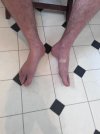
Here is a photo of my legs and feet after sitting, showing significant blood pooling (the white mark is from a 'finger press').
WARNING: *PHOTO OF FEET*.

Along with onset of these symptoms, I've had some strange sensations in my legs, not pain but they definitely feel neuropathic — a bit like a few drops of warm water landing on your leg. Strangely these occur almost exclusively in the evening before sleep.
 

Attachments

  • IMG_20230910_160848.jpg
    IMG_20230910_160848.jpg
    41 KB · Views: 19
Yes, more prominent veins are quite normal at a certain age right? I remember thinking it looked like my veins had aged 30-40 years overnight (not seriously, but just that that was their appearance).
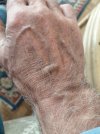
I think there are multiple factors at play here - first, while it is difficult to really get a sense from a single picture, I would say that, in comparison with @Jonathan Edwards' photo, my own blood vessels are more prominent and more visible, and look more like filled to bursting rather than the kind of prominence that emerges with age and the loss of cutaneous fat.

Second, there is the question of how widespread these bulging veins are - whether they are apparent only in the hands or in hands, arms, legs, around the pelvis, etc.

Finally, and most importantly, the degree and speed of the change. What might be totally normal for one individual, or which could be explained by aging or any variety of slow-moving processes when it emerges over years, takes on a much more suspicious aspect when it appears over night over over the course of a couple weeks.
 
Yes, more prominent veins are quite normal at a certain age right? I remember thinking it looked like my veins had aged 30-40 years overnight (not seriously, but just that that was their appearance).

To be honest I don't think my veins have become more prominent with age. This is equally normal for someone aged 30. It depends on the ambient temperature an dposition and so on but those are normal vein contours.
 
Yes, more prominent veins are quite normal at a certain age right? I remember thinking it looked like my veins had aged 30-40 years overnight (not seriously, but just that that was their appearance).
My hands have been like that in the evening since my twenties as long as my hands aren’t freezing.

Now they sometimes turn red/blue/purple if below heart level for a short while.
 
I recall in the early mid 90s when pwME/CFS were diagnosed neurally mediated hypotension made worse after showing. I don't hear much about this term being used anymore. Was it replaced with orthostatic intolerance?
 
I recall in the early mid 90s when pwME/CFS were diagnosed neurally mediated hypotension made worse after showing. I don't hear much about this term being used anymore. Was it replaced with orthostatic intolerance?
The first time I heard of NMH was here on the forum. I had heard of orthostatic hypotension (OH) but I got ill during the pandemic. I don't recall seeing any mentions of NMH in LC groups, OH yes.
 
I too experience issues with my hands and feet when standing up, especially when hot. From my experience the bulging veins are only relevant because they occurs along side colour changes in the hands/feet, along with a painful tingling feeling and heat. Its not the veins that are a problem, I couldn't care less what they look like. The problem is the redness, pain and heat that goes along with it; something I never experienced before getting sick.

This most commonly occurs after waling in shoes, in the shower or at night. I think it is more pronounced when I feel worse generally but it is hard to know for sure.
 
From my experience the bulging veins are only relevant because they occurs along side colour changes in the hands/feet, along with a painful tingling feeling and heat. Its not the veins that are a problem, I couldn't care less what they look like. The problem is the redness, pain and heat that goes along with it; something I never experienced before getting sick.

This makes sense to me. What you describe may be similar to @InitialConditions. I have seen pictures like that on several occasions posted by people with ME/CFS. The colour change and blanching are not normal under normal room conditions. What is unclear is whether this is an unusual occurrence in a small number of people or whether it is a more general feature that goes with ME/CFS OI. It indicates slow flow in dilated skin capillaries and venules. It is probably within the normal range of skin vascular responses but normally only occurs under very specific conditions.

Whether or not it would contribute significantly to poor cardiac filling and OI I think is very uncertain. It will be mediated by autonomic nerves but that does not necessarily mean the autonomic system is at fault - it may be responding normally to an abnormal stimulus.

There are a whole range of dots to join up here and I think we have to be careful not to assume they all join in the way the folklore suggests.
 
What is unclear is whether this is an unusual occurrence in a small number of people or whether it is a more general feature that goes with ME/CFS OI.

I only get it when I can't potter about the house much. Normally my feet are on the floor throughout waking hours and I get up from my chair numerous times a day, but I sometimes get very flushed feet if I've been unwell enough to need to lie down for longish stretches.

Not one I've come across with my own OI or have heard of in other PwME before now.

Yep, it's not been discussed very much.

The characteristic thing about OI for me is the fact that even limited leg muscle movements prevent onset and/or escalation.
When I could walk around supermarkets I'd to wear a pair of biker-style boots, which fastened with a side zip but had eyelets and laces for decoration. I'd tangle one of them up beforehand in case I got held up in a queue—bending down to fiddle with a knot could double or triple the length of time I could wait. Another ploy was carrying low value coins in my pocket that I could 'accidentally' drop, then scrabble around to pick up.

That pattern's been consistent throughout decades of illness.
 
Back
Top Bottom