Trial Report Plasma cell targeting with the anti-CD38 antibody daratumumab in ME/CFS -a clinical pilot study, 2025, Fluge et al

No, I am saying I am suspicious because

1. There is no baseline pre run in measurement, for both groups, whereas in Dara we know the run in baselines for 90 days.
2. There is no data on the severity of these patients pre treatment, whereas in Dara we know severity pre treatment. By severity, I mean step count, not survey score.
3. The step counts were recorded for a period of 4-6 days, in contrast to a period of 9 months pre and post treatment in Dara.
Gotcha.

I don't think these things matter as much as we might think they would.

The part of the placebo response that is drug-related starts when the drug starts (unless the participants know the drug would not be expected to have an effect till X weeks). The run-in data is still useful to have, but it's not relevant for the point we're debating here.

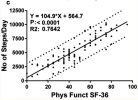
It's true that we don't have baseline step counts for ritux in the phase II trial, but we do know that the responders were a little, but not a lot, less severe than the non-responders (mean SF36 PF at baseline 42.9 vs 36.5, table 4), and steps per day correlate well with SF36 PF (van Campen et al. 2020).

Continuous measurement is likely to give more representative data for individuals, but when we're comparing group means to determine if something is effective or not, I'm not sure there'll be an advantage over shorter-term measurements.

None of these points can explain normal or near-normal step counts of responders in the phase II rituximab trial. But the placebo response can.

Editing to add this graph from van Campen et al. 2020:

 
Last edited by a moderator:
Gotcha.

I don't think these things matter as much as we might think they would.

The part of the placebo response that is drug-related starts when the drug starts (unless the participants know the drug would not be expected to have an effect till X weeks). The run-in data is still useful to have, but it's not relevant for the point we're debating here.

It's true that we don't have baseline step counts for ritux in the phase II trial, but we do know that the responders were a little, but not a lot, less severe than the non-responders (mean SF36 PF at baseline 42.9 vs 36.5, table 4), and steps per day correlate well with SF36 PF (van Campen et al. 2020).

Continuous measurement is likely to give more representative data for individuals, but when we're comparing group means to determine if something is effective or not, I'm not sure there'll be an advantage over shorter-term measurements.

None of these points can explain normal or near-normal step counts of responders in the phase II rituximab trial. But the placebo response can.

Run in baseline is most important because we don't have any baseline reference for these step counts and continuous is important because we need to see if these increases are sustained over a year or a Hawthorne effect.

For example, does this armband overestimate steps and baselines might be 6k on average? Were the responders with the armbands purposely stepping up their counts just for the period of being measured?
 
For example, does this armband overestimate steps and baselines might be 6k on average? Were the responders with the armbands purposely stepping up their counts just for the period of being measured?
What's nice is, if Fluge & Mella do a phase III, we will know, because they put it all in their papers for everyone to pore over.
 
My worry is that there is an effect, because of the LLPC depletion, but Dara in general is too weak. We know in MM results vary with Dara, not because it doesn't work, but because the strength or effectiveness varies amongst patients.

So put it in the Phase 2 study, and there will be some effect, but some non responders too, even with higher NK cells.

For example, maybe some plasma cells, the faulty ones, have less CD38 on them? Maybe in some people their immune systems are too weak for Dara to work? Since Dara does not kill anything directly, it flags the CD38 cells, and lets the bodys immune system kill them.

The problem is, right now there is no way of identifying the antibodies, and also, no way of sampling the plasma cells, assuming a small fraction are the bad actors. You would have to take bone marrow samples of ME patients. Which is very painful and intrusive I presume.
 
Survey data is only reliable if it correlates with step count data. In Ritux P3, it did not, in Dara, it did.
Coming back to this point. Can you explain what you mean by saying that in the phase III rituximab trial, the SF36 PF did not correlate with step count data?

As far as I can see, it correlated very well. Looking at table 2 of the 2019 paper:
  • The rituximab group improved by roughly 10 points on the SF36PF and 480 steps.
  • The placebo group improved by roughly 13 points on the SF36PF and 671 steps.

And looking at Appendix table 4 of the 2019 paper:
  • At baseline, those who went on to worsen had both lower SF36 PF and lower steps than the other two groups, and those who continued with stable symptoms had higher mean SF36PF and higher steps than the other two groups. (When I say lower and higher here I do not mean statistically significantly lower or higher, just that the numbers are slightly lower or higher.)
What am I missing?
 
Last edited:
For example, does this armband overestimate steps and baselines might be 6k on average?
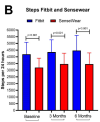
Found something interesting in Rekeland et al. 2022 about this. They compared steps measured by Fitbit with steps measured by the Sensewear armband that was used in the phase II rituximab trial, where "responders" were measured as have end-of-treatment mean step count of 9829 (range 5794–18177). You were wondering if that number could be artificially high.

Compared to Fitbit, Sensewear step counts were lower.

At baseline in Rekeland et al. 2022, the group mean step count over 8 days measured by Fitbit was 7816 vs 4768 by Sensewear. At 24 weeks, the group mean step count over 5 days measured by Fitbit was 7051 vs 4923 by Sensewear.

So the mean step count of 9829 reported for "responders" in phase II ritux, which was measured by Sensewear, would have been higher if measured by Fitbit.

A Bland-Altman plot (Fig 5C) showed a systematic difference between the two devices, with a bias of 974 steps per 24 hours, (95% CI -542 to 2489), which corresponds to a bias of 27.5% (95% CI -5% to 60%).

This simple chart shows the difference:
1770463690992.png
 
Last edited:
Sorry I mean the no intervention study. In that case it was physical fatigue score that didn’t correlate with step counts at all
So Rekeland et al. 2022, right? I still don't follow, because SF36 physical function correlated reasonably well with steps there too, at group level: 0.49 (p<0.01) in figure 4, second only to SF36 social function.

The correlations between steps per day and self-reported SF-36 Physical function, Social function, and DSQ-SF were significant.

The individual data is always going to be messy,

I think there has been such a need for more objective outcome measures that people have maybe overestimated how reliable or straightforward step count will be as an outcome measure. Step count is likely to be influenced by many factors other than change in underlying disease. For example, I’ve had to move a lot between rooms and houses in recent years, and that impacts my step count. Sometimes my range, and hence step count, has been smaller or bigger, simply because of the layout of rooms, even though my physical function remains the same. Someone with mild or mild-moderate ME/CFS might walk outside more during summer compared to winter.
 
Measuring steps is completely pointless for mild patients

Wouldn't even want mild patients included in MECFS treatment studies given the current research state. I say this as someone who has spent the majority of my time with MECFS as mild. So it isn't some gatekeeping thing.
 
Measuring steps is completely pointless for mild patients

Wouldn't even want mild patients included in MECFS treatment studies given the current research state. I say this as someone who has spent the majority of my time with MECFS as mild. So it isn't some gatekeeping thing.

From my mild perspective, I don't think its pointless.

I could go up to 10k steps for week maybe. But not for a month. Or several months. I wouldn't be able to sustain it at all.
 
So Rekeland et al. 2022, right? I still don't follow, because SF36 physical function correlated reasonably well with steps there too, at group level: 0.49 (p<0.01) in figure 4, second only to SF36 social function.


The individual data is always going to be messy,

I think there has been such a need for more objective outcome measures that people have maybe overestimated how reliable or straightforward step count will be as an outcome measure. Step count is likely to be influenced by many factors other than change in underlying disease. For example, I’ve had to move a lot between rooms and houses in recent years, and that impacts my step count. Sometimes my range, and hence step count, has been smaller or bigger, simply because of the layout of rooms, even though my physical function remains the same. Someone with mild or mild-moderate ME/CFS might walk outside more during summer compared to winter.
Any seasonal or temporal effects should smooth out over a year of monitoring
 
Did anyone look at the recruitment of Ritux P2? Is there any info on this?

I just think on a first principles basis it is impossible to go from 3k to 9k steps consistently on a pure placebo effect. How many of you would be able to do that, and consistently hold it for a year?

Therefore, IMO this deduction leads to me thinking there is something wrong with the Ritux P2 step count measurement. Especially given the step counts in P3.

Either recruitment or the measurement was wrong. Again this argument is built on the idea of tripling step count over a year being not possible unless being cured.
 
Last edited:
On step counts, the assumption that step counters are impartial and accurate is IMHO a very questionable one. I’ve found them unreliable, admittedly I’m severe and haven’t tried all the devices, but that’s the point, they have different hardware and algorithms and suitability. One I had counted mainly how much I was moving my hands (like washing them) rather than anything related to steps, because my steps were so few. In all I’ve used measures were erratic and didn’t reflect how good I felt or active I was. They also completely ignore cognitive or sensory load which is vital for many of us at least.

I’m all for the idea of objective measures, but assuming a ‘device’ or ‘step counts’ is objective is something I would strongly question. Maybe they work well for mild people or in specific circumstances but knowing what those circumstances is is just as important as knowing which circumstances subjective measures are and are not suitable.
 
I’ve found them unreliable, admittedly I’m severe and haven’t tried all the devices, but that’s the point, they have different hardware and algorithms and suitability. One I had counted mainly how much I was moving my hands (like washing them) rather than anything related to steps, because my steps were so few.

They do this when you move around in a powered wheelchair too. Also, despite living in a level access bungalow and only visiting places that also have level access, they somehow manage to record me climbing steps every day.
 
I think if you want to actually count steps accurately for a clinical trial you need an ankle worn monitor, or better still, both ankle and wrist so arm movements can be estimated. I would only consider consistent changes of long term averages of over about 50% or 2000 steps clinically significant, given quite big percentage fluctuations are normal.

My daughter is amused that her steps went up from well under 1000 to over 10,000 on days she's knitting. Each stitch counts as about 4 steps on her fitbit.

I find mine useful as a rough guide. I like it counting arm movements, as I find things like folding laundry, dressing and undressing, and drying myself after a shower even more exhausting than walking.
 
So this might be a very stupid question.

But given the new focus on the immune system and brain due to the genetic studies being done....

IF the Ptwo study ultimately turns out successful, would it be any use to ask patients what symptoms improved first? Could this give any further insights into the disease mechanisms of the disease? Or would it just be noise? As in.... maybe hypothetically... The first symptoms to improve would be symptoms typically associated with... the brain? Or maybe the first symptoms of improvement could be a noticeable improvement in digestion for example.
 
IF the Ptwo study ultimately turns out successful, would it be any use to ask patients what symptoms improved first?

My experience of remissions, and of recovery from illness generally, is that everything improves more or less at once. You feel better in every respect.

One of the interesting things about remission is that you discover you had symptoms you weren't even aware of. They were buried in the all-round feeling of illness, so you didn't notice them till they stopped. For instance, I'd no idea I had constant low grade stomach discomfort until it went away—suddenly I wasn't 'aware' of my stomach all the time, it just got on quietly with its job.
 
Back
Top