Trial Report Plasma cell targeting with the anti-CD38 antibody daratumumab in ME/CFS -a clinical pilot study, 2025, Fluge et al

OK, but why pick HHV-6B reactivation? There may be some data on increased levels in saliva but how does HHV-6 explain things any better than anything else? And why is it reactivated (which would be the real question) and how would explain delayed PEM?

You seem to be starting from the assumption that HHV6 has the edge on other things but I suspect other members here haven't heard a reason for it.
I'll write an answer to that in the upcoming weeks. I believe that I can give you very good arguments on all of the questions you raise that do make HHV-6b reactivation hypothesis the most plausible of all the ideas on causative mechanism that were brought forward.
 
My lab gives very different NK count ranges for females and males. The ones in the study dont strikeme as particularly low, maybe they reported the compound range in the study?

Females: 77-321
Males: 67-516

Bisset LR, Lung TL, Kaelin M, Ludwig E, Dubs RW. Reference values for peripheral blood lymphocyte phenotypes applicable to the healthy adult population in Switzerland. Eur J Haematol 2004; 72: 203-12.
 
I've been trying to make sense of some of the facts stated here.
- There is not a lot of difference in IgG levels between responders and non-responders.
- All the killing happens fast (JE)
- Yet a single dose is not enough
- and non-responders show no improvement at all.

So maybe all the important killing happens later and it's about having a steady stream of NK supply so whenever a B-cell expresses CD-38 there is something there to kill it. That would also imply CD-38 is a good target for picking the culprits.

Just my thoughts, not sure if it makes sense medically.
 
There is not a lot of difference in IgG levels between responders and non-responders.

Not really.

Well working with very small sample sizes here.

For non-responders:

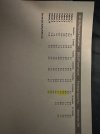
Patients 3 and 9 weren’t able to reduce IGG much—8.2 and 7.7 at 5 months. Patient 4 was able to reduce IGG to 3.7 at 5 months but started at the lowest level—6.8. By month nine patient 6 was above 7 and the partial responder, patient 5, was back to 7.6.

Because I love cherries, if we exclude patient 4 and count the partial responder as a non responder, then by month 9, mean of responders is 4.6 and non-responders is 7.3–a 60% difference.

So with the exception of patient 4, if you can’t reduce and maintain low IGG you are less likely to respond.

Did this really quickly—please let me know if I made an error.
 

Attachments

  • IMG_7962.jpeg
    IMG_7962.jpeg
    953.3 KB · Views: 7
Last edited:
Not really.

Well working with very small sample sizes here.

For non-responders:

Patients 3 and 9 weren’t able to reduce IGG much—8.2 and 7.7 at 5 months. Patient 4 was able to reduce IGG to 3.7 at 5 months but started at the lowest level—6.8. By month nine patient 6 was above 7 and the partial responder, patient 5, was back to 7.6.

Because I love cherries, if we exclude patient 4 and count the partial responder as a non responder, then by month 9, mean of responders is 4.6 and non-responders is 7.3–a 60% difference.

So with the exception of patient 4, if you can’t reduce and maintain low IGG you are less likely to respond.

Did this really quickly—please let me know if I made an error.

Thank you. I have been fooled by the small sample size and Figure 6H. Still I find the ratio between IgG drops and response magnitude odd.
 
I was just looking at some of the first rituximab studies, and comparing them to the Daratumumab trial like some members were doing on the first pages here. They do have a point. The resemblance between the self reported results are eerie!! Sadly, no step counts were measured in the P1 and Ptwo as far as I can see. So the only thing we can go by is the difference in the P3 rituximab and Dara P1. Where the difference in my opinion is huge.

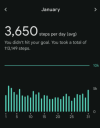
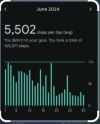
In my twenty five years of MECFS I have only had one brief remission, and just as I was starting to get worse during said remission I bought a Fitbit to track my daily steps.

January represents my current daily steps.

1770234138931.png

June is when I bought the Fitbit
1770234293400.png

You can see the point where my ´´remission`` really starts going downhill in the middle of June.

If the P1 trial results can be replicated then in my opinion it doesn`t just have massive biological implications for MECFS, but also has the implication that step count is an important outcome measure that should be used from now on to predict if the patients are actually genuinely improving. It isn`t perfect. But if the results can be replicated in the placebo trial then the step counts seem a better indicator of improvement? Depending on the sort of patients you include of course (For the majority of my time as mild I could easily do and probably did 10k steps a day, thus if I were included when I was mild in a study daily steps would be useless).

Thanks to Murph who has the comparison between the different rituximab trials and Daratumumab on the first page, if anyone is interested.
 
Last edited:
Back
Top Bottom