Open Norway: Plasma cell aimed treatment with daratumumab in ME/CFS (ResetME) - Haukeland University Hospital

They're not sure yet, but it's possible. But age is unlikely to be the main factor in that, surely? Immune cell populations seem to change all the time, for any number of reasons. I'd be surprised if a low NK count during one time period automatically means a person always will have a low count.
If it's a stage in ageing, it implies that older people will consistently have lower counts - but the article didn't go into detail so my assumption there might be incorrect.
 
I have just read in this article in the New Scientist (paywalled, sorry, I've got the paper version, no references given) that '...some key immune system cells, including B cells, T cells and natural killer cells, experience two bursts of decline and ageing around the ages of 40 and 65, probably contributing to the weakening of the immune system that is a hallmark of ageing.'

Does this mean that if dara works for at least some people in ME/CFS, those over 40, and particularly those over 65 are less likely to benefit?
One of the responders had ME/CFS for 35 years iirc so it's unlikely she was under 40.

Also I don't think the NK threshold for response, if real, was particularly high for the average population, I seem to remember non responder counts were particularly low. But I could be misremembering.
 
One of the responders had ME/CFS for 35 years iirc so it's unlikely she was under 40.

Also I don't think the NK threshold for response, if real, was particularly high for the average population, I seem to remember non responder counts were particularly low. But I could be misremembering.
Google and a few abstracts say norm values are anywhere between 70-700. So 125 would be at the very lower end.
 
Google and a few abstracts say norm values are anywhere between 70-700. So 125 would be at the very lower end.
That makes me think there's more of a chance the NK thing is about drug effect than a marker of subgroups or something mechanistic. If those numbers in non responders are really low and dara needs NK cells to work surely the simplest conclusion is that dara just isn't effective when NK cells are that low.

But maybe thats illogical I'm not sure. Or just wishful thinking haha.
 
I have some reservations about the NK cell data in general.

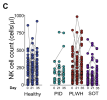
This paper measured NK cells in relation to Covid vaccine seroconversion. Plenty of people are falling below 125 there, so it seems that it's not particularly unusual to be at the "lower end" (the other categories besides healthy are different immunosuppressed conditions)
1769448034352.png
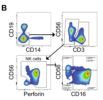
I'm certainly not a flow cytometry expert but I'm concerned because I can't tell from the methods whether samples were processed together--this particularly matters for gating strategies since that is highly subjective. Basically you're relying on someone to draw [edit: a series of boxes] around what is and is not an NK cell based on some surface protein levels (see below for example from the Covid vaccine paper). The boxes needs to be drawn the same on all samples or else you're not comparing like to like
1769448280429.png
It says that the measurements were done in a hospital, which makes me worry that they were run as separate lab tests rather than a single experiment. Doing it as an individual lab test can help differentiate people with abnormally low levels, but I'm pretty sure it's not a great way to do comparisons between participants when all fall within normal levels. If someone has information to the contrary please let me know.

Also I'd like to see the values expressed as a percentage rather than absolute counts because there could be substantial differences in overall number of cells between samples, especially if they were not all collected and run together (live/dead fraction would be the main concern). All these issues might be less of a concern if we were looking at hundreds of samples all processed independently, but here I think there is a big chance of skew.

Long story short, without more details I don't know if it's worth spending much time on the [edit: baseline] NK cell connection here. I've already noted previously that cell type frequencies are known to bounce around over time anyways, even without these specific confounders.
 
Last edited:
Long story short, without more details I don't know if it's worth spending much time on the [edit: baseline] NK cell connection here. I've already noted previously that cell type frequencies are known to bounce around over time anyways, even without these specific confounders.

I would endorse those reservations. Jo Cambridge got involved in NK cell counts and assays early on and developed an ingrained scepticism for both the data and the interpretation. The low and high NK counts in the Dara pilot correlating with response did seem to me pretty remarkable - enough for me to think the results might mean something important. But it's post hoc and could easily be a fluke.
 
Noting the reservations in the above posts (really hoping the responses aren't flukes, at least! ) If the responses and nk data are indeed real I would still have thought that occams razor would suggest that the separation is due to drug action. Do we have data on how patients with other conditions and low NK cells respond to dara?
 
Do we have data on how patients with other conditions and low NK cells respond to dara?
There was discussion about NK cell counts correlating to response in multiple myeloma, with the caveat that I think those studies saw correlations based on bone marrow NK cells, as opposed to blood like in the Fluge study.

- https://www.s4me.info/threads/the-b...tumumab-based-therapy-korst-et-al-2025.44745/
- https://www.s4me.info/threads/long-...ities-between-cfs-and-lupus.45936/post-646217
 
There was discussion about NK cell counts correlating to response in multiple myeloma, with the caveat that I think those studies saw correlations based on bone marrow NK cells, as opposed to blood like in the Fluge study.

- https://www.s4me.info/threads/the-b...tumumab-based-therapy-korst-et-al-2025.44745/
- https://www.s4me.info/threads/long-...ities-between-cfs-and-lupus.45936/post-646217
Also that study looked at CD16+ NKs which are a specific subset associated with greater cell killing functionality, not overall NK cell numbers.

There were these case studies showing efficacy in treatment-refractory lupus, where lower NK cells are somewhat to be expected:

1769458399741.png
Here's the exact numbers from Supplements 2A, but I'm not sure why the scale is a different order of magnitude despite showing the same units as the other studies. If anyone can figure that out maybe it'll tell us whether it was comparable to the fluge and mella trial
 
Also that study looked at CD16+ NKs which are a specific subset associated with greater cell killing functionality, not overall NK cell numbers.

I think the ME/CFS study also looked at the CD16+ subset:
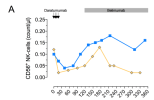
Fluge 2025 said:
In Figures 6DF corresponding data for number of CD16/56 positive NK cells in peripheral blood are shown.

The description of which lymphocytes were tested at baseline from the protocol:
Lymphocyte subtypes in peripheral blood (CD19, CD3, CD4, CD8, CD56/16, ratio CD8/CD4).
 
Here's the exact numbers from Supplements 2A, but I'm not sure why the scale is a different order of magnitude despite showing the same units as the other studies. If anyone can figure that out maybe it'll tell us whether it was comparable to the fluge and mella trial
I think it's almost certainly just a wrong unit since it's off by 1000 from the numbers you'd expect for count/uL. So probably should be baseline 100 count/uL in one patient and 125 count/uL in the other. I'm not sure what the plot can tell us, though.
 
I think it's almost certainly just a wrong unit since it's off by 1000 from the numbers you'd expect for count/uL. So probably should be baseline 100 count/uL in one patient and 125 count/uL in the other. I'm not sure what the plot can tell us, though.
I think you’re right about the units. If so, that puts these two cases in the same range as the non-responders in the fluge+mella study, and they both got substantial benefit from dara for life-threatening lupus symptoms.

It's only case studies and there might be different disease dynamics at play. But the reason to look at lupus is that the number of disease-causing plasma cells will be much lower than in myeloma, so it should be much more comparable to ME/CFS if ME/CFS is [edit: an antibody-mediated] disease. And these cases seem to suggest that it is absolutely possible for dara to ameliorate an antibody-mediated disease even with lower values of NKs (and, potentially, despite repeat findings of reduced NK cell functionality in lupus--several references in the intro)

There have been more cases in lupus showing success with dara, but they didn't seem to measure NKs.

[edit: TLDR if we take the correlation between baseline NK and ME/CFS improvement at face value, these case studies are a small piece of evidence suggesting that plasma cell killing capacity is not the best explanation]
 
Last edited:
Back
Top Bottom