New Zealand: Management of Long Covid in primary care - Resource for GPs

Hutan

Moderator
Staff member
This was published last week:
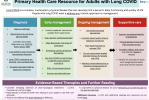
Resource for GPs 2026
It was aimed to outline the essential elements stakeholders consider to be the core components of managing Long Covid in primary care. There is a lot in the links of the one page for GPs, so click through to it rather than staying with the screenshot below.


It was produced by a Victoria University Wellington Te Herenga Waka team, and funded by the NZ Government's Health Research Council. It sounds as though they held extensive workshops and made collaborative decisions between patients, healthcare professionals and researchers.
  1. We will organise six exploratory workshops across Aotearoa New Zealand, and invite individuals with lived experiences of Long COVID, along with their whānau/caregivers to discuss their journey and the services they have received. These workshops will provide an overview of areas where primary care services can be improved to better support those living with Long COVID.
  2. We will continue with co-design team meetings using an iterative approach to explore the needs of individuals with Long COVID, make collaborative decisions between patients, healthcare professionals and researchers and test pilot ideas with people with lived experience of Long COVID.

 
Last edited:
Aside from the "patients want a holistic approach", when they definitely mean something else entirely, this is acceptable. It's the bare minimum that could have been a starting point many years ago, long before LC was a thing, so the bar is very low, but at least it gets many basic details correct.

Now the question is whether things will happen in secret, behind closed doors, to screw this up and return to the biopsychosocial pile of cocaine, like it always happens.
 
Looks like the usual mix of some sensible bits and some less thought through parts. Trying to include everyone’s views I guess and, as usual, I get the impression the authors were very focused on the message they wanted to convey and not enough on what the audience is likely to hear (most people assume that what is said = what is heard, but that’s not always the case). They only had 1 GP and 3 nurses to test it out on, unlikely to be a representative sample

The fact the resource has been disseminated to all GPs via the Royal College might lend it more credibility and gain it more attention than any comparable ME/CFS resource has ever had in NZ – yet ironically the ones from our patient organisations are not very different from this LC one

The video is quite interesting. Talks about the process of going through multiple workshops and gives an idea of how they ended up with what they did. One thing I’m wondering though is selection bias because the first step was pwLC creating art works to express their experience. That may have put off some less arty folks. Having said that, some of the pieces presented do a great job conveying the lived reality

There are a few Māori words sprinkled throughout the video; I don’t think it’s a problem for comprehension but if anyone needs a specific translation, feel free to ask, with a time stamp. The auto-transcriptions defy any dictionary
 
I get the impression the authors were very focused on the message they wanted to convey and not enough on what the audience is likely to hear

I m not quite sure what is implied in this sttement but I think I very much agree. Most medical readers will hear nothing except the social mantra that glosses everything now in medicine, and either put the thing aside or skim through as little as they can. It may seem very on message to patients but to me this is the sort of thing that will bounce straight off the professionals that need reaching. And the ones that follow it will do so without really understanding why and more to satisfy their do-gooding instincts than anything. It is a recipe for passing patients off to the usual rehab dumping ground or the off-label meds that just make most people iller.

Why not have something more like the S4ME fact sheets, which make sense and don't use a lot of politically correct guff?
 
Yes, I was disappointed with this. The author is someone I know and respect, New Zealand is a small country, we see each other reasonably regularly, and yet the first I heard of the project was seeing the finished result a few days ago.

I agree with @Ravn's summary that it is the usual mix of good bits and bad bits, and that they have focussed the messages they wanted health professionals to hear, but have not thought enough about how it would land.

I also think there is considerable devil in the detail.

Introductory sentences
The first link there on Long COVID is to Long COVID - a clinical update, 2024, Greenhalgh et al which has the same fundamental problem as the first sentence of this new resource. That is, it presents Long COVID as a single thing, a 'complex, multi-system disease'. This is nonsense. The definition includes people who have lost the senses of taste or smell, people who have lasting damage from being on a ventilator, people who had strokes and sepsis, people with ME/CFS, people with lung damage from the infection, myocarditis...

To roll all of those conditions and more into one thing makes efforts such as identifying risk factors or suggesting management and treatments completely meaningless.

The Greenhalgh paper also has a number of other problems, including advocating for the usual range of 'holistic' multidisciplinary rehabilitation approaches that have no proven efficacy and waste people's time and energy. It sends mixed messages about exercise, suggesting that rehabilitation therapies work well for some people. Figure 3 in particular is a travesty of misinformation. The paper does not acknowledge that a considerable proportion of people with Long COVID have ME/CFS.

The Greenhalgh paper was not a good one to link to. It's also not great to give Greenhalgh or another author, Sivan, any more profile than can be helped - they and their ideas have not been helpful to people with ME/CFS.

Getting back to the introductory sentences of this resource:
The first sentence describes Long COVID as a 'complex .. disease'. We've talked about that word 'complex' a lot on the forum. Advocates trying to convey something about how awful the disease is end up shooting themselves and us in the foot. Many health professionals hear 'complex' and think 'at least partly psychological' - it's almost a code word for that. And, what is it really adding there? If the authors are trying to say that Long COVID has a heterogeneous presentation, then they should say that. If they are trying to say that it is poorly understood, then they should say that.

'Multisystem' has similar problems. We don't have any great evidence that any particular system is being affected. Most diseases are multisystem in a limited sense - the body is one thing and if there is an infection for example, there will be symptoms in many parts of it. Using 'multisystem' there in an attempt to explain that people have lots of symptoms actually just misleads people about the evidence (i.e. the lack of evidence).

The second introductory sentence says 'People with long COVID want a whānau ora, holistic approach to management'. 'Whānau ora' links through to a graphic about what Long Covid services should be - here. Whānau ora literally means 'healthy families'. A lot of this is good:
  • Culturally safe
  • Addresses systemic violence
  • Provide practical support
  • Protection from the financial burden of being unwell
  • Services to support those who care for us
  • Grief counselling
But, I would have liked to talk to the people who informed and created this work about the risks of siloing off Long Covid services, and for calling for holistic 'integrated' services. Surely we want every person with a disabling chronic illness to have help with those points above? And, the big risk with calling for services that
'integrate traditional and alternative healing practices with conventional medicine',
with calling for alternative therapies specifically for Long Covid, is that it makes the illness appear very 'fringe'.

We've discussed these problems on the thread about what we would like ME/CFS and LC services to look like. 'Holistic and integrated' sounds really nice, but many health professionals read that as 'we can make people happy and well by offering them a mindfulness course'. We actually need people and doctors too feeling a bit motivated about the fact that there is no useful evidence based treatment. We don't need people fobbed off into a quiet corner with healing crystals, acupuncture and a course on how to breathe better, trialling their next expensive supplement because they have been assured 'it works for some people'.

It is not at all accurate to say that 'people with Long COVID' want such an approach that integrates alternative therapies. Not everyone does. Perhaps as Ravn noted, the process of creating this resource selected for the people who are more likely to think certain things.

I think if the consequences of promoting this integration of alternative therapies were explained, including the massive risk of exacerbating inequities, encouraging people to not think scientifically and confirming the view many doctors hold of Long COVID and ME/CFS as psychosomatic conditions, some of the people who signed on to this approach might change their mind.

At a time when we desperately need to be educating people with LC and ME/CFS not to waste their money on unevidenced supplements and therapies and to become more critical of people offering cures, we have this resource being sent out to all GPs in New Zealand, advocating for alternative therapy integration.
 
Last edited:
The fact the resource has been disseminated to all GPs via the Royal College might lend it more credibility and gain it more attention than any comparable ME/CFS resource has ever had in NZ – yet ironically the ones from our patient organisations are not very different from this LC one
I suspect the proponents of CBT and the Lightning Process who are influential in the Royal NZ College of GPs will be smiling and reasonably happy as this resource is distributed. I'll get to the section on management eventually, but I might just jump ahead to cover off on the link at the bottom of the document about brain retraining.

The sentence in the resource says
'There is no evidence that brain retraining is effective.'
The big problem is that there is no evidence that alternative therapies of any sort help. But, that has not stopped the authors from calling for alternative therapies to be integrated into Long COVID services. The door is open wide.

The link is to a UK MEA resource about the Lightning Process. Phil Parker will be happy too.

It quotes Ros Vallings' luke warm caution against the Lightning Process - she says this:
The Lightning Process is a treatment offering psychological management and potential ‘cure’ for an illness with disordered immunological and biochemical parameters. There is strong evidence, in particular research by Prof Warren Tate (Otago) and Prof Sonya Marshall Gradisnik (Queensland) confirming immunological changes. The Otago research has shown that a SWATH-MS analysis of ME/CFS peripheral blood mononuclear cell proteomes reveals mitochondrial dysfunction.3 This supports a model of deficient ATP production in ME/CFS, compensated for by upregulation of immediate pathways upstream of Complex V that would suggest an elevation of oxidative stress. There were 20–30 times higher unstable genetic codes. A second study has shown evidence of neuroinflammatory changes.4

The Queensland research which looked at transient receptor potential (TRP) pathology found that in ME/CFS patients’ natural killer cells there are fewer functioning TRPM3 receptors and some are defective.5 TRPM3 receptors control movement of calcium in and out of cells. Damaged single-nucleotide polymorphism leads to decrease in the TRPM3 receptors causing changed function leading to decreased intracellular calcium in cells and impaired lysis. These abnormalities affect many systems throughout the body, leading to multiple symptomatology.
While I acknowledge that psychologically-based therapies such as the Lightning Process can have benefit for some patients with any illness, ‘curing’ a serious illness such as ME/CFS is unlikely. The UK ME Association describes the Lightning Process as a commercial treatment programme promoted as a cure for ME and CFS. A combination of neurolinguistic programming and osteopathy, its exponents claim that it can cure the condition in 3 days.
and
I would therefore recommend extreme caution in promoting this expensive treatment modality without careful evaluation of its suitability.

The first two references in the MEA handout are
[1] GoodFellow Symposium. The Lightning Process Training. 26–27 March 2022. Available at https://www.goodfellowunit.org/node/946722
[2] GP CME Rotorua. The Lightning Process Training – Evidence Based option for Patients who are ‘Stuck’ (WS#166). 11 June 2022. Available at https://www.gpcme.co.nz/speakers.php

Both of those references strongly endorse the Lightning Process and make it clear that the RNZCGP and the respected New Zealand Goodfellow Unit that produces education materials for GPs think it is great.

Yes, the handout says 'don't use the Lightning Process for CFS/ME' and 'NICE says don't use the Lightning Process for ME/CFS' but there are so many mixed messages that someone even slightly leaning towards it will be convinced that it is worth a try. There is no explanation about what not endorsing the treatment for ME/CFS or CFS/ME means for Long Covid. There is nothing about the myriad of other brain retraining efforts popular in NZ such as The Switch.

There is nothing there about how harmful it is trying to convince someone that they aren't really ill and could think their way to health when in fact they are ill and can't think their way to health. There is nothing about the ideology of think yourself better being cited as a major cause of poor mental health and suicidal thinking among people with similar conditions.
 
Last edited:
It is not at all accurate to say that 'people with Long COVID' want such an approach that integrates alternative therapies. Not everyone does. Perhaps as Ravn noted, the process of creating this resource selected for the people who are more likely to think certain things.
From several occurrences of this, what I have noticed is that it comes from surveys, discussions or working groups where patients express that they are indifferent to the nature of treatments that work, as long as they work, which is then interpreted as them wanting holistic rubbish, without the qualifier of actually working, because it's long been assumed that they do. It's not even really a problem where people misinterpret something out of a paper, the papers themselves misinterpret/misrepresent what the patients said.

It's a huge problem, but it's also absurdly ironic that this completely debunks the idea that patients are against the idea of psychological therapies, they literally say they don't care as long as it's actually helpful, but professionals can't seem to accept the idea that they don't work at all, and so we get this toxic mix where they are both happy to claim that we want them, even though all people say is they don't mind, but at the same time reject them.

I doubt there's a reasonable way to fix this, it's too fundamental a problem.
 
Does anyone have a link to the "post covid symptom map" that is supposed to be used to identify the most pressing symptoms?

I would like to think people know what their most pressing symptoms are...
 
Does anyone have a link to the "post covid symptom map" that is supposed to be used to identify the most pressing symptoms?

I would like to think people know what their most pressing symptoms are...
Click on the resource linked first up in the OP, here it is again:
This was published last week:
Resource for GPs 2026
From there you can click through to the symptom map, as well as to all manner of other things
 
Back
Top Bottom