Preprint Microtesla Magnetic Therapy for cognitive impairment in post-acute sequelae of SARS CoV-2: A randomized controlled feasibility study Canori Putrino

Jaybee00

Senior Member (Voting Rights)

Abstract​

Background: Cognitive impairment has significant implications for function and quality of life and is common in individuals with post-acute sequelae of SARS CoV-2, also known as long COVID (LC). Emerging evidence suggests that sustained neuroinflammation, cerebrovascular dysfunction, and mitochondrial impairment are contributors to cognitive symptoms. Microtesla Magnetic Therapy (MMT) is a low-amplitude radiofrequency magnetic field intervention that has demonstrated anti-inflammatory and neuroprotective effects in preclinical models, suggesting it may be valuable in the management of cognitive impairment from LC and other neurological disorders. This study is the first randomized controlled trial to evaluate MMT for LC-related cognitive impairment.

Objective: To evaluate the feasibility, safety, and preliminary efficacy of an at-home MMT intervention in individuals with moderate-to-severe cognitive impairment from LC.

Methods: In this prospective feasibility study, 30 participants with LC-related cognitive impairment were randomized (2:1) to receive active or sham MMT. Participants self-administered 15-minute treatments at home with remote monitoring twice weekly for 4 weeks using a head-worn device that delivered a nonthermal radiofrequency magnetic field to the whole brain. Feasibility was defined as completion of at least 80% of prescribed treatments and all study visits. Secondary outcomes included safety, cognitive function, and self-reported mood and quality of life assessed at baseline, post-treatment (Week 4), and follow-up (Week 8).

Results: Feasibility was high, with 100% treatment adherence among participants who completed the study and strong usability ratings for at-home administration. There were no device-related adverse events. Compared with sham, participants receiving active MMT showed significantly greater improvements from baseline to Week 8 in WAIS-IV Digit Span Sequencing (p= 0.026), HVLT-R Recall (p= 0.044), and D-KEFS Color Naming (p= 0.049). Additional measures of attention, processing speed, and executive function demonstrated favorable trends in the active group. Emotional well-being, assessed by the SF-36, improved significantly in the active group at Week 8 compared with sham (p= 0.017), and mood symptoms showed clinically meaningful improvement.

Conclusions: Administration of the MMT intervention at home was feasible, safe, and well tolerated in individuals with cognitive impairment from LC. Preliminary findings suggest sustained clinically meaningful improvements in multiple cognitive domains and mood following treatment.

 
Last edited by a moderator:
Putrino X Thread


“Excited to get this out in preprint: triple-blind, placebo-controlled microtesla magnetic therapy (MMT) is safe, feasible and effective in reducing cognitive impairment in people with #LongCOVID. I get excited about interventions for cognitive symptoms…”
 
The small sample size limited statistical power, and multiple outcomes were assessed without correction for multiple comparisons. Findings should be interpreted as exploratory.
In my view, if a study describes itself as exploratory and does not do multiple test correction, then what it is saying is that no efficacy conclusions can be drawn from the data, where instead the results are meant to be used as a reference for seeing if the most significant findings replicate in a followup study.

Thus, I think the conclusion makes it sound too much like they found an intervention that works:
Preliminary findings suggest sustained clinically meaningful improvements in multiple cognitive domains and mood following treatment.
 
I wondered about dropouts, because they talk about treatment adherence in those who completed the study:
Feasibility was high, with 100% treatment adherence among participants who completed the study and strong usability ratings for at-home administration.

They say
A total of 65 participants were screened; 32 participants failed screening, and 33 subjects were enrolled (Figure 2). To preserve the randomization allocation and ensure that 30 participants completed all study procedures, screening exceeded the target sample size to account for anticipated attrition. Three study participants were withdrawn from the study after enrollment for the following reasons: (1) COVID reinfection during the study period, which per protocol required withdrawal; (2) Two consecutive video visits missed, which per protocol required withdrawal; (3) Participant injured their ankle and withdrew to pursue surgical intervention. In total, 30 participants with LC-related cognitive impairment completed all trial activities (active=20; sham= 10).
So, that's potentially okay, not many dropping out from the 33 subjects that were said to have been enrolled.
 
Putrino’s whole stchick is to find companies or treatments already out there and have them fund the studies.

I listened to a podcast with him describing this process a while ago, he claims this provide faster results, but I’m starting to think it allows snake oils to have an easy target. So pretty much every study he puts out will have conflicts of interest
 
Primary
  • Proportion of Successfully Completed Treatments
They claim that that measure is 100%. That's rather misleading, because they say that their protocol required the researchers to withdraw participants who missed two consecutive video visits. That gives the researchers the capacity to get rid of people who aren't complying. Lack of compliance is likely to be because either because the participant doesn't think the treatment is helping or they have become too ill to manage it. It's the sort of trial methodology that helps guarantee a positive outcome.

Results: Feasibility was high, with 100% treatment adherence among participants who completed the study

To be fair, they are reporting that only one participant in the active treatment were withdrawn in this way, but really 'completion of treatment' should be on an intention to treat basis. The fact that they ended up with their perfect 30 participants suggests that the participant who was withdrawn was replaced with a more compliant participant.
 
Last edited:
Lack of compliance is likely to be because either because the participant doesn't think the treatment is helping or they have become too ill to manage it. It's the sort of trial methodology that helps guarantee a positive outcome.
Shouldn't the reasons for dropping out be similar in the placebo group, making the groups still comparable?
 
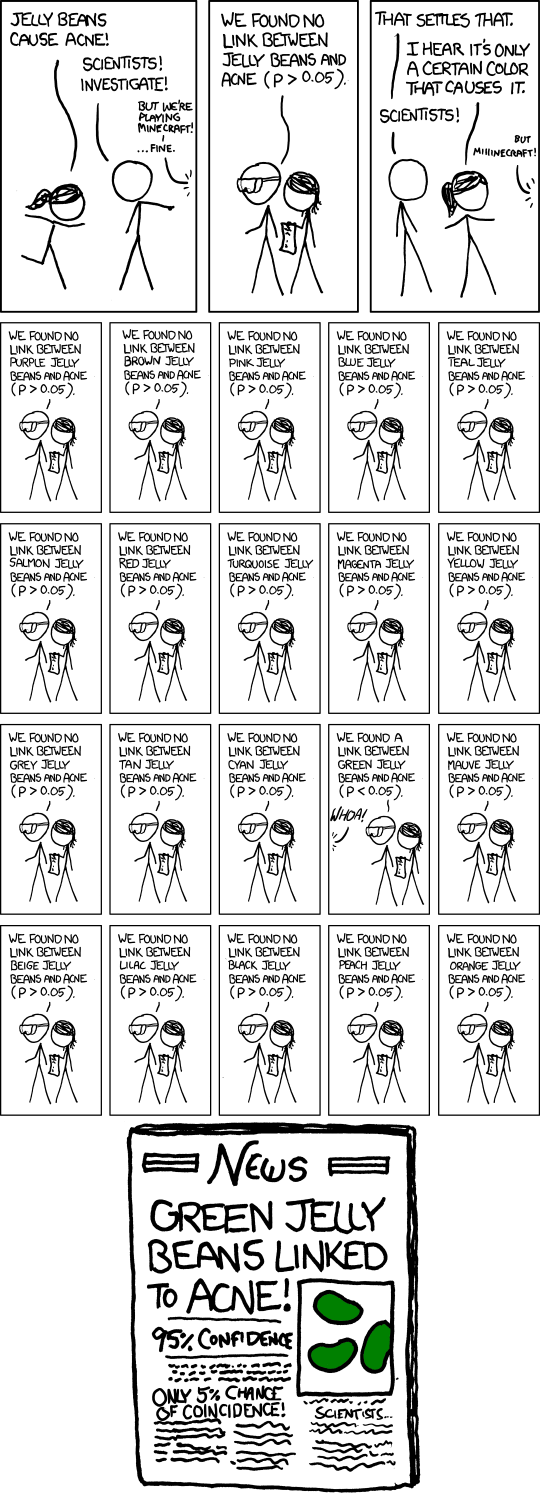
No correction for multiple comparisons, 44 tests and 5 p-values <0.05. No assessment of the blinding, and conflicts of interest for two authors.
Yeah, we could pick through the details, but that sentence really sums it up.

Except that it looks like there are actually another 4 cognitive tests at two timepoints, and another 8 tests associated with the SF measures at two timepoints, so it's 68 tests and 5 significant p-values.
The D-KEFS Category Fluency, RCFT, SDMT, and MINT did not show improvements from baseline to 8 weeks (Supplementary Table 3).
The results for the tests that did not show improvements are hived away in a Supplementary Table 3, whereas the rest are given in Table 3. You can check that what I'm saying by comparing Table 1 which lists all the tests done with Table 3. Or looking at Supplementary Table 3.

Supplementary Table 3 tells us that the sham treatment participants improved on the SF36 from baseline at 8 weeks by 35.75 points whereas the treatment participants improved only by 0.49 points. Not significant though. There was no benefit from the treatment for
SF-36 Energy /Fatigue
SF-36 General Health
SF-36 Pain
SF-36 Physical functioning
SF-36 Role limitations - emotional
SF-36 Role limitations - physical
SF-36 Social Functioning
SF-36 Total score

The one SF-36 measure that is reported in Table 3 is SF35- Emotional Wellbeing. That is one of the measures that @Eddie mentioned where the reduction in the controls contributed a lot to making the difference between the arms significant. The control mean score decreased by 10 points, while the treatment mean increased by 9.2 points. I think the score is out of 100, so a mean change of plus or minus 10 points is nothing much.

Preliminary findings suggest sustained clinically meaningful improvements in multiple cognitive domains and mood following treatment.
I think it is really irresponsible of the authors to make that conclusion.
 
Shouldn't the reasons for dropping out be similar in the placebo group, making the groups still comparable?
If the treatment was causing harm to some people, then the people who are harmed would drop out, and be replaced by people who could complete the treatment. I don't think that happened in this case - I think the treatment is probably pretty close to a placebo.

But, if you are trying to determine the feasibility and acceptability of a treatment, it seems a bit bad to have a trial design where people who drop out are replaced.


Is this similar to TMS device offered by some psychiatrists?

“No. Very different. It is a continuous magnetic field rather than pulsed like TMS and it is about 1/100000th the strength of the magnet used in TMS. TMS is about stimulating neurons, MMT triggers reductions in neuroinflammation without stimulating neurons.”

Wow such low strength…..reminds me of homeopathy.
 
This is a grift paper, selling a product. Dont even need to read it which I won’t to know…Putrino is a grifter trying to make money
 
Back
Top Bottom