[ME/CFS Research Foundation] International ME/CFS Conference 2026 on 7–8 May - register for free now!

"The rehabilitation programme was specifically designed for people with ME/CFS (including ‘localised rehabilitation’, stimulation shielding and no strenuous exercise). According to the rehabilitation centre, the programme was very labour-intensive and, in terms of staffing requirements, could not be compared to standard rehabilitation programmes funded by the German Pension Insurance."
Also very significant. Same thing happened with PACE. Even Wessely admitted that no health care system could possibly fund and staff the intensive levels involved in their treatment programs, it would be far too expensive. Which makes the fact that it became recommended anyway stunning, because it shows that a treatment doesn't even have to be realistic to be widely deployed.

And that's before you consider widespread deployment of the actual program, rather than a downsized version. In-person 1:1 labor-intensive therapy like this is the absolute worst possible way of delivering treatments, it scales negatively, the more you do of it, the bigger the administrative structure to support that staffing, and there are zero economies of scale. This comment was made for a limited program, so limited it couldn't even be applied to 1% of the patient population, and it doesn't even take into account the explosive growth needed to make it widely available.

The rehab model is a fantasy, as much as a system built around the healing power of prayer. It has no viable future outside of extremely narrow needs.
 
The problem with this line of thinking is that it never stops:

The dose was too low.
The dose was too high.
The titration was too fast.
The titration was too slow.
The trial was too short.
The trial was too long.
They didn't measure the response after enough time had passed.
They measured the response too soon.
The dose was not individualized to best response of each participant. (Even though there is no way to do this)
They didn't pick the participants well enough. (Even though there is zero evidence of subgroups)

If you look at the thread over on /r/cfs it is just combinations of the above statements. This way people cling to hope that their most likely useless drug is the miraculous cure despite null result after null result. "But surely it must be doing something! It helped me!" is the exact line of argumentation that brain retraining proponents use but because this is an actual medication suddenly anecdotes are better than null results in double blinded RCTs.


Nevertheless, the study did not follow the very low dose start/gradual increase protocol/advice given by the LDN Research Trust which patients go to for LDN guidance.

I have not suggested that dosing advice from the LDN Trust, or LDN per se, is validated by research, but it is the program which most ME patient LDN users follow, rightly or wrongly.

.
 
Last edited:
Do you have a source for this? It may be relevant to something I'm (slowly) writing


"I made this figure.

Having looked at many thousands of similar plots - this result is very striking. Will attempt to explain….

Daratumumab (anti-CD38) has partially reset autoantibody repertoires in this trial.

The cohort is small, but the reset effect occurs more in responders than non-responders.

What you typically see at paired timepoints looks like the “untreated” patients at bottom. Very tight and reproducible autoantibody repertoires across time. We and others have published on this. It is hard to get autoantibody repertoires to change (Bodansky et al 2024 shows BCMA CAR-T can do it, but not anti-CD20 - a B cell depletion that does not reset long lived plasma cells).

The plot is an intra-patient z-score scatter of raw HuProt protein microarray IgG autoantibody data before treatment, and then one year later. Each dot is a unique human protein. Most of the autoantibody events are private to individual patients. You can quantify these events to call “hits” with a simple binary cutoff (z>3).

Colored are unique antibody hits for patients in each sample pair. Blue occur ONLY at baseline, red pass threshold in both samples, yellow only post-treatment). You’ll note that all patients preserve a dominant autoantibody signature (red diagonal) demonstrating that the autoantibody reset is not perfect - the most dominant clones hold out in most patients.

You’ll note in the responder scatters “blue blobs” - these are the dozens of autoantibodies that go-away post therapy. You’ll note this blob looks a bit larger in the responders.

You can quantify the amount of this reset with a sort of Venn diagram ratio of target overlaps called a jaccard similarity. The untreated patients are about a 0.8/1 meaning nearly all the dots are red and all autoantibodies are shared at both timepoints by a simple binary categorization. I’ve seen that same ratio in thousands of other pre vs post timepoint autoantibody samples.

And thus, I find changes in that ratio quite striking! The treated non-responders have a median jaccard ratio about 0.5/1 and the responders about 0.3/1 which are the largest changes I’ve ever seen in HuProt data from the same individuals longitudinally. The amount of autoantibody hits that disappear also correlate with magnitude of patient improvement (SF 36PF scores, another slide from talk). The identities of the autoantibodies which disappear most is somewhat shared between the responders and also quite interesting- but will be up to the authors to reveal those results. Hard to be too certain about mechanistic autoantibodies as biomarkers in any study this small."
 
Last edited by a moderator:


I made this figure.

Having looked at many thousands of similar plots - this result is very striking. Will attempt to explain….

Daratumumab (anti-CD38) has partially reset autoantibody repertoires in this trial.

The cohort is small, but the reset effect occurs more in responders than non-responders.

What you typically see at paired timepoints looks like the “untreated” patients at bottom. Very tight and reproducible autoantibody repertoires across time. We and others have published on this. It is hard to get autoantibody repertoires to change (Bodansky et al 2024 shows BCMA CAR-T can do it, but not anti-CD20 - a B cell depletion that does not reset long lived plasma cells).

The plot is an intra-patient z-score scatter of raw HuProt protein microarray IgG autoantibody data before treatment, and then one year later. Each dot is a unique human protein. Most of the autoantibody events are private to individual patients. You can quantify these events to call “hits” with a simple binary cutoff (z>3).

Colored are unique antibody hits for patients in each sample pair. Blue occur ONLY at baseline, red pass threshold in both samples, yellow only post-treatment). You’ll note that all patients preserve a dominant autoantibody signature (red diagonal) demonstrating that the autoantibody reset is not perfect - the most dominant clones hold out in most patients.

You’ll note in the responder scatters “blue blobs” - these are the dozens of autoantibodies that go-away post therapy. You’ll note this blob looks a bit larger in the responders.

You can quantify the amount of this reset with a sort of Venn diagram ratio of target overlaps called a jaccard similarity. The untreated patients are about a 0.8/1 meaning nearly all the dots are red and all autoantibodies are shared at both timepoints by a simple binary categorization. I’ve seen that same ratio in thousands of other pre vs post timepoint autoantibody samples.

And thus, I find changes in that ratio quite striking! The treated non-responders have a median jaccard ratio about 0.5/1 and the responders about 0.3/1 which are the largest changes I’ve ever seen in HuProt data from the same individuals longitudinally. The amount of autoantibody hits that disappear also correlate with magnitude of patient improvement (SF 36PF scores, another slide from talk). The identities of the autoantibodies which disappear most is somewhat shared between the responders and also quite interesting- but will be up to the authors to reveal those results. Hard to be too certain about mechanistic autoantibodies as biomarkers in any study this small.

So how do we square these interesting plots with the negative HLA analysis in DecodeME and the failure of the immunoabsoption phase 2?

Could this be connected to a) JE et als idea about antigens to junk in their hypotheses or b) Lipkins findings of immune overreaction to various things in his recent paper?
 
One of the questioners is raising the point that Fatigue is a poor end point which we all agree with especially when its Chalder Fatigue Score!

They really need the objective results like step count and Funcap as the PROM as well as measuring their hypothesis impact to confirm the treatment works (many did do this thankfully).
FUNCAP is also susceptible to manipulation, because it asks you what think would happen. If you convince someone they are better, they will get a better score.

But it’s much more relevant for ME/CFS than any other PROM.
Well, that's certainly a positive viewpoint, but I hold researchers to higher standards than that.

I would argue that there is no such thing as a null result. This is not one condition, and in every null result there are patients that improved... but since the studies are not collecting even basic data about them, they have no idea why!
If there were improvements for individuals due to the treatment, it would affect the averages on a group level. Because there were no differences on a group level, we can’t claim that anyone benefitted from the treatment.
Also very significant. Same thing happened with PACE. Even Wessely admitted that no health care system could possibly fund and staff the intensive levels involved in their treatment programs, it would be far too expensive.
Which is why tele- and 3-day-interventions are so popular now..
 
Last edited:
Given they called it CFS I am also not clear what the patient group was. Many of the good presentations mentioned CCC and IOM but this one didn't and the use of Chalder Fatigue Score suggests they are quite out of touch. It may be immunabsorption doesn't work on Fatigue patients. Will be interesting to see the paper on that one as the presentation raised some concerns.
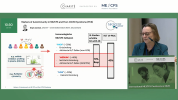
In her closing presentation, Scheibenbogen noted once again that the neurological research group had not taken her comments on the selection of participants into account.
It seems there are significant differences of opinion on this matter.
She added the following slide to the analysis:
Screenshot (68).png
 
Also of interest:
She confirmed that there will be an isatuximab trial.

(Wikipedia: "Chemically, isatuximab is similar in structure and reactivity to daratumumab; therefore, both drugs bind to CD38 in the same way. However, isatuximab exhibits greater inhibition of its ectoenzyme function. Isatuximab acts as an allosteric antagonist, inhibiting the enzymatic activity of CD38 in a dose-dependent manner.")

Unfortunately, this is only available to patients who have previously undergone immunadsorption.
I would have loved to have taken part...
 
CFS_Care was a rehab of 270 people, really unclear what their usual care and rehab arms were and also patient selection is poorly defined. They made 43% of the patients that did the rehab worse.:speechless:

The summary lays it quite clearly, rehab didn't work it made the patients worse and that Rehab must not be used in this patient group.

A third dropped out as well, due to insurance payment mess. Some of the patients missing data.
This study was done in cooperation with Charité. So the patients were diagnosed with the criteria they use for ME/CFS. As far as I know they use the CCC.

This is a very important study because it shows that even when a rehab programme has a somatic understanding of ME/CFS and makes it its top priority to teach the patients pacing and energy management there are still almost half of the patients who get worse during such an in person programme.

At the same time it is really nice to see that patients did profit somewhat. A slight increase in emotional health is a good thing I find.

I hope they will draw the conclusion that they have to go online with offering support to ME patients so that (mild and moderate) patients could chose from a variety of programmes according to what they themselves feel would support them best or are attracted to try out.
 
I hope they will draw the conclusion that they have to go online with offering support to ME patients so that (mild and moderate) patients could chose from a variety of programmes according to what they themselves feel would support them best or are attracted to try out.

They draw quite different conclusions!

(Riffreporter/Scheibenbogen): The ME/CFS researcher’s conclusion is mixed. “The study shows that learning pacing helps – but patients don’t need to go to a rehabilitation centre to do so.”

(Riffreporter/Deutsche Rentenversicherung Bund (DRV): “As soon as the results are published, we will analyse them, compare them with other research findings and respond as necessary.” The research findings are “still preliminary and therefore cannot serve as a basis for action.”

It sounds as though the pension insurance scheme is refusing to change its procedures solely because of results like these...
 
Is there much positive bias left for people visiting the Charite and getting Rehab?
The Reha was done by Klinik Bavaria in Kreischa, Saxony.

Riffreporter: “Feedback from participants regarding our rehabilitation programme was overwhelmingly positive,” writes the private organisation.

But: Admission is “unfortunately no longer possible for patients with fatigue at present” :laugh:

"Three-quarters said that the rehabilitation had helped them significantly or to some extent. Mainly because they learnt pacing."

So it was a good idea to also ask about SF36 and Bell...
 
Unfortunately, this is only available to patients who have previously undergone immunadsorption.
I would have loved to have taken part...
This is really really frustrating. So in order to get into the trial they have to have 'responded' to immunoabsoption, which as we all just saw probably doesn't work.

I am concerned this could affect patient selection in a way that could affect the results. What if the patients who show some kind of 'response' to immunoabsoption are also the people who would be a non responder to anti cd38? I know that might be far fetched but my point is it adds confusion and could potentially skew the trial results, even if just by influencing patient selection - the best patients for cd38 might not fit this criteria. we dont know.

There's no convincing CS though, as we saw today...
 
Also of interest:
She confirmed that there will be an isatuximab trial.

(Wikipedia: "Chemically, isatuximab is similar in structure and reactivity to daratumumab; therefore, both drugs bind to CD38 in the same way. However, isatuximab exhibits greater inhibition of its ectoenzyme function. Isatuximab acts as an allosteric antagonist, inhibiting the enzymatic activity of CD38 in a dose-dependent manner.")

Unfortunately, this is only available to patients who have previously undergone immunadsorption.
I would have loved to have taken part...
It's... stupid. I wouldn't have said so if one arm was isatuximab only and they also had an arm with immunadsorption followed by isatuximab. This feels like pushing for her pet theory. It always is in a way but this looks like a missed opportunity.
 
Back
Top Bottom