[ME/CFS Research Foundation] International ME/CFS Conference 2026 on 7–8 May - register for free now!

I’m a bit worried that Scheibenbogen has become sort of the face of ME/CFS research in germany and at the same time seems to be very attached to a particular hypothesis in a way that feels it might compromise “neutrality”. I’ve not been particularly impressed methodology wise from the papers I’ve seen she authored either.

I do hope the ME research community does chase the autoimmunity idea to a logical end, with either a positive or negative result. We never get any idea worked on thoroughly which always leaves us constantly wondering what-ifs
 
I’m a bit worried that Scheibenbogen has become sort of the face of ME/CFS research in germany and at the same time seems to be very attached to a particular hypothesis in a way that feels it might compromise “neutrality”. I’ve not been particularly impressed methodology wise from the papers I’ve seen she authored either.
She really seems to be very attached to the AAB hypothesis.

But I can’t imagine that other clinics are particularly influenced by the kind of research Scheibenbogen is doing.

Isn’t she more the face of taking the disease seriously?

Without her and former minister Karl Lauterbach, we certainly wouldn’t have a ‘Decade against post-infectious diseases’.
I write this with a definite bias, because having my condition confirmed by her department at the Charité helped me a great deal.
 
Sustained step counts with pre baseline is the only way to determine true response.

If someone really is cured, they will go back to normal life and do normal people things for a long period of time. This will translate into a sustained increase in step count. It's that simple.
Also why I am such a big advocate of step count, extremely bullish on it. Need it in every P1 study, so cheap these days too. No excuses.

Say it again louder for the people in the back!

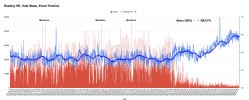
Here's what it looks like to go from very healthy to very sick:
Screenshot 2026-05-08 at 7.32.20 AM.png

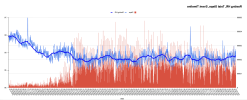
If a treatment really works I expect the response will look something like a mirror image:
Screenshot 2026-05-08 at 7.34.25 AM.png

Anything less is settling for too little.
Stop playing games with questionnaires and claiming "success" because someone thinks they felt a little better on a random Tuesday...
The only question that matters is "Can you do all the things you could before, without limitation?" Yes or No
 
Also why I am such a big advocate of step count, extremely bullish on it. Need it in every P1 study, so cheap these days too. No excuses.
I'm certain the wearables I've used overestimate the step count but when I went from moderate to severe, my step count reduced more than 3 times. You can see on the graph the exact day I became bedboud.

Other major crashes are also visible on the graph because the reduction seems to be at least 1/3 without going back up again.

Unfortunately, I don't have any instances of improvement but yes, I would expect to see it in the step count, as imperfect as the estimate is. In addition, patients could log somewhere or be asked by the researchers about the movements that could be significantly inflating the step count, like knitting or similar that a forum member reported here. There must be some known culprits by now.
 
Could that point to LDN being harmful or likely just noise?

ME patients who use LDN were all surprised at the dose in this study, considering it too high for a starting dose. The patients who use LDN had started at .5 mgs or less, then very gradually increasing up to (it varies) 5 mgs. They say that their symptoms are exacerbated when the dose is too high for them. So the final dose, gradually arrived at, varies between 1 mg and 7 mg (approx).

I don't/have never used LDN but have read accounts over many years by people who do, or who tried it.
 
Last edited:
Anything less is settling for too little.
Stop playing games with questionnaires and claiming "success" because someone thinks they felt a little better on a random Tuesday...
The only question that matters is "Can you do all the things you could before, without limitation?" Yes or No
Yeah even in cases where you dont have a cure the increase or decrease in percentages would be massive. So if you cant even get a big increase in numbers, the patient most likely didnt meaningfully get better. Simple.

The PACE trial authors dropped the Acti like someone else mentioned. They used the excuse that it was inconvenient for patients (lol). We should measure steps in all the clinical trials. Its just a cheap watch on the wrist with lots of important data.

No excuses, get it done. unless there are specific reasons, any trial that doesnt measure step counts is automatically a big minus for me, because it shows the authors havnt read up on other MECFS studies like F and M, or even the PACE trial, that despite its flaws can teach you about study design (and what not to do).
 
Last edited:
ME patients who use LDN were all surprised at the dose in this study, considering it too high for a starting dose. The patients who use LDN had started at .5 mgs or less, then very gradually increasing up to (it varies) 5 mgs. They say that their symptoms are exacerbated when the dose is too high for them. So the final dose, gradually arrived at, varies between 1 mg and 7 mg (approx).

I don't/have never used LDN but have read accounts over many years by people who do, or who tried it.

The problem with this line of thinking is that it never stops:

The dose was too low.
The dose was too high.
The titration was too fast.
The titration was too slow.
The trial was too short.
The trial was too long.
They didn't measure the response after enough time had passed.
They measured the response too soon.
The dose was not individualized to best response of each participant. (Even though there is no way to do this)
They didn't pick the participants well enough. (Even though there is zero evidence of subgroups)

If you look at the thread over on /r/cfs it is just combinations of the above statements. This way people cling to hope that their most likely useless drug is the miraculous cure despite null result after null result. "But surely it must be doing something! It helped me!" is the exact line of argumentation that brain retraining proponents use but because this is an actual medication suddenly anecdotes are better than null results in double blinded RCTs.
 
I’m a bit worried that Scheibenbogen has become sort of the face of ME/CFS research in germany and at the same time seems to be very attached to a particular hypothesis in a way that feels it might compromise “neutrality”. I’ve not been particularly impressed methodology wise from the papers I’ve seen she authored either.
Yes, it was clear already a year ago that some members of the Charité group have convinced themselves that ME was an autoimmune illness. I witnessed Sawitzki stating that explicitly in a talk. I don't remember it was at last years conference or somewhere else around that time. (And thought that was very bad because personally I want to see more pathogen reactivation research)

That's why I think that especially Iwasaki, Pretorius, Gennaro and others are so important who wrote and talk a lot about all the different hypotheses there are in the fields of LC and ME/CFS and that they all deserve attention.
 
Should we have a thread to discuss these Michelle James PET scans? I am really interested in them. She said she'd publish late last year or early this year before. I wonder what the hold up is.
I remembered @Jonathan Edwards had queried them in an old thread after some initial excitement..

Post in thread 'Community Symposium on the Molecular Basis of ME/CFS Sept 5 (Stanford/Ron Davis)'
https://www.s4me.info/threads/commu...s-sept-5-stanford-ron-davis.45671/post-639771
 
Is it me or are none of these studies controlling for subtype, symptoms, or test results?!

I keep seeing slides saying something worked or didn't work but they have no idea who it worked or didn't work for!
I have spun this thought off into a thread brainstorming why researchers continue to not subtype or stratify trials in 2026.

 
They used the excuse that it was inconvenient for patients (lol).
That was the public excuse. The excuse behind the scenes to the trial governing committee was that actimeters had failed to show a benefit, therefore there was no point in using them.

Think about that. They are saying that they should not be required to use measures that might falsify their claim.
 
That was the public excuse. The excuse behind the scenes to the trial governing committee was that actimeters had failed to show a benefit, therefore there was no point in using them.

Think about that. They are saying that they should not be required to use measures that might falsify their claim.
Do you have a source for this? It may be relevant to something I'm (slowly) writing
 
CFS_Care was a rehab of 270 people, really unclear what their usual care and rehab arms were and also patient selection is poorly defined. They made 43% of the patients that did the rehab worse.:speechless:

The summary lays it quite clearly, rehab didn't work it made the patients worse and that Rehab must not be used in this patient group.

A third dropped out as well, due to insurance payment mess. Some of the patients missing data.
The most important detail here is the "improved daily life management and higher perceived appreciation" while almost half deteriorated and over half would continue trying. This makes it clear that the questionnaires-based evaluations are not reliable, while also making it clear, yet again, as always, that motivation is not an issue. If anything, there is too much motivation considering how it can blow back.

Nothing, and I mean absolutely nothing, is graded on a gentler curve than health care. Uber drivers, who must maintain a 4+ rating to continue working, are graded far more harshly than failed treatments that don't improve anything and clinicians with nothing useful to offer but can handle basic social norms in a clinical context. This is why alternative medicine is so popular, it gets the same gentle rating curve and being nice and warm and encouraging is always part of the service.

None of this is ever taken into account. Minor positive blips keep getting over-hyped as basically the second return of deity on toasts, even though those blips happen regularly without anything happening. They're background noise tuned with a massive positive bias. For a non-pharmaceutical clinical trial to be truly considered effective, the bar for minimal clinical significance should be raised at least 2-5x, and even then it likely would catch too many false positives.

And that would likely mean that 90%+ of everything "evidence-based" would fall below, and it's the best thing that could happen to medicine. Sometimes being forced to step back from a disaster is the best thing someone can do, even if it's humiliating (and possibly litigious, this is the point of litigation, screw up and there should be consequences).
 
Back
Top Bottom