

You are using an out of date browser. It may not display this or other websites correctly.
You should upgrade or use an alternative browser.
You should upgrade or use an alternative browser.
[ME/CFS Research Foundation] International ME/CFS Conference 2026 on 7–8 May - register for free now!
- Thread starter Jaybee00
- Start date

Murph
Senior Member (Voting Rights)
your slides are all over Twitter! including the text that says "not for distribution"!Happy to send slides to anyone on PM (just message me and I'll send them) . Was asked by collaborators to keep them out of public domain until published. I wanted to present some interesting info on lipid work.
BrokenBeaktheBrave
Established Member (Voting Rights)
Well that's not cool.your slides are all over Twitter! including the text that says "not for distribution"!

ryanc97
Senior Member (Voting Rights)
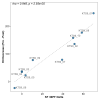
Reduction in aab hits from Huprot. Good linear fit.
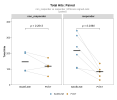
Note 6 green line was a placebo responder aka nonresponder, her sf36 went up at the start but dropped later. Also her step count did not go up. This shows how FM measure response is very accurate. SF36 increasing with no step count increase means nothing.
Only debate is that 9 dropped same amount as 7, but I imagine its due to difference in types of aabs dropped and 7 hit the bad ones
@jnmaciuch
@Jonathan Edwards
you guys might find this interesting
Note 6 green line was a placebo responder aka nonresponder, her sf36 went up at the start but dropped later. Also her step count did not go up. This shows how FM measure response is very accurate. SF36 increasing with no step count increase means nothing.
Only debate is that 9 dropped same amount as 7, but I imagine its due to difference in types of aabs dropped and 7 hit the bad ones
@jnmaciuch
@Jonathan Edwards
you guys might find this interesting
Attachments
Last edited:

Rick Sanchez
Senior Member (Voting Rights)
Yes the infamous 6th ´´responder´´ shows why step count, or other meassures like going back to work, education, even if just part time is so important in non-placebo controlled studies, like in P1. SF just isnt enough in itself to avoid being fooled by randomness.Reduction in aab hits from Huprot. Good linear fit.
Note 6 green line was a placebo responder aka nonresponder, her sf36 went up at the start but dropped later. Also her step count did not go up. This shows how FM measure response is very accurate. SF36 increasing with no step count increase means nothing.
Think I was right in my tealeaf reading about this one at least not being a real responder at all
Last edited:

V.R.T.
Senior Member (Voting Rights)
Immunoabsorption phase 2 RCT showed no significant difference between groups. Disappointing but not shocking, perhaps.
Although the two researchers presenting it kept talking about how happy they were to share the data which made me think it might go the other way!
Does immunoabsoption do much for traditional autoantibody mediated disease?
Although the two researchers presenting it kept talking about how happy they were to share the data which made me think it might go the other way!
Does immunoabsoption do much for traditional autoantibody mediated disease?
BrightCandle
Senior Member (Voting Rights)
The controlled Immunoabsorption study shows no result on its primary endpoint. That is a bit of a shocker for the audience, they expected that to work but they measured IGG of controls and treated and the differences were there it just didn't impact Chalder Fatigue Score nor SF-36.
Hmm that is going to get me in trouble. Can you share links?your slides are all over Twitter! including the text that says "not for distribution"!
V.R.T.
Senior Member (Voting Rights)
Is there any other illness where one of the 'gold standard' diagnostic tools was designed by a denier of that illness?Chalder Fatigue Score


Can you share links?
I can't search Twitter itself, but Google led me to —
It looks like that account is posting a thread of representative shots from most presenters, so it's likely an oversight.
Murph
Senior Member (Voting Rights)
Hmm that is going to get me in trouble. Can you share links?
BrightCandle
Senior Member (Voting Rights)
The studies without controls don't seem to be setting themselves up to determine these sort of questions for some reason and they ought to. All the ones with control have failed to find an effect.Is it me or are none of these studies controlling for subtype, symptoms, or test results?!
I keep seeing slides saying something worked or didn't work but they have no idea who it worked or didn't work for!
ryanc97
Senior Member (Voting Rights)
Yes, sustained step count cannot lie, which is what I've been pushing over here. It can't lie.Yes the infamous 6th responder shows why step count, or other meassures like going back to work, education, even if just part time is so important in non-placebo controlled studies, like in P1. SF just isnt enough in itself to avoid being fooled by randomness.
Think I was right in my tealeaf reading about this one at least not being a real responder at all
Murph
Senior Member (Voting Rights)
The most interesting thing about that null finding might have been Scheibenbogen's response!The controlled Immunoabsorption study shows no result on its primary endpoint. That is a bit of a shocker for the audience, they expected that to work but they measured IGG of controls and treated and the differences were there it just didn't impact Chalder Fatigue Score nor SF-36.
She sounded mad.
I am in no position to judge if she was right on the substance but it sounded like there may be bitter divisions in German research.