Maeve Boothby O'Neill - articles about her life, death and inquest

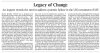
Page 5 of the hard copy of the Times today is totally about Maeve, with a link to a leading article on page 23.
For anyone who would like to read them:
Media coverage - with the exception of the execrable Alastair Miller in the Observer - has been excellent throughout. I also hadn't realised that Andrew Gwynne (new Labour Public Health minister) had suffered from Long COVID; perhaps he will take things rather more seriously.

ETA: The first image was truncated; now fixed.
 
Last edited:
Even if it happened, I wonder if it would achieve more than the inquest and the media coverage. Everyone can see it was a complete clusterfuck, and what that poor young woman and her family had to endure is horrifying.

The fact that the inquest was relatively short and the information coming out wasn't all mind-numbingly technical might have helped with the story's power and impact. Change happens much faster when people understand on a human level that it really has to.

Important and relevant points from Kitty, I think.

The Coroner’s response to the ‘complete clusterfuck’ may not be as full or clear cut as we would like it to be, but the focus has changed somewhat from just blaming the patient to looking at systemic NHS shortfalls in knowledge and resource provision to care for and protect severe ME/CFS patients from unnecessary suffering. Stage 2 of this process at the end of September will help flush out the seriousness of the intent behind this apparent changed focus.

History unfortunately tells us that very few of those behind a ‘clusterfuck’ are ever really held to account. The focus is almost always about moving on in someway. It would,I think, be a major win just to get ME/CFS taken seriously by the NHS as a disease with very serious consequences for patients which require very careful and compassionate management, which the BPS psychological view of ME/CFS would appear to frustrate.
 
Two new articles in The Guardian:

Devon woman died from malnutrition due to severe ME, coroner concludes
https://www.theguardian.com/uk-news...lnutrition-due-to-severe-me-coroner-concludes

What is ME and why is the NHS approach to it being criticised?
https://www.theguardian.com/society...s-me-myalgic-encephalomyelitis-nhs-criticised

They had to say the M.E. Killed her, yes it did. Face solemn voice low, it’s the kind of “real” (well maybe like anorexia yes but I couldn’t comment) illness that can kill.

Because a killer is evidently on the loose, and they’re all in the frame, M.E is all of a sudden a terminal illness.
 
Last edited by a moderator:
The contrast with acute COVID is glaring. They tried everything, knowing that the outcome was death anyway. When doing nothing leads to death, there is an obligation to take more serious measures.

Many MDs who testified basically said that they had written her off as dead, that she was going to die regardless of what they did. Which is what should have compelled to go beyond the absence of explicit guidance.

Also it's absurd how the line is that a problem was there were no doctors with experience with ME, but they mostly ignored Dr Weir, who did. So they're painting a false narrative. Yes, there is a systemic, and deliberate, lack of ME experts. But there was one involved, actually more than one if we count Dr Strain. So they're arguing that there were no MDs with experience, even as they literally ignored the advice of such experts, because, and we know this is the case, they don't even believe that ME is a real thing anyway. Although from memory, I'm not sure if Strain advised for it.

This is all so impressive you'd think we're in 1984, rather than 2024. It's not as if anything changed since, other than actually getting worse anyway.
There’s procedural issues with taking Dr Weir’s advice. He wasn’t an employee of the trust, or even the NHS. His advice was “considered” but didn’t convince them to deviate from their processes.

The reason the trusts have Standard Operating Procedures etc is a combo of tried and tested research, which therefore protects them legal and indemnifies them against being wrong and or sued.

This is why it comes back to systems and processes rather than individuals. Because whether they think ME is a physical disease or made-up woo woo, they followed their procedures and that’s what has protected them.

It’s not fair, but it’s probably legally sound. I have high hopes for the next hearing, and hope to one day see the Public Inquiry we need.
 
It's difficult to degrade services based on generic factors, such as "we don't know if the patient is exaggerating their illness / if this is a functional disorder", without degrading it for everyone. Almost impossible, even.

This is the inevitable outcome of this rotten ideology. It makes all of medicine worse, as a result of trying to make medicine worse for some. Because they do this all on the basis of the most common factors in all medicine: symptoms and their impacts. Which is basically everything but what MDs do. It's like degrading the concrete of a building during construction because you want a specific room to collapse. The whole structure will follow, because the concrete holds the entire thing together.

They never think about that. They don't ever think that the face-eating leopards they're placing everywhere will eat their face one day.
Agree, GPs would happily send everyone to a wellness/CBT list if they could. Got a rash? Go speak to someone about your feelings. Sore knees? Walking fitness group. Menopausal? Mindfulness. Sores weeping pus? Healthy eating app. Axe in your head? Call 111.
 
Last edited:
There's something else that I noticed while sitting through the coroner's remarks: she referenced Strain's testimony about Weir being able to trial potential treatments on the basis of "anecdotal" evidence & that he would not have the same freedom in the NHS. She then essentially conflated the inability of the NHS to provide experimental "treatments" with their failure to provide artificial nutrition to someone who desperately needed it.

But they are not the same thing: just because Strain had to go through various procedures and consult with others to arrange for the prescription of supposed treatments (Maeve apparently trialled a number of medications and "supplements", including fludrocortisone, vitamins, L-carnitine and aripiprazole) on an off-label basis - that should not have been conflated in any way with the failure to provide adequate nutritional support in a manner that would have been acceptable to someone with the severe sensory sensitivities & intolerances of very severe ME.
 
Last edited:
including David Tuller's pieces.

I really would like to see a written copy of the ruling and understand better some of the thresholds for a coroner to be able to conclude evidence is sufficient for determining, for example, whether something did or didn't contribute to death. Sean's piece put a positive spin on what the coroner found in terms of moving forward, but is his piece just overlooking the negative aspects?
 
I meant little anecdotes from people who’ve found their doctors more sympathetic, more willing to listen or treat them and where their doctors have explicitly referred to their interest arising from the coverage of this case.

It does seem that the message that people can die from malnutrition from ME should or could have a positive impact on better/earlier treatment in other cases.
 
There's something else that I noticed while sitting through the coroner's remarks: she referenced Strain's testimony about Weir being able to trial potential treatments on the basis of "anecdotal" evidence & that he would not have the same freedom in the NHS. She then essentially conflated the inability of the NHS to provide experimental "treatments" with their failure to provide artificial nutrition to someone who desperately needed it.

But they are not the same thing: just because Strain had to go through various procedures and consult with others to arrange for the prescription of supposed treatments (Maeve apparently trialled a number of medications and "supplements", including fludrocortisone, vitamins, L-carnitine and aripiprazole) on an off-label basis - that should not have been conflated in any way with the failure to provide adequate nutritional support in a manner that would have been acceptable to someone with the severe sensory sensitivities & intolerances of very severe ME.

Hopefully her remarks will be released soon (she said "after the weekend").

I feel like a main point in this history is time. We know how ME progresses and so when Maeve went to hospital the first time, she has a problem with eating we would recognise as an emergency, but the NhS doesn’t see it that way. They have a kind of “it’s ok because you can still swallow”.
There was a point, in my estimation it might be around June or July where it was probably past the point of no return, ME would take years to recover from after months of crashing and malnutrition. We know that, they started to realise that, but of course by them it was too late. Apparently all options would have lead to immediate death by sepsis or aspiration, we can’t do anything else for you, apart from section you and have an NG forced upon you (aka torture).
 
I really would like to see a written copy of the ruling and understand better some of the thresholds for a coroner to be able to conclude evidence is sufficient for determining, for example, whether something did or didn't contribute to death. Sean's piece put a positive spin on what the coroner found in terms of moving forward, but is his piece just overlooking the negative aspects?
I think there’s probably a difference between his personal thoughts and his campaign for change.
 
I feel like a main point in this history is time. We know how ME progresses and so when Maeve went to hospital the first time, she has a problem with eating we would recognise as an emergency, but the NhS doesn’t see it that way. They have a kind of “it’s ok because you can still swallow”.
There was a point, in my estimation it might be around June or July where it was probably past the point of no return, ME would take years to recover from after months of crashing and malnutrition. We know that, they started to realise that, but of course by them it was too late. Apparently all options would have lead to immediate death by sepsis or aspiration, we can’t do anything else for you, apart from section you and have an NG forced upon you (aka torture).

I am not sure why we would credit them with ignorance at first admission, and still credit them with knowledge later.

By their own admission they couldn’t possibly have known one way or the other whether or not survival was possible. Because they don’t know about ME.


She was a young woman with a disease all there training told them was so unserious that it required no medical intervention at all none.

No right up to the end they were insisting she let herself down by eventually discharging herself. Not something that they would have done then or now had they had a revelation on the seriousness of her condition and inadequacies of their treatment of her.
 
I wonder if it's worth putting Sean and Sarah in touch with the Good law project given the wider good at stake here.
I’m sure they’ve had and will have legal counsel.

They may well have interacted with GL already. I’d be surprised if not. I don’t know if GL would be interested in taking on something in this area, would be good if they did one day. I know other people with ME have tried to get assistance from them.

I expect everyone will wait until after this process has concluded to decide if they want to formally challenge it or to move on and campaign in other ways.
 
I wonder if it's worth putting Sean and Sarah in touch with the Good law project given the wider good at stake here.

It's a lot to ask, though, given that they're lost their child in such traumatic circumstances and then had to deal with the inquest. And done so much groundwork before and during the hearing, too.

I hope the pressure comes off them now. They may need time to grieve all over again.
 
Back
Top Bottom