Is there a connection between ME/CFS and Sjogren's Syndrome? Discussion and a poll about testing

Has your doctor tested you for Sjogren's Syndrome?

  • Yes - I tested positive and I have dry eyes and dry mouth

    Votes: 3 3.4%
  • Yes - I tested positive but I don't have dry eyes and dry mouth

    Votes: 4 4.5%
  • Yes - I tested negative

    Votes: 19 21.6%
  • No - I have never been tested

    Votes: 53 60.2%
  • I don't know if my doctor has tested me

    Votes: 9 10.2%

  • Total voters
    88
I think it seems your MECFS identity is jeopardized when I claim Sjogren's can cause it, it is emotional response, like as if my claim diminishes MECFS level of seriousness, which shouldn't be the case.

No, I'm saying that currently nobody can say definitely that Sjogren's causes ME/CFS. They should be looked at as two separate conditions, but at the same time we can't rule out comorbidity.
 
Gotta love deleting my posts.
I was saying it makes no sense because we can just say some MS patients' fatigue, sleep disorder and brain fog are caused by his MS. The same applies to Sjogren's!

As for neuro involvement, the animal model of SLE - the MRL/lpr mouse- is considered, according to some researchers, the best model of neurosjogrens. Anti-SSA/Ro antibodies show up in only a subset of animals, anti-Ro52 (30%), and even a much lower % have anti-Ro60.
However, MRL/lpr mice develop neurological involvement very early in their life - thermal hyperalgesia, mechanical allodynia, and spontaneous pain behaviors from ~12–16 weeks (equivalent to human adolescence /early adulthood), consistent with a small fiber neuropathy–like phenotype. This is accompanied by clear pathology at the level of the dorsal root ganglia (DRG) .
So, this model includes exocrine involvement, SFN-like pain phenotype, and DRG-centered neuroinflammation in the absence of consistent SSA positivity.

(if you want to know more, you'll simply read studies)

and from MECFS UK org:
https://meassociation.org.uk/medica...anglionitis-and-post-mortem-research-into-me/

 
We have removed a number of posts that started with the querying of someone's diagnosis and whether someone who lifts weights could have ME/CFS.

The topic of what physical feats someone can do while having ME/CFS is a valid one, but off-topic here. If you want a copy of your deleted post, in order to re-use some of the content to start a thread for that topic, please contact a moderator.


Moderators have found it difficult to balance competing needs in this thread, so please bear with us.
 
Last edited:
In other words causation is not established. It's just a bunch of assumptions because we don't have enough data from ME/CFS patients.

The causation is almost never established in medicine, as I explained with fatigue in MS, it is arbitrary, as I gave an example of NMOSD in Sjogrens, depends who you ask, but conceptually it fits as neurological complication of Sjogrens & the animal models support it

I'm not sure why do you think that MECFS/dysautonomia/SFN/POTS etc clusters which occur so often in Sjogrens patients are anything different than all other listed neurological complications. Especially cos SFN/DRG is much more common than NMO or CIDP in Sjogrens.
 
That's right because disabling fatigue is a recognised feature of Sjögren's syndrome so to add in a diagnosis of ME/CFS makes no real sense. And ME/CFS is defined as disabling symptoms without any other explanation because that makes a useful prognostic category.
Yes, disabling fatigue isn't enough to talk about ME/CFS. But, if someone has PEM, then that's a different thing.

Of course, PEM is very hard to define though and too often gets equated with being tired after exercise. But, if there really is crashing, a major loss of function and feeling unwell after exertion, I think it's valid to at least keep open the possibility that the person has ME/CFS as well as their other diagnoses, such as Sjogrens.
 
Yes, disabling fatigue isn't enough to talk about ME/CFS. But, if someone has PEM, then that's a different thing.

Of course, PEM is very hard to define though and too often gets equated with being tired after exercise. But, if there really is crashing, a major loss of function and feeling unwell after exertion, I think it's valid to at least keep open the possibility that the person has ME/CFS as well as their other diagnoses, such as Sjogrens.
I have not kept up with the Sjögren's discussions here, so forgive me if this has been covered, but I would think that, in light of the fact that if PEM does indeed occur in Sjögren's, it seems to affect small minority of patients, it would be worthwhile to consider the possibility that its presence might well indicate the presence of two conditions with some shared symptoms. It is true that the utility of doing so might be in part prospective - should treatments for ME/CFS be discovered, it might be reasonable to try them -, but, more importantly for the present moment, it would suggest that any such patient should observe all of the cautions regarding pacing and exertion the pwME advocate, and which tend to be treated quite differently in other patient populations to which the individual likely has exposure (e.g. lupus).
 
I think it's valid to at least keep open the possibility that the person has ME/CFS as well as their other diagnoses, such as Sjogrens.

Yes, but it makes most sense to keep open the idea that it is one or the other, and maybe that the Sjogren diagnosis is just a red herring - which I suspect it may be in 755 of cases, especially in private practice.
 
but, more importantly for the present moment, it would suggest that any such patient should observe all of the cautions regarding pacing and exertion the pwME advocate, and which tend to be treated quite differently in other patient populations to which the individual likely has exposure (e.g. lupus).

I agree that anyone with PEM is likely to benefit from advice on pacing but what I find so odd about this aspect is the idea that anyone should be treated otherwise in any other condition. Pushing through fatigue is not known to be a good thing in any medical condition I know of. It is not that if you don't have PEM it is OK to do rehab. There is no point in that sort of rehab for anyone. Pacing was the advice I got for post EBV fatigue at a time when nobody had invented PEM.
 
I hadn't heard this - can Sjogrens really cause MS?
No. But it can cause MS-like symptoms, meaning symptoms that mimic MS, but do not constitute MS.

For example, in Pibee's post #69 above, the second green box, the one for CNS involvement, details "optic neuritis or mutliple sclerosis-like syndrome with symptoms restricted to pure sensory impairment or proven cognitive impairment".

So not MS, but things that look a bit like MS.

It's kind of like the way progressive supranuclear palsy (PSP) and a few other diseases are sometimes called Parkinson's Plus syndromes, because they mimic Parkinson's at the beginning. But they are not Parkinson's. They mimic it. So you wouldn't say PSP causes Parkinson's. You would say PSP causes parkinsonism or Parkinson's-like symptoms or it mimics Parkinson's.

Initial misdiagnoses or at least initial-working-diagnoses-that-end-up-being-revised are common in neurology.
 
I have not kept up with the Sjögren's discussions here, so forgive me if this has been covered, but I would think that, in light of the fact that if PEM does indeed occur in Sjögren's, it seems to affect small minority of patients, it would be worthwhile to consider the possibility that its presence might well indicate the presence of two conditions with some shared symptoms. It is true that the utility of doing so might be in part prospective - should treatments for ME/CFS be discovered, it might be reasonable to try them -, but, more importantly for the present moment, it would suggest that any such patient should observe all of the cautions regarding pacing and exertion the pwME advocate, and which tend to be treated quite differently in other patient populations to which the individual likely has exposure (e.g. lupus).
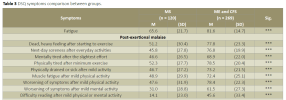
I get where you're coming from, and I agree that it's theoretically possible that if we get to the point of understanding the pathophysiology of PEM in ME/CFS, we may well find it occurs in people with other diseases too. But I think an idea has grown in recent years that if someone has PEM, then they have ME/CFS. That's a very flawed idea - PEM has not been defined yet in a way that distinguishes it adequately from how people with chronic fatigue due to other diseases respond to exertion.

For example, this is from a paper by Jason et al. 2017 comparing the PEM section of the De Paul Symptom Questionnaire in people with multiple sclerosis and people with ME/CFS:

1773922603195.png
 
I agree that anyone with PEM is likely to benefit from advice on pacing but what I find so odd about this aspect is the idea that anyone should be treated otherwise in any other condition. Pushing through fatigue is not known to be a good thing in any medical condition I know of. It is not that if you don't have PEM it is OK to do rehab. There is no point in that sort of rehab for anyone. Pacing was the advice I got for post EBV fatigue at a time when nobody had invented PEM.
The problem is that exercise is now considered to be beneficial for fatigue in so many conditions, from cancer-related fatigue to MS. And particularly fibromyalgia. Doctors think there's a solid evidence base for it. My guess is that for people who can withstand a bit of exercise, they may well get some of the other benefits of exercise, not least a boost in positivity that would make them fill out forms and report back in a more positive way. But if you can't withstand exercise or increased activity, and you have the misfortune to have a less credible condition like ME/CFS, you're really in a tough spot now.
 
Yeah a survival of the fittest/exercise worship culture has infiltrated every aspect of our lives and medicine is no exception
Indeed.

And they think the evidence base is even stronger for pain, and at least as strong for orthostatic intolerance, constipation etc. Any symptom I seek help for, I'm told to exercise.

They don't realise that this is a game of rock, paper, scissors where ME/CFS wins every time. It doesn't matter if we have pain and exercise is effective for pain, we still can't temporarily slip out of our ME/CFS bodies to do it.
 
The problem is that exercise is now considered to be beneficial for fatigue in so many conditions, from cancer-related fatigue to MS. And particularly fibromyalgia. Doctors think there's a solid evidence base for it. My guess is that for people who can withstand a bit of exercise, they may well get some of the other benefits of exercise,

Yes this is the problem and it leads to vast waste of money. I don't see why anyone ill with fatigue should benefit from exercise to be honest. I think it is all the same empty hype.
 
Yes this is the problem and it leads to vast waste of money. I don't see why anyone ill with fatigue should benefit from exercise to be honest. I think it is all the same empty hype.
I think there is genuinely good evidence for exercise in conditions like rheumatoid arthritis and Parkinson's, right? Not for fatigue, but for functioning. I think that makes it easy for them to believe that it would be helpful in other conditions, without bothering to look closely at the evidence. And in conditions they consider psychosomatic, they really don't feel the need to thiink at all.

From what some doctors have said to me, I think their own positive experiences with exercise often contribute to their conviction. They sometimes tell me what they do, and it's clear I'm supposed to be impressed or motivated by it. As someone who used to exercise a lot and loved it, and miss it, it's a particularly low point in the consultation. I guess it's the price I pay for having gushed too much about exercise pre-ME/CFS.
 
I think there is genuinely good evidence for exercise in conditions like rheumatoid arthritis and Parkinson's, right?

No, I don't think so. These days you treat RA with drugs. I never told my patients to exercise. They already did as much as they could. The evidence for exercise in rheumatology has, as far as I am aware, always been poor quality and since the 1990s has become pretty much irrelevant. All the stuff about strengthening quads is nonsense as far as I know.

Children and people with neurological deficits are different. I worked this out very early on. Children do not instinctively protect their bodies from the harm of immobility in the way that they do after age 18. They will sit in a pushchair and develop knee contractures. The same applies to people with neurological deficits like Parkinson's, stroke, MS and, importantly, myxoedema, where there is mental blunting and sleepiness. These people need to be helped to keep their joints mobile. BUT I would still argue that this is not an issue of exercise. It is an issue of range of movement. Passive movement with no exertion would be fine.

From what some doctors have said to me, I think their own positive experiences with exercise often contribute to their conviction.

People feel good after exercise if they aren't fatigued or have ME/CCFS type symptoms. I very much doubt they feel good after exercise if there is something wrong. I have deliberately exercised to keep my weight down in recent years and to stop myself from letting my knee pain keep me immobile. But after a long walk with screaming knees I am completely knackered, without any sense of 'feeling better'. Doctors confuse the euphoriant effect of exercise in healthy people with a therapeutic effect.
 
But after a long walk with screaming knees I am completely knackered, without any sense of 'feeling better'. Doctors confuse the euphoriant effect of exercise in healthy people with a therapeutic effect.
I think they would argue that you're confusing feeling exhausted straight after exercise with a lack of therapeutic effect!

I remember the doctor who supervised my GET going on about endorphins, which was daft, because the tiny amount of light exercise I was doing was never going to get me a runner's high. But it made me realise, oh dear, you just want to cheer me up the way you get cheered up when you do your intense gym session. How...irrelevant.
 
I think they would argue that you're confusing feeling exhausted straight after exercise with a lack of therapeutic effect!

Well my knees didn't get any better week in week out either - so I am not sure what this 'therrypootic' effect is supposed to be!!

And I was exhausted because it hurt so much every. time.
The benefit was not putting on half a stone but still being able to eat my wife's cooking. Purely prophylactic.
 
Well my knees didn't get any better week in week out either - so I am not sure what this 'therrypootic' effect is supposed to be!!

And I was exhausted because it hurt so much every. time.
The benefit was not putting on half a stone but still being able to eat my wife's cooking. Purely prophylactic.
See, it just wasn't gradual/personalised enough because there was no Therry involved. If Therry had been involved, the poo would have followed.
 
Back
Top Bottom