Chandelier
Senior Member (Voting Rights)
Involvement of autoantibodies against G protein-coupled receptors in post-COVID condition and Chronic Fatigue Syndrome
Autoantibodies (AAbs) targeting adrenergic and muscarinic receptors have been implicated in their pathophysiology.
This study aimed to investigate the association between these AAbs, autonomic nervous system (ANS) function, and cognitive performance in PCC and ME/CFS.
We included 96 PCC patients, 59 ME/CFS patients, and 36 healthy controls (HCs). Plasma AAbs against α1, β1, β2 adrenergic and M1–M4 muscarinic receptors were measured via ELISA.
ANS function was evaluated using COMPASS-31, Sudoscan, hemodynamic tests (deep breathing, Valsalva, tilt test), and heart rate variability.
Cognitive domains assessed included attention, fluency, processing speed, memory, visuoconstruction, perception, and executive functions.
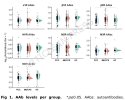
ME/CFS patients had significantly higher β2 adrenergic AAb titers than PCC and HCs (F₂,₁₈₆ = 3.15, p = 0.046). PCC patients showed more borderline/pathological M3 muscarinic AAb results compared to HCs.
β2 AAb levels correlated with increased autonomic symptoms in PCC (r = 0.27, p = 0.048) and sympathovagal imbalance in ME/CFS (r = 0.45, p = 0.001).
In ME/CFS, M1, M3, and M4 AAb titers positively correlated with verbal and working memory performance.
Distinct AAb profiles in PCC and ME/CFS suggest potential differences in immunological mechanisms.
β2 adrenergic receptor AAbs were associated with measures of autonomic dysfunction in PCC patients, and with sympathovagal parameters in ME/CFS patients.
Muscarinic AAbs were correlated with cognitive performance in ME/CFS, supporting a potential role of these autoantibodies in autonomic and cognitive dysfunction.
These findings support further investigation of AAbs as biomarkers and therapeutic targets.
Web | DOI | Scientific Reports
Azcue, N.; Prada, A.; Del Pino, R.; Acera, M.; Fernández-Valle, T.; Ayo-Mentxakatorre, N.; Pérez-Concha, T.; Murueta-Goyena, A.; Lafuente, J. V.; López de Munain, A.; Ruiz Irastorza, G.; Ribacoba, L.; Gabilondo, I.; Tijero-Merino, B.; Gómez-Esteban, J. C.
Abstract
Post-COVID condition (PCC) and Myalgic Encephalomyelitis/Chronic Fatigue Syndrome (ME/CFS) are chronic disorders marked by fatigue, autonomic dysfunction, and cognitive impairment.Autoantibodies (AAbs) targeting adrenergic and muscarinic receptors have been implicated in their pathophysiology.
This study aimed to investigate the association between these AAbs, autonomic nervous system (ANS) function, and cognitive performance in PCC and ME/CFS.
We included 96 PCC patients, 59 ME/CFS patients, and 36 healthy controls (HCs). Plasma AAbs against α1, β1, β2 adrenergic and M1–M4 muscarinic receptors were measured via ELISA.
ANS function was evaluated using COMPASS-31, Sudoscan, hemodynamic tests (deep breathing, Valsalva, tilt test), and heart rate variability.
Cognitive domains assessed included attention, fluency, processing speed, memory, visuoconstruction, perception, and executive functions.
ME/CFS patients had significantly higher β2 adrenergic AAb titers than PCC and HCs (F₂,₁₈₆ = 3.15, p = 0.046). PCC patients showed more borderline/pathological M3 muscarinic AAb results compared to HCs.
β2 AAb levels correlated with increased autonomic symptoms in PCC (r = 0.27, p = 0.048) and sympathovagal imbalance in ME/CFS (r = 0.45, p = 0.001).
In ME/CFS, M1, M3, and M4 AAb titers positively correlated with verbal and working memory performance.
Distinct AAb profiles in PCC and ME/CFS suggest potential differences in immunological mechanisms.
β2 adrenergic receptor AAbs were associated with measures of autonomic dysfunction in PCC patients, and with sympathovagal parameters in ME/CFS patients.
Muscarinic AAbs were correlated with cognitive performance in ME/CFS, supporting a potential role of these autoantibodies in autonomic and cognitive dysfunction.
These findings support further investigation of AAbs as biomarkers and therapeutic targets.
Web | DOI | Scientific Reports