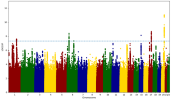
Preprint Initial findings from the DecodeME genome-wide association study of myalgic encephalomyelitis/chronic fatigue syndrome, 2025, DecodeMe Collaboration

That makes sense to me but is it accurate? Is there anything that anyone would correct or add?
Looks good to me. And the DecodeME team are well aware of these issues (and spell out the generic limitations of GWAS in the paper) - one reason the analysis took so long.

They have more analyses in the pipeline. I think fine mapping is one of these, like they did for the genetic signal for ME/CFS vs depression. This should further narrow down the candidate list of genes. I believe the summary statistics will allow other groups to do this kind of analysis too.
 
Last edited:
EDIT: these probably reflect artefacts that were excluded in the main analysis?

I'm looking at the DecodeME summary data, namely the file: gwas_1.regenie.gz taken from here: https://osf.io/rgqs3/files/osfstorage

When I arrange by lowest p-value however, I get 8320 rows with a p-value lower than 5 * 10^-8. Some go all the way up to 2.44^-62.
It looks like what we want is in the qced.var.gz file. It just has a list of SNPs, which I assume are those that passed QC. When I filter the main summary stats file (gwas_1.regenie.gz) to only include the SNPs in this list, then it looks like it matches the reported data:

Screenshot from 2025-08-09 08-00-27.png
 
It looks like what we want is in the qced.var.gz file. It just has a list of SNPs, which I assume are those that passed QC. When I filter the main summary stats file (gwas_1.regenie.gz) to only include the SNPs in this list, then it looks like it matches the reported data:
Oh yeah, I should have read the readme file first. It's got all the info that confirms that.
The shared summary statistics (*.regenie.gz) are the raw output from REGENIE v4.1. only filtered on the fly for minor allele frequency (MAF ≥ 0.01). Two additional files are provided, one listing the variants that passed QC (MAF ≥ 0.01, INFO ≥ 0.9 and dentist-like test) and the other one with the imputation quality (INFO score) of each variants. The published GWAS were QCed we therefore recommend user to keep only the QCed variants.

In all these files, the genomic positions reported are based on genome build GRCh38/hg38.

All GWAS fit the 20 first PCs and genetic sex. The latter is not use for the sex separate analysis.

Files descrtiption

Summary statisitc: *.regenie.gz
REGENIE (v4.1) output one file per phenotype containig one line per variant after a header line (description below). The output is a single gzipped file.

Column Description
CHROM Chromosomes
GENPOS Genomic positions GRCh38 (bp)
ID Variant IDs formated as chromosome: position:allele0:allele1
ALLELE0 Non effect alleles (reference)
ALLELE1 Effect alleles (alternate)
A1FREQ Effect allele frequencies
A1FREQ_CASES Effect allele frequencies in cases
A1FREQ_CONTROLS Effect allele frequencies in controls (not to be use as incorrect calculation in REGENIE v4.1)
N Number of samples tested
N_CASES Number of cases tested
N_CONTROLS Number of controls tested
TEST Test performed here additive “ADD”
BETA Estimated effect sizes (for allele 1)
SE Standard errors
CHISQ Chi-square test statistics
LOG10P −log10(p-value)
EXTRA specifies if Firth corrections failed

List of variants that passed QC: gwas_qced.var
gzipped file with one variant ID (chromosome: position: ref_allele:alt_allele) per line.

Imputation quality (INFO score) for all the variants: imputed.info.gz
gzipped tab-separeted file with one variant per line.
header: chromosome, position, reference allele, alternate allele, imputation variant ID, INFO score

@ME/CFS Science Blog you were wondering which SNPs were imputed. The imputed.info.gz file might have that.

Also, I noted the issue with the reported frequencies not making sense. The readme says not to use A1FREQ_CONTROLS because it is incorrect.
 
was anyone else besides me surprised that 86.1% of the cohort reported "muscle pain"? many years of following ME/CFS forums, webinars, conferences led me to believe the number would be much lower. I’m not saying this number is good or bad or inaccurate, just that it surprised me.
 
was anyone else besides me surprised that 86.1% of the cohort reported "muscle pain"? many years of following ME/CFS forums, webinars, conferences led me to believe the number would be much lower. I’m not saying this number is good or bad or inaccurate, just that it surprised me.
Same as me. Suprised as well. Perhaps a vestige of the “Myalgia” thing. (Ie. in biases as to whose active in the online “ME communities”)
 
was anyone else besides me surprised that 86.1% of the cohort reported "muscle pain"? many years of following ME/CFS forums, webinars, conferences led me to believe the number would be much lower. I’m not saying this number is good or bad or inaccurate, just that it surprised me.
Does not surprise me, it really seems like a big part of me/cfs. Its one of my most disabling symptoms.
 
I have aches, soreness, stiffness, tingling, twitching and various forms of ‘regular’ (sharp, burning, pulsing) pain in my muscles. I’d cross of on pain for everything but the tingling and twitching.
Same symptoms above. The only other pain I get is severe headaches, sinus facial pain, neck and also there is a localized area which happened when I got an infection when 20 years old that suddenly changed homeostasis permanently where I can experience severe pain but that last one happened before ME kicked in.
 
@ME/CFS Science Blog you were wondering which SNPs were imputed. The imputed.info.gz file might have that.
Thanks, and big thanks to the DecodeME team for uploading all this info!

This is all quite new to me so apologies for any errors or dumb questions. I think the INFO score give an indication if the imputation went well by comparing the variance of the dosage (expected number of alternative alleles) to the expected variance using the Hardy-Weinberg Equilibrium.

I would think that the genotyped SNPs are the ones with an INFO score of exactly 1 but there are only 408,031 of those in the dataset while the array (Thermo Fisher UKB AxiomTM array) should have around 820.000.

Anyone who has more experience with this who could help explain these things? Perhaps some of the measured SNPs had a INFO score slightly below 1? This all doesn't matter that much but curious to know how the actual procedure went.
 
I thought pain was really common.

I thought it was pretty much universal, at least in women. Not the pain of a torn muscle, or an overworked and stiff one the day after unaccustomed exercise—ever-present discomfort, and a characteristic burning after movement that I never experienced before ME/CFS. Enough to stop me sleeping at night, not enough to make me wish I had a physio handy for a deep tissue massage.

I think every woman I've known in person or chatted to in-depth online has talked about muscle pain. I wouldn't be surprised to hear it was less common in men, though, I've seen posts from several saying they'd never had an issue with it.
 
I thought it was pretty much universal, at least in women. Not the pain of a torn muscle, or an overworked and stiff one the day after unaccustomed exercise—ever-present discomfort, and a characteristic burning after movement that I never experienced before ME/CFS. Enough to stop me sleeping at night, not enough to make me wish I had a physio handy for a deep tissue massage.

I think every woman I've known in person or chatted to in-depth online has talked about muscle pain. I wouldn't be surprised to hear it was less common in men, though, I've seen posts from several saying they'd never had an issue with it.
Interesting. Because the only pain I get is rare but really sharp pain. Almost like a painful long lasting cramp. Occurs always in my right hamstring for some reason. (Same hamstring that got grafted for a knee surgery, maybe thats why, but the pain only started once I slipped into extremely severe). (am biologically male)
 
I thought it was pretty much universal, at least in women.

I think it's one of the many symptoms that doesn't affect everyone just like some pwME don't experience GI issues or a sore throat. I sometimes have muscle pain when I'm in PEM and it's usually in my neck/shoulders. At the beginning I thought I had slept in a weird position and didn't associate with ME/CFS.
 
Back
Top Bottom