Preprint Initial findings from the DecodeME genome-wide association study of myalgic encephalomyelitis/chronic fatigue syndrome, 2025, DecodeMe Collaboration

One thing that worries me is how differently different countries (let alone individual physicians) appear to be diagnosing ME/CFS, not least with the muddying of the water from the CFS label. This makes me wonder if it even can be replicated or if that of itself is too much of a confounder.

It makes me think getting to a diagnostic test is more important than first thought for future research reasons.
 
One thing that worries me is how differently different countries (let alone individual physicians) appear to be diagnosing ME/CFS, not least with the muddying of the water from the CFS label. This makes me wonder if it even can be replicated or if that of itself is too much of a confounder.

It makes me think getting to a diagnostic test is more important than first thought for future research reasons.
Until then our screening questionnaire made sure that our DNA donor participants met CCC and/or IOM criteria and is available to be used in any future research.
 
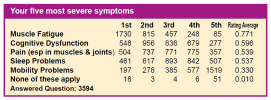
was anyone else besides me surprised that 86.1% of the cohort reported "muscle pain"? many years of following ME/CFS forums, webinars, conferences led me to believe the number would be much lower. I’m not saying this number is good or bad or inaccurate, just that it surprised me.
Interesting. This came out in 2023, and I was unsurprised then, and I don't think it drew any comment from PwME. I'm sure I've seen similarly high figures in other large patient surveys. Can anyone point to other large symptom surveys?

Assuming this is right, the surveys are more likely to be representative of the broader population than either forums or webinars (I think there are only 400-odd members here, for instance).

Pain is a major feature of my PEM. I had assumed it was for many (though I don't think I have see PEM-pain covered in surveys).
 
I would think that the genotyped SNPs are the ones with an INFO score of exactly 1 but there are only 408,031 of those in the dataset while the array (Thermo Fisher UKB AxiomTM array) should have around 820.000.
I know there was extensive QC, and your and @forestglip 's Manhattan plots showed how important they were (there would have been lots more exciting results without QC, no doubt lots of blind alleys). Maybe @Andy can comment?
 
A question I have is if there is any way to infer whether we are looking at one common pathological process or more from the GWAS data. A related question is if the risk from each risk variant stacks additively. If you have all 8 for instance would you just combine the increased risk from each other together in a linear way, or do they act together synergistically for example to increase risk even further?
 
One thing that worries me is how differently different countries (let alone individual physicians) appear to be diagnosing ME/CFS, not least with the muddying of the water from the CFS label. This makes me wonder if it even can be replicated or if that of itself is too much of a confounder.

It makes me think getting to a diagnostic test is more important than first thought for future research reasons.
I suspect that it has more to do with how ME/CFS is viewed in each country among healthcare professionals than case definitions.

In Italy nobody uses the ME label, and Fukuda criteria are used and my impression is that there's a lot less toxicity towards patients and the illness. It's widely neglected, more than in the UK it seems, but not widely psychologized, unlike in the UK.

In Italy there's probably very significant underdiagnosis of ME/CFS, and instead some of the patients are given a fibromyalgia diagnosis. Fibromyalgia seems to function as a "we don't know what's wrong and you have fatigue and pain" diagnosis.
 
ME/CFS research has been conducted since around 1990, and there have been clinical trials of treatments. None of them have convincingly shown a benefit. Finding a working treatment with this approach is difficult and could take a very long time.
I'd go one step further and assert, based on all the evidence I have seen spanning decades of such trials, that so-called pragmatic clinical trials of treatments are a completely useless method and should be banned entirely. It might be the most inefficient process ever put together by people who weren't pulling a prank or building a Rube Goldberg machine.

And I don't mean this just for ME/CFS. As a whole, applied to any sort of health condition, I haven't seen a single useful result out of this entire industry. Because there never has to be any plausible mechanisms, and since it's easier not to bother with that, no one does. In the very best case, the benefits are much smaller than even the least effective medication out there. The very best that this kind of trial methodology has yielded isn't even half as good as aspirin is as a pain-killer, and it's not even a good one at it.

In fact, until we find a significant theoretical clue, I don't think there should be any more clinical trials for ME/CFS or LC. They are a complete waste of time and resources, and have combined to do far more harm than good. The odds of finding something useful with those methods are about on the same order as randomly firing off a spaceship and hoping to find a habitable planet. It's beyond obvious that medical research is pointless until they know what to target, and that behavioral interventions are simply not a useful tool.
 
Thanks, and big thanks to the DecodeME team for uploading all this info!

This is all quite new to me so apologies for any errors or dumb questions. I think the INFO score give an indication if the imputation went well by comparing the variance of the dosage (expected number of alternative alleles) to the expected variance using the Hardy-Weinberg Equilibrium.

I would think that the genotyped SNPs are the ones with an INFO score of exactly 1 but there are only 408,031 of those in the dataset while the array (Thermo Fisher UKB AxiomTM array) should have around 820.000.

Anyone who has more experience with this who could help explain these things? Perhaps some of the measured SNPs had a INFO score slightly below 1? This all doesn't matter that much but curious to know how the actual procedure went.
Hi. There were lots of SNPs (approximately half) that were discarded in the initial QC steps (see Supplemental Methods). Then there were lots of SNPs that were imputed (>8 million), and we only look at those with INFO>0.9. So discard all those with INFO<0.9.
 
So, it's a bit puzzling. I'm assuming the sex chromosome results weren't prioritised for inclusion in the initial preprint for a strategic reason. I'm not sure what the reason is. @Andy, Simon M?
I suspect it is it's practical rather than strategic. I believe sex chromosomes have to be analysed separately in all GWAS . So it makes sense to do all the autodomed (non--sex chromosomes) first.

The wind we also have six chromosome data – which is one of the things they flagged up – we'll have a better understanding of why there is such a big sex difference in diagnosed cases of ME/CFS.
 
Interesting. This came out in 2023, and I was unsurprised then, and I don't think it drew any comment from PwME. I'm sure I've seen similarly high figures in other large patient surveys. Can anyone point to other large symptom surveys?

Assuming this is right, the surveys are more likely to be representative of the broader population than either forums or webinars (I think there are only 400-odd members here, for instance).

Pain is a major feature of my PEM. I had assumed it was for many (though I don't think I have see PEM-pain covered in surveys).
This is from the MEA's 2010 survey:
1754934437372.png
 
I saw that the rate of muscle pain was mentioned (presumably because it was the highest) but didn't find data on the other pain questions (for example the 2 joint pain questions). Presumably this will still follow at some point in time or the data can be requested, but having this data at some point would probably be nice. There's some additional data in the previous study (Typing myalgic encephalomyelitis by infection at onset: A DecodeME study), but I find it a little bit harder to make out what the pain data exactly means.

(My layman impression is that joint pain is more common in the general population than muscle pain, especially when people get older, so having some idea how "ME/CFS specific" things are, would be nice).
 
this variation highlights what biological aspects need changing via drugs. And these drugs can be made to alter biology to a far, far greater extent than the genes can.
(This as the answer to the question about how can small genetic differences between cases controls produce valuable information )

Is it also true that somebody who doesn't have a relevant genetic difference in a particular gene can benefit from any such drug targeting the biology behind the gene?

In other words, can information from genetic study help all those people with the illness who don't have relevant genetic differences?
 
In an interview with David Tuller, Ponting also said something interesting (starting at minute 21:23):
Ponting: What we are doing is asking the question whether the associations we are seeing are equivalent to what others have seen for other diseases. And thus far the ME ones seem to be specific to ME and not to any other traits or disease aside from this one on chronic pain.

Tuller: And that means what?

Ponting: It means that the ME genetic signals are not equivalent to any… arthritis, Parkinson’s, Alzheimer’s, depression, anxiety, none of those and more.
All I can tell you is this from the FAQs.

"Are these findings unique to ME or have they been found in other illnesses?

The signals we have found are different from those found in other illnesses to date, except for the one on chromosome 17 that was previously found in people experiencing chronic pain."

This is interesting. But I don't see the preprint talk about the data source for looking for shared intervals with all these other assorted traits like Parkinson's and arthritis. Only depression, pain, and anxiety. @Chris Ponting, is it that all traits in the UK BioBank were checked for similar significant intervals?
 
In other words, can information from genetic study help all those people with the illness who don't have relevant genetic differences?
I've been trying to understand this through a made-up analogy. Thought I might share it to see if it holds and if others find it useful or not.

Suppose an illness is caused by a structure somewhere in the body that lets cells through that it should hold back, like a dam that is breaking. There is one gene X that helps to create a simple protein that acts as one of many support structures in the dam.

One variant of the gene creates a slightly stronger protein than the other variant to support the dam. The difference between the two proteins is minor and this protein is only a minuscule part of what holds the dam. There are many other mechanisms involved in the strength of the dam that involves feedback loops and complex interactions. These are much more important but gene X is simple and straightforward. It only has one job.

In GWAS of the illness, gene X might show up with a very small effect size. The others don't show up because the mechanisms are too complex and intertwined or there is a signal but it's ambiguous and hard to interpret. Luckily gene X points to the problem: the dam is breaking! And luckily scientists know a lot of biology so that they can do much more to support the dam than gene X could by coding its protein. They can create drugs that ensure the dam no longer breaks.

So in this analogy, the dam might be breaking even in those with the stronger protein from gene X. And fixing the dam might cause physiological changes and benefits that are out of proportion to the effect size of gene X.

Now I only hope that real life works like this as well!
 
Exactly @ME/CFS Science Blog. Any of a hundred genes can lead us to a treatment strategy that is not dependent on any of them. Ritux for RA works whether or not you have DR4, but DR4 pointed us to it.

Everyone has a DR gene of course. And it is involved in the whole scenario that provides the causation. And all genes do to a degree, for all diseases, but the critical step that flips into RA does not need the DR4 version.

These gene variants are just clues to a testable theory. Just as the pump was the clue to all cholera, even where there are no pumps.
 
I guess the caveat is that MECFS might be two similar looking diseases like DR4 encouraged arthritis and B27 encouraged arthritis. Ritux is no good for the latter. But it was knowing about both genes' significance that allowed us to develop treatments for both when the technology came along. We knew not to give up on anti-IL17 just because it didn't work for RA.
 
Back
Top Bottom