High-throughput discovery of MHC class I- and II-restricted T cell epitopes using synthetic cellular circuits, Kohlgruber et al 2024

Murph

Senior Member (Voting Rights)
Published: 02 July 2024

High-throughput discovery of MHC class I- and II-restricted T cell epitopes using synthetic cellular circuits​


Nature Biotechnology volume 43, pages 623–634 (2025)Cite this article

Abstract​

Antigen discovery technologies have largely focused on major histocompatibility complex (MHC) class I-restricted human T cell receptors (TCRs), leaving methods for MHC class II-restricted and mouse TCR reactivities relatively undeveloped.

Here we present TCR mapping of antigenic peptides (TCR-MAP), an antigen discovery method that uses a synthetic TCR-stimulated circuit in immortalized T cells to activate sortase-mediated tagging of engineered antigen-presenting cells (APCs) expressing processed peptides on MHCs. Live, tagged APCs can be directly purified for deconvolution by sequencing, enabling TCRs with unknown specificity to be queried against barcoded peptide libraries in a pooled screening context.

TCR-MAP accurately captures self-reactivities or viral reactivities with high throughput and sensitivity for both MHC class I-restricted and class II-restricted TCRs. We elucidate problematic cross-reactivities of clinical TCRs targeting the cancer/testis melanoma-associated antigen A3 and discover targets of myocarditis-inciting autoreactive T cells in mice. TCR-MAP has the potential to accelerate T cell antigen discovery efforts in the context of cancer, infectious disease and autoimmunity.
 
I'm sharing this paper because this researcher, Ayano Kohlgruber, has been given a solveME grant (https://solvecfs.org/february-2026-catalyst-awards/) to use this technique in me/cfs.

recent webinar explains the technique:


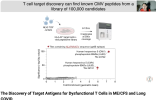
relevant screenshot:

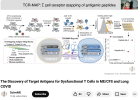
The next screenshot gives an example of how their technique works, it finds what it is the clonally expanded t-cells are after.

This is a new technology which I'm sure will take more time and money to produce results than they think, and may throw some false positives too. But the brand of skepticism that places all its weight on the scale marked hopelessness and doubt is, in my view, as ignorant as optimism that places all its weight on the scale marked "certainty". I think this has a possibility of teaching us something and I am pleased they are pursuing it.

IN particular it could be very powerful for subsetting patients. What if two patients with similar symptom profiles have very different t-cell receptor repertoires, one targeting self, and another targeting a virus. They could have very different responses to the same treatment.
 
Last edited:
Worth pointing out that @Chris Ponting and Josh Dibble had a look at t-cell receptors quite recently using bulk sequencing and their data did not show a difference.

Comparison of T-cell receptor diversity of people with myalgic encephalomyelitis versus controls​

BMC Res Notes, 2024 Jan 4;17(1):17. doi: 10.1186/s13104-023-06616-4.

Joshua J Dibble , Ben Ferneyhough <, Matthew Roddis , Sam Millington , Michael D Fischer Nick J Parkinson , Chris P Ponting

Abstract

Objective: Myalgic Encephalomyelitis (ME; sometimes referred to as Chronic Fatigue Syndrome) is a chronic disease without laboratory test, detailed aetiological understanding or effective therapy. Its symptoms are diverse, but it is distinguished from other fatiguing illnesses by the experience of post-exertional malaise, the worsening of symptoms even after minor physical or mental exertion. Its frequent onset after infection suggests autoimmune involvement or that it arises from abnormal T-cell activation.


Results: To test this hypothesis, we sequenced the genomic loci of α/δ, β and γ T-cell receptors (TCR) from 40 human blood samples from each of four groups: severely affected people with ME; mildly or moderately affected people with ME; people diagnosed with Multiple Sclerosis, as disease controls; and, healthy controls. Seeking to automatically classify these individuals' samples by their TCR repertoires, we applied P-SVM, a machine learning method. However, despite working well on a simulated data set, this approach did not allow statistically significant partitioning of samples into the four subgroups. Our findings do not support the hypothesis that blood samples from people with ME frequently contain altered T-cell receptor diversity.

I believe, and I'd be interested in Ponting's view here, that the technology being used by Kohlgruber's team offers sharper resolution. It seems to have grown out of (or been accelerated by) some cancer research where they engineer t-cells to chase down tumours ( https://pmc.ncbi.nlm.nih.gov/articles/PMC11667231/) and as we know, cancer has money to invent all sorts of amazing technology. When we get some benefit from it, that's good news.
 
IN particular it could be very powerful for subsetting patients. What if two patients with similar symptom profiles have very different t-cell receptor repertoires, one targeting self, and another targeting a virus. They could have very different responses to the same treatment.

I think it is interesting to see people using new techniques for identifying T cell repertoires. My reservation is that over the years this sort of study has yielded very little in diseases where we have much clearer evidence of T cell misbehaviour. And there are reasons for thinking that looking at repertoires in blood may not be as easy to interpret as every one assumes. The history is of groups putting out claims of finding special repertoires and then either never publishing substantive results or nobody being able to replicate (as for the Davis data).

I also think that the idea that you can be sure that a T cell with a certain receptor is directed against self or virus is simplistic. Any individual T cell receptor will engage a spectrum of peptides with varying affinity. The chances of finding one 'repertoire targeting self' and another 'targeting a virus' are zero I think.

If it was easy we ought to have detailed data on T cell repertoires in Long Covid and Covid recovered cases by now, surely? It would be a no-brainer to do that, not something using as yet untried technology six years down the line?
 
Worth pointing out that @Chris Ponting and Josh Dibble had a look at t-cell receptors quite recently using bulk sequencing and their data did not show a difference.


I believe, and I'd be interested in Ponting's view here, that the technology being used by Kohlgruber's team offers sharper resolution. It seems to have grown out of (or been accelerated by) some cancer research where they engineer t-cells to chase down tumours ( https://pmc.ncbi.nlm.nih.gov/articles/PMC11667231/) and as we know, cancer has money to invent all sorts of amazing technology. When we get some benefit from it, that's good news.
Thanks @Murph. Yes, our previous approach was likely underpowered, and we said this. Their approach can discover what (self-)antigens bind what T-cell receptors, which is perfect for chasing down why some T cell receptor clones are expanded in some people (e.g. pwME) versus others. Finding a "public" T cell receptor repertoire that distinguishes pwME vs others would be great because it might indicate what pathogen (or self-antigen) has triggered their immune systems. But it might not shed any light whatsoever on what causes the later chronic symptoms of ME/CFS. To me, the bigger question is whether there's hard-and-fast evidence for autoimmunity as a cause of ME/CFS, and thus far, I've not been convinced there is but others might/will disagree.
 

That site overview looks a bit preliminary in terms of knowing the drug really does the job intended.
Most kinase inhibitors have to be taken repeatedly and can have a lot of unwanted effects. A single shot of Campath might be better proof of concept for ongoing T cell involvement. I am not sure, but kinase inhibitors in inflammatory disease have ended up with mixed ratings.
 
Probably a dumb question, because most of this is over my head, so take it easy on me. But thinking along the lines of Professor Edwards' post above, what if things aren't so straightforward.

For instance, what if the (or an) issue was failure of antigen-specific t-cells to adequately expand? And maybe other parts of the immune system are "overactive" as a compensation attempt? (this might make no sense biologically, I was just trying to come up with a hypothetical)

Maybe down the road the utility will be in subsetting as @Murph suggested.
 
Back
Top Bottom