Health outcomes of patients in the Complex Chronic Diseases Program, 2025, Meagher, Nacul, et al.

It's shocking to see such trauma nonsense being wheeled out again when there's no good evidence for it.

I just looked back at the data quoted here:
Patients reported no significant improvement in pain, sleep or fatigue over time.

View attachment 21937
The so called significant improvements are based on less than one third of the starting group. So the fact that most people dropped out is ignored, making the conclusions nonsense.
 
Actually, just reading that last comment of mine, what this study shows is that the whole package of those alternative therapies are not worth anything much. And therefore, neither are the individual therapies. If mindfulness or acupressure or naturopathy and whatever else the clinic has been offering made any significant difference, this clinic would not be finding that people reported no significant changes in symptoms.

In fact, it's quite possible that there is some harm being done, which is not being measured, because people who think they are being harmed by a clinic don't tend to stick around to fill out surveys at discharge.

Of course it could be argued that this poor result proves that pacing doesn't help either. I'd argue that
1. This clinic does not seem to be offering very good advice, even on pacing, making it overly complicated and essentially pacing up, and
2. Probably most of the people attending the clinic had already worked out much of their pacing strategy before they came to the clinic. It comes naturally - you do stuff, you get clobbered by PEM, eventually you learn to do a bit less and do it a bit differently, and

So, it is evidence that providing (poor) advice on pacing at the time when people eventually get to a specialist clinic is not helpful, but it is not evidence that an adaption to the constraints imposed by ME/CFS is not helpful.


I think this paper is incredibly important. It is essentially the result of a long experiment. It blows the whole idea of a 'multi-disciplinary clinic' out of the water. The package this clinic offered is similar to what is promoted by Peter Gladwell and what the MEA seems to be totally on board with. @Russell Fleming, @sarahtyson - you need to look carefully at the paper. AfME too, and the people working on the new Australian guideline @Simone. Specialist clinics where all sorts of woo is allowed to run free and that don't have a really clear focus on research are a waste of everyone's time, funds, hope and effort.

If Luis Nacul does genuinely care about people with ME/CFS, he will now make it abundantly clear around the world that this model does not work, and that it slows progress towards a better understanding of the illness. I don't know if anyone here knows him? If so, perhaps he could be encouraged to now make a positive difference? He is in a unique position to do so.
I take the points of criticism made.

I do know Dr Nacul as does Jo Edwards who gave a reasoned explanation as to why this situation and outcome resulted.

I know the Canadian Government cut the funding for Long Covid clinics some while go. Just like here in the UK.

It's telling that Luis in effect 'came home' last year.

It may have been because others from within, were pulling strings in the wrong direction?
Plus, there was a distinct possibility, from 2022 that Suffolk ICB may have been 'persuaded' by us, to agree a co produced 'best fit' Service Spec and Model, NICE compliant, to meet needs particularly the severely affected.
The NICE GRIP steer, was never going to be agreed to by NHS England!

So we made our service design and spec the best it could be in dire circumstances, behind the scenes shenanigans, helped by national charity paid staffers from summer 2024 - a disgrace IMHO.

But, we did out manoeuvre all the opposition, even whilst being excluded from direct involvement.
Whether the new service will realise expectations is still to be seen.......

Time will tell!

My husband now referred has his first Contact next week....
He has a really complex presentation currently, with co existing conditions and treatments, and comorbidity, so we will see!
 
Last edited:
I do know Dr Nacul as does Jo Edwards who gave a reasoned explanation as to why this situation and outcome resulted.
You mean that @Jonathan Edwards has explained why this clinic needed to promote a buffet of therapies that both unevidenced and unsupported by logic that includes symptom contingent Graded Activity Therapy using a mechanism of 10% increases? I haven't seen anything from anyone that explains why what happened at the Complex Chronic Diseases Program had to happen.

I have no doubt that there are all sorts of pressures on a 'complex chronic diseases clinic' to offer all sorts of problematic therapies. But the CEO surely has the choice to lead or to resign? They have the choice to not mention therapies like acupressure as a good thing in promotional talks or to mention them. They have the choice to only offer therapies like aripiprazole if they are part of a good quality trial. They have the choice to focus on research and careful diagnosis or to focus on alternative therapies.

Reduced funding is not a reason to offer a service full of therapies that have no reason to work - it's another reason not to.

I don't know Dr Nacul personally and perhaps I would feel differently if I did. But, from a distance, the evidence strongly suggests that Dr Nacul supports a type of clinic that is uncomfortably close to the type of clinic most of us here do not want.

We have been caught out many times before by being thankful when kind doctors step up to care for people with ME/CFS. But meaning well is not enough.

Time will tell!
Indeed, and I really hope the new service is a success. I just think we should all be very aware of what has happened before and try to avoid repeating past mistakes.

(Best wishes to your husband Suffolkres.)
 
A post elsewhere on the forum includes tributes to Dr Nacul for his contribution upon his departure from the BC clinic. One comment on social media is this:

I wish I could have had the opportunity to receive his help. I have been on the waiting list for the Complex Care Clinic in Vancouver for a year for evaluation for ME/CFS and still 1 1/2 years to do to receive an appointment. I feel so let down by our Government who don't seem to be able to provide needed Health Care to much of BC population.

To me, that underlines the need to get people with suspected ME/CFS seen early for careful diagnosis and provision of timely advice. A situation where people are waiting years and then, when they finally get to the clinic, get offered advice on graded activity therapy and acupressure is surely far from what we would see as a model clinic?

The funds spent on offering mindfulness therapy and whatever 'Beneath the surface' therapy is could have instead been used to increase the capacity to provide, at the very least, a competent and timely doctor-led diagnostic service.
 
But the CEO surely has the choice to lead or to resign?
He is no longer at that clinic. So maybe he tried and ended up resigning because it wasn’t possible?

I agree that the practice there is unacceptable, and I still hold the people involved responsible, but I also think that formal and informal power structures might make it very difficult for someone to change what’s being done.

The idealist in me thinks that not banning the harmful treatments from day one isn’t good enough. But reality might make that impossible to achieve.
 
He is no longer at that clinic. So maybe he tried and ended up resigning because it wasn’t possible?
Luis Nacul joined the clinic in 2019, left in 2025 and the pandemic was no doubt a complication. Of course you can't turn around a ship overnight. And I can imagine that there are trustees and other influential people who could make change very difficult.

But, the 'fact sheet' on returning to exercise that promotes a graded activity strategy, with all of the nonsense about Mary walking 10 minutes one day and 11 minutes the next is still there. Another example, there's an LDA fact sheet that says:
We do not know how long it takes for LDA to work in people with ME/CFS. In a small study, 74% of people with ME/CFS noticed improved symptoms and continued to take LDA for less than 1 month up to 17 months.

Do we know anything about who is now leading the clinic? I think we need to know who and what was responsible for the clinic not being better, in order to have any hope of improving things.
 
Last edited:
I think we need to know who and what was responsible for the clinic not being better, in order to have any hope of improving things.
That will never be publicly known unless Nacul decides to tell his version publicly. Which won’t happen anytime soon.

I understand and agree with your reservations, but I also suspect that a CEO might not have much influence over what people do in their day to day in a medical clinic. We’ve seen how stubborn these people can be.
 
That will never be publicly known unless Nacul decides to tell his version publicly.
Yes, it's probably not possible for Luis Nacul to say what happened, at least right now. But, there are other people involved. There must be trustees, there are staff, there certainly are patients who will have seen things. Surely some of those can't be happy about the buffet of useless therapies offered?

If a CEO widely regarded as caring and sensible and knowledgeable about ME/CFS can't stop bad information appearing on their organisation's website, then there is something seriously wrong. It's hard to see the BC Complex Chronic Diseases Program getting better any time soon unless people do start calling out what happens there.

We have a thread calling for patients and patient advocates to get things right. But, it's even more important that the clinics get things right.


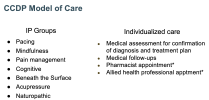
I've mentioned elsewhere that Luis Nacul made a presentation in 2023. This is one of the slides, presenting the BC clinic as a model of care. The presentation promotes acupressure, naturopathic therapy, LDN and LDA among other things, and presents data supposedly showing that the approach is having good outcomes. If Luis has moved on from these views, it would be great if he can demonstrate that by offering a fundamentally different sort of clinic in Suffolk.

Screenshot 2026-02-09 at 10.25.48 AM.png
 
Well... job prospects in the countries with public healthcare...

In a way, the Canadian service catered to the patients with a range of different views and beliefs about the illness and recovery. Some patients are quite hopeful about acupuncture, mindfulness, etc., some like to experiment with pharmacological options. So I'm not surprised that there was not a group of dissatisfied patients feeling well enough to complain about it. In the eyes of many, that was probably better than just being followed up once or twice a year with no new input from the staff.

I'm curious if he'll be offering off-label prescriptions in Suffolk.
 
Yes, it's probably not possible for Luis Nacul to say what happened, at least right now. But, there are other people involved. There must be trustees, there are staff, there certainly are patients who will have seen things. Surely some of those can't be happy about the buffet of useless therapies offered?
They will be restricted by the same mechanisms.
If a CEO widely regarded as caring and sensible and knowledgeable about ME/CFS can't stop bad information appearing on their organisation's website, then there is something seriously wrong.
Yes, but we already knew that.
It's hard to see the BC Complex Chronic Diseases Program getting better any time soon unless people do start calling out what happens there.
Agreed.
I've mentioned elsewhere that Luis Nacul made a presentation in 2023. This is one of the slides, presenting the BC clinic as a model of care. The presentation promotes acupressure, naturopathic therapy, LDN and LDA among other things, and presents data supposedly showing that the approach is having good outcomes. If Luis has moved on from these views, it would be great if he can demonstrate that by offering a fundamentally different sort of clinic in Suffolk.
I agree that the presentation doesn’t reflect well on Nacul. But there might be mitigating factors, e.g. that this is the company line that had to be presented. Or Nacul might have learned something since then.
 
Well... job prospects in the countries with public healthcare...

In a way, the Canadian service catered to the patients with a range of different views and beliefs about the illness and recovery. Some patients are quite hopeful about acupuncture, mindfulness, etc., some like to experiment with pharmacological options. So I'm not surprised that there was not a group of dissatisfied patients feeling well enough to complain about it. In the eyes of many, that was probably better than just being followed up once or twice a year with no new input from the staff.

I'm curious if he'll be offering off-label prescriptions in Suffolk.
If I recall, only standard medication can be recommended by Specialist Service, as a non prescribing service- but the patient's GP would have to facilitate that.
 
Judging by the outcome measures and dropout rates, the whole 'treatment' part of the program looks like an enormous waste of money. Patients would have been as well or better off getting diagnosis, meds for symptoms where possible and general management advice which could all be done in a single doctor consultation plus a few leaflets.

I find the claims of benefits in mental health and overall health in the abstract dishonest, given that only about a quarter of the participants completed the end of program questionnaires. It's possible the whole cohort got worse, but only those with milder symptoms stayed to tne end. I'm surprised it go past peer review.

I don't know Nacul's role in the clinic. He's only listed as a researcher in the list of authors, not as the manager of the program. If he joined the program after it was already eastablished he may have had little or no say on what other clinicians were doing.
 
Back
Top