Genome-wide association study of major anxiety disorders in [Europeans] identifies 58 loci and highlights GABAergic signaling, 2026, Strom+

SNT Gatchaman

Senior Member (Voting Rights)
Staff member
Genome-wide association study of major anxiety disorders in 122,341 European-ancestry cases identifies 58 loci and highlights GABAergic signaling
Strom, Nora I; Verhulst, Brad; Bacanu, Silviu-Alin; Cheesman, Rosa; Purves, Kirstin L; Gedik, Hüseyin; Mitchell, Brittany L; Kwong, Alex S; Faucon, Annika B; Singh, Kritika; Medland, Sarah; Colodro-Conde, Lucia; Krebs, Kristi; Hoffmann, Per; Herms, Stefan; Gehlen, Jan; Ripke, Stephan; Awasthi, Swapnil; Palviainen, Teemu; Tasanko, Elisa M; Peterson, Roseann E; Adkins, Daniel E; Shabalin, Andrey A; Adams, Mark J; Iveson, Matthew H; Campbell, Archie; Thomas, Laurent F; Winsvold, Bendik S; Drange, Ole Kristian; Børte, Sigrid; ter Kuile, Abigail R; Naamanka, Joonas; Nguyen, Tan-Hoang; Meier, Sandra M; Corfield, Elizabeth C; Hannigan, Laurie; Levey, Daniel F; Czamara, Darina; Weber, Heike; Choi, Karmel W; Pistis, Giorgio; Couvy-Duchesne, Baptiste; Van der Auwera, Sandra; Teumer, Alexander; Karlsson, Robert; Garcia-Argibay, Miguel; Lee, Donghyung; Wang, Rujia; Bjerkeset, Ottar; Stordal, Eystein; Bäckman, Julia; Salum, Giovanni A; Zai, Clement C; Kennedy, James L; Zai, Gwyneth; Tiwari, Arun K; Heilmann-Heimbach, Stefanie; Schmidt, Börge; Kaprio, Jaakko; Kennedy, Martin M; Boden, Joseph; Havdahl, Alexandra; Middeldorp, Christel M; Lopes, Fabiana L; Akula, Nirmala; McMahon, Francis J; Binder, Elisabeth B; Fehm, Lydia; Ströhle, Andreas; Castelao, Enrique; Tiemeier, Henning; Stein, Dan J; Whiteman, David; Olsen, Catherine; Fuller, Zachary; Wang, Xin; Wray, Naomi R; Byrne, Enda M; Lewis, Glyn; Timpson, Nicholas J; Davis, Lea K; Hickie, Ian B; Gillespie, Nathan A; Milani, Lili; Schumacher, Johannes; Woldbye, David P; Forstner, Andreas J; Nöthen, Markus M; Hovatta, Iiris; Horwood, John; Copeland, William E; Maes, Hermine H; McIntosh, Andrew M; Andreassen, Ole A; Zwart, John-Anker; Mors, Ole; Børglum, Anders D; Mortensen, Preben B; Ask, Helga; Reichborn-Kjennerud, Ted; Najman, Jackob M; Stein, Murray B; Gelernter, Joel; Milaneschi, Yuri; Penninx, Brenda W; Boomsma, Dorret I; Maron, Eduard; Erhardt-Lehmann, Angelika; Rück, Christian; Kircher, Tilo T; Melzig, Christiane A; Alpers, Georg W; Arolt, Volker; Domschke, Katharina; Smoller, Jordan W; Preisig, Martin; Martin, Nicholas G; Lupton, Michelle K; Luik, Annemarie I; Reif, Andreas; Grabe, Hans J; Larsson, Henrik; Magnusson, Patrik K; Oldehinkel, Albertine J; Hartman, Catharina A; Breen, Gerome; Docherty, Anna R; Coon, Hilary; Conrad, Rupert; Lehto, Kelli; Deckert, Jürgen; Eley, Thalia C; Mattheisen, Manuel; Hettema, John M

The major anxiety disorders (ANX; including generalized anxiety disorder, panic disorder and phobias) are highly prevalent, often onset early and cause substantial global disability. Although distinct in their clinical presentations, they probably represent differential expressions of a dysregulated threat–response system.

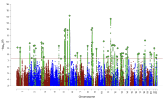
Here, we present a genome-wide association meta-analysis comprising 122,341 European ancestry ANX cases and 729,881 controls. We identified 58 independent genome-wide significant risk variants and 66 genes with robust biological support. In an independent sample of 1,175,012 self-report ANX cases and 1,956,379 controls, 51 out of the 58 associations replicated.

As predicted by twin studies, we found substantial genetic correlation between ANX and depression, neuroticism and other internalizing phenotypes. Follow-up analyses demonstrated enrichment in all major brain regions and highlighted GABAergic signaling as one potential mechanism implicated in ANX genetic risk.

These results advance our understanding of the genetic architecture of ANX and prioritize genes for functional follow-up studies.

Web | DOI | PDF | Nature Genetics | Open Access
 
Intriguing. I see nothing in common with ME/CFS except, would you believe it:

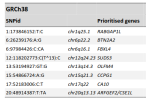
BTN2A2 and related genes. I wonder if the locus is matched?
This hit is actually right in an intronic region of BNT3A2. Much closer to the BNTs than any of the DecodeME SNPs

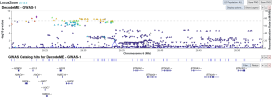
The plot below is DecodeME results, centered around the SNP from this study (chr6:26,365,679). It would be right above the second "o" where it says "Chromosome 6 (Mb)"

1770499275114.png
 
centered around the SNP from this study (chr6:26,365,679)
chr6:26365451:T:G.
Both technically right, but just to prevent confusion, the position given by jnmaciuch and in the anxiety paper, is using GRCh37 assembly coordinates, while the one I gave is in GRCh38 coordinates, which is the assembly used by the DecodeME summary stats and LocusZoom above.

(Though it's close enough that jnmaciuch is referring to pretty much the same region in the plot.)
 
Both technically right, but just to prevent confusion, the position given by jnmaciuch and in the anxiety paper, is using GRCh37 assembly coordinates, while the one I gave is in GRCh38 coordinates, which is the assembly used by the DecodeME summary stats and LocusZoom above.

(Though it's close enough that jnmaciuch is referring to pretty much the same region in the plot.)
Thanks for catching that
 
NEGR1 was noted in Temporal dynamics of the plasma proteomic landscape reveals maladaptation in ME/CFS following exertion (2025) —

Following the first CPET, at D1POST, a broader molecular response was evident. A total of 33 proteins were associated with VO₂max1, 23 of which were exclusive to this timepoint. These included proteins involved in cellular signaling and neuroregulatory processes (ANXA8, ART3, NCBP2, NEGR1, TMEM132A), glucose metabolism (FBP2), and muscle physiology (TMOD4).
 
including generalized anxiety disorder, panic disorder and phobias
This seems like a pretty wide net. I never thought about phobias as being related to anxiety, they seem entirely different things to me, but I have no real experience with either so there's that. Feels like a lost opportunity to try and do a lump thing. GAD is very problematic all on its own.

They mention having done subgroup analyses and finding "moderate to high" correlations, but left the details in supplementary material.
 
This seems like a pretty wide net. I never thought about phobias as being related to anxiety, they seem entirely different things to me, but I have no real experience with either so there's that. Feels like a lost opportunity to try and do a lump thing. GAD is very problematic all on its own.

They mention having done subgroup analyses and finding "moderate to high" correlations, but left the details in supplementary material.
Large sample size is very important in GWAS, and that was their rationale for combining. Even though they're not the same disorders, I think it's reasonable to suspect that they may have some factors in common, which a shared GWAS would uncover. Another benefit is that any such findings would apply to a much larger group of individuals, so would potentially help more people more quickly.
To maximize sample size and power, we assigned the composite Any Anxiety case status if a participant had at least one of five core adult ANX across their lifetime: GAD, panic disorder, social phobia, agoraphobia or specific phobias. This amounts to identifying common genetic effects shared across these disorders.

And they did find many associations, so it seems there are likely shared genetic traits among the disorders.
 
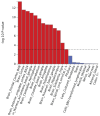
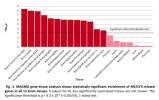
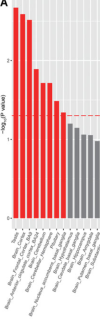
Interestingly, the top four significantly enriched tissues based on MAGMA are the same four tissues as DecodeME, in the same order:
Frontal Cortex, Cortex, Anterior Cingulate Cortex BA24, Nucleus Accumbens.

1770505694322.png

Supplementary Figure 89: MAGMA tissue expression analysis to test tissue enrichment of 53 specific tissue types for ANX genes (derived
from the main ANX GWAS meta-analsis (Ncases = 122,341, Ncontrols = 729,881)).

From DecodeMe:
1755126187821.png

Edit: Looking at the MAGMA plots I previously compiled from several other GWAS, none of the other conditions seem to match this pattern. The closest is another GWAS of anxiety, which appears to be a USA cohort, while the thread's study is European [Edit: or at least European ancestry]. Here are the significant tissues from that study, starting from most significant: Testis, Cortex, Frontal Cortex, Anterior Cingulate Cortex BA24, Cerebellum, Cerebellar Hemisphere, Pituitary, Nucleus Accumbens.

Transcriptome-Wide Association Study Provides Insights Into the Genetic Component of Gene Expression in Anxiety (2021, Frontiers in Genetics)
 
Last edited:
Are the NEGR1 hits coinciding, can we tell?

What I like about the BTN one is that it seems to indicate that this is not just some fluff picked up as an artefact of cohort selection for GWAS studies or diagnostic overspill because it is a different locus. NEGR1 looks like the sort of gene that might be picked up fluff but maybe it's a different locus again?
 
I never thought about phobias as being related to anxiety, they seem entirely different things to me, but I have no real experience with either so there's that.
I don't have phobias but I do have OCD and I was in my 30s before I realised that OCD was a form and manifestation of anxiety. It had never really clicked before. It certainly makes sense to me that phobias are included under the banner of anxiety. Like OCD, phobias are essentially underpinned by an (irrational) sense of fear about bad things happening.
 
Fascinating. We need a BTN geneticist to pick this apart if there is such a person. Otherwise you people seem to be doing a pretty good job. Clearly different hits but why does this area come up in two seemingly very different conditions?
Google sayeth this:
From the main BTN2A2 thread- seems there might be some at Cambridge uni?
 
We need a BTN geneticist to pick this apart if there is such a person. Otherwise you people seem to be doing a pretty good job. Clearly different hits but why does this area come up in two seemingly very different conditions?

BTN3A2 has also been associated with schizophrenia in this study that concluded:

"Findings
We identified BTN3A2 as a potential risk gene for schizophrenia. The mRNA expression and methylation data showed that BTN3A2 expression in human brain is highest post-natally. Further electrophysiological analyses of rat hippocampal slices showed that BTN3A2 overexpression specifically suppressed the excitatory synaptic activity onto CA1 pyramidal neurons, most likely through its interaction with the presynaptic adhesion molecule neurexins.​
Interpretation
Increased expression of BTN3A2 might confer risk for schizophrenia by altering excitatory synaptic function. Our result constitutes a paradigm for distilling risk gene using an integrative analysis and functional characterization in the post-GWAS era."​
And it came up in this study on plasma proteins and brain disorders, that also used mendelian randomization (MR):

"Among the nine proteins with significant MR associations, BTN3A2, a member of the immunoglobulin superfamily playing a role in T-cell responses within the adaptive immune response, exhibited a broad association with AD, anxiety, attention deficit hyperactivity disorder (ADHD), BP, MDD, and SCZ. This finding is supported by prior evidence that the genetic variants of BTN3A2 showed pleiotropic effects on SCZ, BP, and MDD49, as well as that increased expression of BTN3A2 might confer risk for SCZ by altering excitatory synaptic function50. The findings of the present study extend knowledge of the role of BTN3A2 to a broader range of disorders. On the contrary, we found that BTN2A1 was associated with decreased risk of AD, anxiety, and SCZ, which is consistent with a report that BTN2A1 is involved in the immunomodulation of the activity of γδ T-cells and has significant anti-neuroinflammatory and neuroprotective effects51. Although BTN3A2 and BTN2A1 are known to interact."​
 
why does this area come up in two seemingly very different conditions?
As someone who had depression and intense 'anxiety' (DPDR, panic attacks, akathesia) since late teens, I see a lot of people on the long covid subreddit who have my pre full ME onset symptoms after a covid infection (including horrendous hangovers after drinking alcohol and cannabis intolerance), some of whom go on to develop PEM from later infections. Perhaps some forms of anxiety/depression are a prodrome of MECFS, or make you more likely to get it.

Edit: You also see people develop these intense 'anxiety' symptoms at MECFS onset - my partner didn't really understand my panic episodes until she got them herself after she got ME.
 
Last edited:
Back
Top Bottom