Genetics: Chromosome 6 BTN2A2 and BTN3A3 (BTN2A1)

Could you explain why I get the following associations in STRING :
I am particularly interested for the relations of MFGE8 (Milk Fat Globule - existing below in the figure describing efferocytosis) with BTN2A2, MERTK and GAS6.
I don't know anything about these proteins, but if you want to see how they're related, you should be able to click the lines between proteins on the STRING plot, and it'll give you all the evidence it based the relationships on.
 
I used the Open GWAS API to retrieve traits associated with the lead variants at each of the 8 DecodeME loci. I wrote more details on the CA10 locus thread.

Keep in mind that multiple traits being significant for the same variant doesn't necessarily mean the same variant is causal for all of the traits, since a variant can be significant just because it is correlated to (in LD with) another variant which is actually causal.

Here are traits associated with rs9358913/6:26239176:A:G (the lead DecodeME variant near BTN2A2). This is just the 20 most significant:
For all rows:
chr = 6
position (GRCh37) = 26239404
ea (effect allele) = G
nea (non-effect allele) = A
idtraiteaf (effect allele frequency)betasepn
eqtl-a-ENSG00000158373ENSG00000158373 (HIST1H2BD)0.301641-0.389930.01254544.2658e-21231033
ebi-a-GCST90002322Mean corpuscular hemoglobin0.261606-0.0603470.002174.02717e-170486823
ebi-a-GCST90002390Mean corpuscular hemoglobin0.26022-0.06295170.002343836.69885e-159408112
ukb-b-10787Standing height0.260314-0.03875690.001474793.3037e-152461950
ebi-a-GCST90025962Mean corpuscular hemoglobin concentration0.260132-0.05692320.00224031.09901e-148443081
ebi-a-GCST90018959Height0.449299-0.04040.00169.1622e-143360388
ebi-a-GCST90028995Mean corpuscular hemoglobin0.260263-0.05413980.002244924.79733e-134572863
ebi-a-GCST90002334Mean corpuscular volume0.263375-0.0496890.002045.97035e-131544127
ebi-a-GCST90029008Height0.260236-0.04407750.001917166.69885e-124673878
ebi-a-GCST90025949Height0.260121-0.04415070.001918871.30017e-123458235
ebi-a-GCST90002392Mean corpuscular volume0.260242-0.05424730.002315312.09894e-121408112
eqtl-a-ENSG00000158406ENSG00000158406 (HIST1H4H)0.301641-0.2786950.01275377.4131e-10630819
ebi-a-GCST90025963Mean corpuscular volume0.260169-0.04700340.002219071.59956e-101444035
ukb-d-30050_irntMean corpuscular haemoglobin0.258524-0.05757020.002694853.41979e-101350472
ebi-a-GCST90013979Mean corpuscular volume (UKB data field 30040)nan-0.04920920.002368116.57355e-96396624
ukb-a-389Standing height0.257995-0.04005240.001969266.62827e-92336474
ukb-d-30040_irntMean corpuscular volume0.258522-0.04949310.002701676.27191e-75350473
ebi-a-GCST90018964Mean corpuscular hemoglobin0.420983-0.0440.00248.47032e-75350472
ebi-a-GCST90095038Height0.2728-0.04980.00285.89794e-71350741
ieu-a-89Height0.267-0.0570.00336.29941e-67251412

The trait most significantly associated with this variant is expression of the HIST1H2BD gene.

The G allele at this variant is associated with increased risk of ME/CFS (odds ratio greater than 1/beta greater than 0 in DecodeME) and decreased expression of HIST1H2BD (beta less than 0 above).

----

There were too many traits associated at p<1e-6 to include them all in the post, so I'll just attach a spreadsheet that has all traits associated with the 8 DecodeME variants.
 

Attachments

I posted on the CA10 thread about a website called Open GWAS / Genotype-Phenotype Map, where you can upload summary stats, and it tests for colocalization (testing if traits share a causal variant) of the uploaded trait with thousands of other GWAS traits and millions of molecular traits.

I thought it'd be worth copying traits identified as potentially colocalizing with ME/CFS at other loci onto the forum, just in case they may be important.

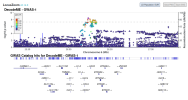
These are the traits that show evidence of colocalization with ME/CFS at the chr6p22.2 locus (near BTN2A2):
Candidate Variant: 6:26331741 A/G
LD Region: EUR/6/25684378-27258180
TraitData TypeGeneTissueCis/TransP-value
H4C8 Muscle Skeletal eQTLGene ExpressionH4C8Muscle Skeletalcis1.08e-18
ENSG00000287050 Whole blood cg13569146 methQTLMethylationENSG00000287050Whole bloodcis0.00e+0
ENSG00000287050 Whole blood cg14575656 methQTLMethylationENSG00000287050Whole bloodcis0.00e+0
H2AC10P Whole blood cg23233200 methQTLMethylationH2AC10PWhole bloodcis1.53e-134
H2AC10P Whole blood cg23282585 methQTLMethylationH2AC10PWhole bloodcis5.91e-210
Gamma glutamyl transferase levelsPhenotype (Physiological Measures)1.50e-10
Standing heightPhenotype (Anthropometric Measures)2.34e-16
Diagnoses - secondary ICD10: I10 Essential (primary) hypertensionPhenotype (Disease Of Circulatory System)5.58e-9
Arm fat percentage (right)Phenotype (Anthropometric Measures)1.88e-8
Arm fat percentage (left)Phenotype (Anthropometric Measures)4.40e-9
 
Do you have any thoughts on the fact that this GWAS comparison technique seems to often be suggesting different genes (as having their expression altered) for each variant than the ones originally identified? E.g. at this variant we have been thinking about BTN2A2 and BTN3A3, but it looks like the Open GWAS comparison might be pointing more towards H4C8, if I'm understanding correctly?

I guess GTEx has the advantage of being tissue-specific (though maybe the con of being an autopsy study)? While the GWAS studies going into this Open GWAS system seem to be looking at gene expression in the blood of living people? I assume the GWAS studies also tend to have more samples than GTEx did?
 
Do you have any thoughts on the fact that this GWAS comparison technique seems to often be suggesting different genes (as having their expression altered) for each variant than the ones originally identified? E.g. at this variant we have been thinking about BTN2A2 and BTN3A3, but it looks like the Open GWAS comparison might be pointing more towards H4C8, if I'm understanding correctly?
Yes, but this region on chromosome 6 has a large number of genes densely packed together, so I think it's plausible that a variant can affect multiple genes here. A variant could very well be directly affecting one gene, which in turn affects another gene, and both would show up as associated with the variant.

1777059946304.png

I guess GTEx has the advantage of being tissue-specific (though maybe the con of being an autopsy study)? While the GWAS studies going into this Open GWAS system seem to be looking at gene expression in the blood of living people? I assume the GWAS studies also tend to have more samples than GTEx did?
I think GTEx is actually one of the data sources used for their website. So it is interesting that DecodeME identified 7 genes' eQTLs that colocalize with ME/CFS at this locus, but none of them showed up here, while another gene, H4C8, did.

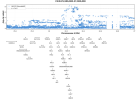
Edit: Just noticed LocusZoom doesn't show all genes if there are too many. Here are all the genes near the locus, showing how dense it is:
1777061465518.png
 
Last edited:
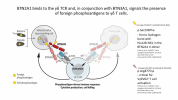
In this recent talk, Chris Ponting says he now thinks the gene at this locus is BTN2A1 not 2A2.


He talks about the fact that according to an analysis someone did, it's the gene that's disrupted most by rare variants; and about its function in helping a molucule (wasnt clear which) to recognise a metabolite of bacteria, which then allows for the activation of gamma delta T cells.
 
That sounds an important clarification. I suspect we are still talking about 'innate' T cell interaction involving butyrate and/or linked signals.

I find the literature on the role of gut in butyrate metabolism confusing and I worry that red herrings can easily enter the discussion, but the more precise the data the better , whatever.
 
That is a very valuable presentation from Chris that i had not been aware of.

He asks people to say where he is wrong. He is wrong to focus on 'HPA axis' I think. Hypothalamus, yes, but most of us have been unconvinced by the role of cortisol and I personally do not see how it could explain the clinical picture. I think we should forget cortisol and focus on branches in signalling within hypothalamus and nearby structures.

The overlap with fibromyalgia genetics is also very interesting - RABGAP and OLFM4 and maybe more. And that is in addition to the CA10 overlap with pain.
 
In this recent talk, Chris Ponting says he now thinks the gene at this locus is BTN2A1 not 2A2.


He talks about the fact that according to an analysis someone did, it's the gene that's disrupted most by rare variants; and about its function in helping a molucule (wasnt clear which) to recognise a metabolite of bacteria, which then allows for the activation of gamma delta T cells.

IMG_4347.png
This slide has been skipped really fast in the presentation, so I took the liberty of taking a screenshot and posting it here.
 
Jonathan, can you expand on why you think we should forget about cortisol -or direct us to where we can find your previous discussion of this?

Low cortisol would not explain the range of ME/CFS symptoms, especially PEM. And lots of studies have been done previously that end up suggesting that cortisol levels are not particularly abnormal. The results quoted by the chap doing the brain histology sound out of line with the body of evidence.
 
Low cortisol would not explain the range of ME/CFS symptoms, especially PEM. And lots of studies have been done previously that end up suggesting that cortisol levels are not particularly abnormal. The results quoted by the chap doing the brain histology sound out of line with the body of evidence.
Thanks for the reply. I tend to have a hot dog level of understanding. When Chris started mentioning Cortisol and the HPA axis I flashed backed to 1980/90s/2000s muddy and vague interpretations about ME/CFS and fibromyaliga and thought, "what the hell"…

Hopefully the brain chap will publish soon….
 
When Chris started mentioning Cortisol and the HPA axis I flashed backed to 1980/90s/2000s muddy and vague interpretations about ME/CFS and fibromyaliga and thought, "what the hell"…

When an answer to a disease mechanism becomes clear it often contains elements of stuff that has been around for ever and should have been seen in a slightly different way. The link between cortisol and sleep may well be relevant, but just indirectly so.

We just need to be obsessive about exactly what pathways we are invoking - as obsessive as a signalbox man at Crewe junction. Everything was very handwaving in the 1980s but by 1990 we had begun to see how specific we needed to be and how paradoxical mediators could be. Fortunately, the last generation of PhDs are very well aware of pathway complexity. What I think may have been lost is the broad background of clinical disease and histopathology. But forums like this can ensure someone has tabs on every aspect.
 
Back
Top Bottom