GDF-15, Growth differentiation factor-15 in ME/CFS - discussion thread

Hutan

Moderator
Staff member
There have been some claims of higher GDF-15 in ME/CFS. I thought it could be useful to note studies that measure GDF-15 in ME/CFS and related conditions, and to think about whether this is something that should be investigated more rigorously.

It is claimed to be a biomarker of mitochondrial diseases. It is potentially interesting with respect to ME/CFS as it increases in response to both physical and mental exertion and hypoxia.

However, that makes it difficult to measure, as even a blood draw can elevate it. It seems to fluctuate considerably with time of day. Obesity and increasing age increase it.
The mitochondrial disease biomarker GDF15 is dynamic, quantifiable in saliva, and correlates with disease severity

It seems likely that at least some of the studies that measured GDF-15 in ME/CFS have not properly taken into account confounders. So, I'm wondering, what evidence do we have that GDF-15 is relevant to ME/CFS, how good is the evidence, should it be looked at in further studies and, if so, what things need to be considered to investigate it properly.


From the paper linked above:
Using a home-based saliva collection protocol, we show that similar to other stress-related metabolic hormones, saliva GDF15 is highest upon awakening and declines rapidly by 61.2 % within 45 min. Elevated saliva GDF15 levels persisted throughout the day in MitoD. Clinically, saliva GDF15 correlated with neurological symptoms, fatigue, and functional capacity.

Mechanistically, elevated levels of GDF15 have been shown in various conditions associated with impaired mitochondrial biology. Systemic GDF15 release results from the activation of the integrated stress response (ISR), which is triggered by mtDNA defects that impair energy transformation via oxidative phosphorylation (OxPhos) in mitochondria, leading to intracellular reductive stress (i.e., elevated NADH/NAD+ ratio) [[16], [17], [18], [19]]. A marked induction of GDF15 has been shown in skeletal muscles of patients with thymidine kinase 2 (TK2) defects, which causes mtDNA depletion/deletions and OxPhos dysfunction [20].
 
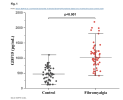
This 2025 fibromyalgia study seems robust, with good sized 100% female cohorts and well matched controls


The difference in GDF-15 seems quite compelling. Possibly, the GDF-15 might be a downstream effect of reduced physical activity? The description of the participants does not tell us about activity levels.

Screenshot 2026-05-08 at 5.38.34 PM.png
 
There is this study of Long COVID, looking at GDF-15 during the acute infection and 3 months later.


But, it's a tiny study with lots of confounding and uncertainties. I don't think we can take anything much from it.
 
The 2019 UK ME/CFS Biobank study is of a good size, with well characterised ME/CFS participants.


Results
Circulating GDF15 remained stable in a subset of ME/CFS patients when sampled on two occasions ~ 7 months (IQR 6.7–8.8) apart, 720 pg/ml (95% CI 625–816) vs 670 pg/ml (95% CI 598–796), P = 0.5. GDF15 levels were 491 pg/ml in controls (95% CI 429–553), 546 pg/ml (95% CI 478–614) in MS patients, 560 pg/ml (95% CI 502–617) in mild/moderate ME/CFS patients and 602 pg/ml (95% CI 531–674) in severely affected ME/CFS patients. Accounting for potential confounders, severely affected ME/CFS patients had GDF15 concentrations that were significantly increased compared to healthy controls (P = 0.01). GDF15 levels were positively correlated (P = 0.026) with fatigue scores in ME/CFS.

So, they say GDF15 levels were significantly higher in the severe ME/CFS group, and they correlated with fatigue scores in the whole ME/CFS group. The mean level in the mild/moderate ME/CFS group was higher than the controls, but not statistically different.

@Ravn commented that an exercise challenge might change things:
GDF15 is not elevated in mild/moderate ME. Would that change after an exercise challenge? Other studies looking at other markers found no big differences at rest but did find some after applying stressors. I don't think this study included any challenge (only skimmed it), so that would be an interesting next step.

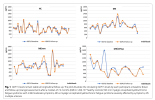
Here is the individual data.
Screenshot 2026-05-08 at 8.33.06 PM.png

The blue and orange dots are measurements taken 7 months apart, the x axis are the individual participants. It is remarkable how consistent the data are for each individual, much more than I thought they might be, given the suggestions I have read about diurnal variation and changes with physical and mental stress. It does look as though there is more variation in the ME groups (bottom left ME mild moderate and bottom right ME severely affected) than in the healthy controls and Multiple Sclerosis groups though. Perhaps that suggests that GDF-15 levels are changing with stressors e.g. with PEM.

But, what I was surprised to see was that the idea of the severely affected ME/CFS having higher levels than controls but the mild moderate not, isn't really borne out at the individual level. If you look at the 600 pg/mL line for all of the groups, most of the ME/CFS individuals are above that line, although there are some with low values. It seems to me that the ME/CFS group, taken as a whole, has higher values than the controls. Levels are also higher in the MS group.
 
Last edited:
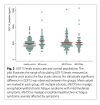
Ah, apologies. I hadn't read the 2019 UK Biobank study and made a mistake. The people included in that longitudinal study in Figure 1 above were just a subset of the cohorts.

Screenshot 2026-05-10 at 7.26.46 AM.png
In the full cohorts, the conclusion is that there was no statistically significant difference between the cohorts. And the chart bears that out.

I think, taken together with Figure 1, which suggests that most of the observations are quite stable, and therefore that issues with sampling error such as diurnal variation probably aren't having much of an influence, this study seems to be very good evidence that GDF-15 in plasma isn't elevated in ME/CFS.
 
Back
Top Bottom