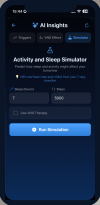
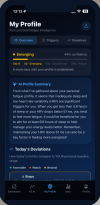
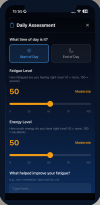
FatigueSense app

Dolphin

Senior Member (Voting Rights)
An ME group I'm connected with got this email tonight.
I don't know anything about it but perhaps it might be of interest to somebody or people can research it and report their thoughts.


---
I hope you are well.

I am reaching out to share the upcoming open beta launch of FatigueSense, a free AI-powered fatigue monitoring and management app designed to support individuals living with chronic conditions where fatigue is a significant symptom.

FatigueSense works with widely used wearable devices to analyse physiological data such as heart rate, sleep, and activity patterns. The app then provides personalised insights to help users better understand and manage their daily energy levels. Importantly, users do not need to purchase a specific device in most cases, as the app now supports a broader range of smartwatches, particularly for iOS users, alongside Fitbit integration on Android.

The project is grounded in longitudinal digital health research and aims to make fatigue tracking more objective, accessible, and practical in real-world settings. The open beta version is free to join, and we are inviting individuals and patient communities who may be interested in testing the app and providing feedback.

If this may be relevant to your members, I would greatly appreciate it if you could share it within your network. More information and sign-up details are available at:

www.fatiguesense.com

Thank you for your time, and please feel free to reach out if you would like any additional information.

Kind regards,

<name>

Phd researcher in digital heatlh

Newcastle University
 
From the website:

Predicts Your Fatigue​

Our AI analyses your sleep, heart rate variability, steps, and activity patterns to predict how you'll feel before you feel it.

Paces Your Day​

Get a personalised activity budget each morning. Know when to push, when to rest, and avoid the boom-and-bust cycle.

Learns YOUR Patterns​

FatigueSense builds a personal profile unique to you. Your baselines, your triggers, your thresholds and not population averages.
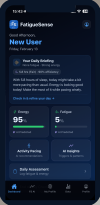
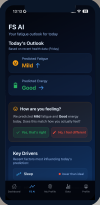
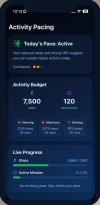
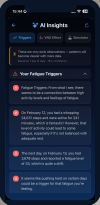
IMG_0599.pngIMG_0600.pngIMG_0601.pngIMG_0602.pngIMG_0603.pngIMG_0604.pngIMG_0605.png
It looks they’ve adopted some of the BACME-style language. To my mind, there is nothing here to indicate that it has any relevance for pwME/CFS.
 
Hi everyone,


I’d like to clarify some points about FatigueSense, as there seems to be a misunderstanding about what the app is and the work behind it.


FatigueSense is a free app being developed purely as part of research at Newcastle University. No one involved is being paid for the development — the goal is to translate our research findings into a practical tool to support people living with chronic fatigue conditions.


The “intelligence” in FatigueSense is not some generic AI gimmick. It is based on rigorous research analyzing physiological data from wearables — heart rate, sleep, and activity patterns — to provide evidence-based insights into daily energy and fatigue management. This work builds directly on established research, including:


We welcome constructive discussion and critique, but it’s important to ensure that comments reflect the actual research. Speculative or dismissive statements about the app don’t consider the scientific work behind it, the time and effort of researchers, or the fact that it is freely available to support the community.


We hope that anyone interested can take a look at the research itself and better understand the evidence behind FatigueSense.


Thank you for reading,
Nana
PhD Researcher, Newcastle University
 
We welcome constructive discussion and critique, but it’s important to ensure that comments reflect the actual research. Speculative or dismissive statements about the app don’t consider the scientific work behind it, the time and effort of researchers, or the fact that it is freely available to support the community.
Hi and welcome.

Perhaps you could explain «the actual research» and «the scientific work behind [the app]»? I can’t find any of it on the website, only generic health tech marketing.

It would also be useful if you could explain why you believe this app is relevant for people with ME/CFS specifically, and if you believe that all fatigue is the same?

I’ll jump right in with specific points about the two papers you shared:

The systematic review demonstrates that only one of the variables have been studied in ME/CFS, with about 100 participants in total.

In the thread for the paper, it’s also apparent that there are some misunderstandings about what pacing entails in ME/CFS and chronic fatigue in general. It is not the pacing that is used in pain management - those are two separate concepts. The approach of breaking up rest with activity has been thoroughly tested for chronic fatigue and demonstrated that it provides no benefit over letting the patients do what they think is best. This approach is at the core of the so-called biopsychosocial model of chronic fatigue that has been debunked for decades.

The feasibility study (thread here) was based on data from a median of 3 (!!) days, which really isn’t enough to demonstrate that the model can handle the highly fluctuating nature of chronic fatigue, and PEM specifically for ME/CFS.
 
Hi, and thank you for taking the time to engage so thoughtfully — we genuinely appreciate detailed feedback like this.

I’ll address your points directly.

First, regarding the visibility of the research: you’re absolutely right that the website could do a better job surfacing the underlying work, and that’s something we’re actively improving. The app itself is built on ongoing academic research, and we aim to make that more transparent. For reference, those papers outline both the current state of the field and the early-stage modelling work that informs the app.

On your point about ME/CFS specifically — we fully agree that fatigue is not a single, uniform construct, and that ME/CFS (particularly with PEM) presents unique and complex challenges. FatigueSense is not built on the assumption that all fatigue is the same. Rather, it is an exploratory research tool aimed at understanding how physiological and behavioural signals may relate to perceived fatigue across individuals, including those with chronic conditions.

You are also correct that the systematic review highlights a limited evidence base in ME/CFS populations. That is precisely one of the motivations for this work — there is a clear gap in robust, objective measurement approaches for fatigue, particularly using digital biomarkers. The app is part of an effort to contribute data and insights to that gap, not to claim that it has already been solved.

Regarding pacing: we fully acknowledge that pacing in ME/CFS is distinct from approaches used in other conditions such as chronic pain. The intention of the app is not to prescribe a specific pacing model or promote any particular theoretical framework, but to provide individuals with additional data-driven insights that may support their own self-management strategies. We are careful not to position this as a replacement for established patient-led approaches.

On the feasibility study — again, the dataset was small and short in duration, and we do not present it as definitive. It is explicitly a feasibility study, intended to explore whether signals from wearable data show any promise in predicting next-day fatigue. Larger, longer-term validation — especially in populations with highly fluctuating symptoms such as ME/CFS — is an essential next step and part of ongoing work.

Finally, I think it’s important to emphasise context: this is early-stage academic research being translated into a free tool. No one involved is being paid to commercialise this — the aim is to explore, learn, and ultimately contribute to a space where there is still limited quantitative understanding of fatigue.

We absolutely welcome critical discussion, especially when it helps refine the work. At the same time, we would encourage conclusions to be grounded in the actual scope and intent of the research, which is exploratory rather than prescriptive.

Thanks again for engaging.
 
I agree, it would be good if you could give us some idea of what hypotheses are being tested here @nanay and what practical benefit is envisaged?

I don't understand this sentence:
The app then provides personalised insights to help users better understand and manage their daily energy levels.
What are daily energy levels? It is not a physiological concept that I am aware of.

Do we have any data indicating that the app provides a better prediction than the person can judge for themselves?
 
I am also a bit confused about what stage this is at. It sounds as if this is early exploratory work to see whether a wearable can predict pay back the next day better than the person could do by experience. But the initial letter in the first post suggests that the App is already set up to provide 'insights'. and is being launched for patients to use.

My understanding is that at present we know very little about what data might predict symptoms the next day better than learning from experience.
 
FatigueSense is not built on the assumption that all fatigue is the same. Rather, it is an exploratory research tool aimed at understanding how physiological and behavioural signals may relate to perceived fatigue across individuals, including those with chronic conditions.
It is not at all being presented like that.

Quotes from the website:

Know Your Fatigue Before It Hits​

AI-powered fatigue prediction using your smartwatch data
Backed by research at Newcastle University

Built from 3+ years of PhD research

Developed with digital health experts
FatigueSense was created to turn fatigue research into everyday support for people living with chronic fatigue and fatigue from long-term health conditions.
Regarding pacing: we fully acknowledge that pacing in ME/CFS is distinct from approaches used in other conditions such as chronic pain.
Unfortunately, it does not look like that’s the case.

Quote from the review:
This relationship further raises important considerations for designing interventions for patients with chronic diseases, simply encouraging increased physical activity may not be sufficient if prolonged sedentary behavior is left unaddressed. Interventions that break up sedentary time, such as promoting LPA throughout the day, could be more effective in reducing fatigue, likely known as “activity pacing”, explored in some studies as a framework for managing chronic pain and fatigue66.
This is equate pacing in pain management to pacing in fatigue, and the reference is clearly not about pacing as it is known in ME/CFS - thread here.
The intention of the app is not to prescribe a specific pacing model or promote any particular theoretical framework, but to provide individuals with additional data-driven insights that may support their own self-management strategies. We are careful not to position this as a replacement for established patient-led approaches.
The website says this:
Build better routines for pacing activity, resting effectively, and staying within sustainable energy limits.
That sounds like a replacement to me through «upgrading».
We absolutely welcome critical discussion, especially when it helps refine the work. At the same time, we would encourage conclusions to be grounded in the actual scope and intent of the research, which is exploratory rather than prescriptive.
I would encourage the communication on the webpage to be grounded in the actual scope and intent of the research.. What you’re telling us here is very different from what the webpage is telling us.
 
Hi @nanay thank you for engaging. Perhaps some relevant context: the people on this forum have seen probably dozens of different iterations of apps, activity tracking toolkits, illness management guides etc. that claim people with ME/CFS can meaningfully improve their quality of life by some combination of tracking patterns and adjusting behavior. Thus far, pretty much all of those approaches have proven to not live up to the promise, though some individuals have found ways to make specific tools and measurements useful to them.

If this app is, as you say, completely exploratory and without published evidence of benefit, I would offer some critique that your website presents the exact opposite impression. The language very strongly implies that the claims of being able to offer useful insight are already grounded in efficacy data from clinical trials, rather than being purely speculative. It seems a little unfair to repeatedly say that critiques are overly dismissive and not accurate to your intentions when every one of us who visited the website got a very different impression from what you’re saying on this thread. I’ve found this forum to be very open and eager for discussion, and it been extremely useful for informing my own research.
 
I do think that this sort of project is worthwhile (I seem to remember recommending it as the other useful thing to do when recommending a GWAS project on an MRC committee some years back!) I think we all do. But it is an area awash with ungrounded claims and overzealous therapy.

As far as I can see the literature review relates to something quite different from the interest here - it shows that people who are more fatigued by illness do less, which is what one would expect. That seems separate from the issue of whether you can show that certain indices of doing less today may predict that you can do more tomorrow. If that were possible and the prediction could not be made intuitively by the person it would be great.

But one would still have to establish that all the hassle of checking an app and trying to do less today so that the app allowed you to do more tomorrow was not in fact counterproductive and that people were more likely to improve if they forget about trying to be more active and just found ways to have a reasonable life without pushing against a brick wall.
 
Welcome, @nanay. Thank you for joining us. I think the research looks interesting. I have signed up to try the free beta version of the app when it's available using Android and Fitbit.

I wonder how familiar you are with ME/CFS, specifically that the key feature of ME/CFS is PEM, not fatigue. For me fatigue is the least of my worries. I suspect I will find if I use the app that the emphasis on fatigue becomes annoying. I'm not primarily fatigued, I'm sick with a range of disabling symptoms.

I hope you and your colleagues will have time to read our fact sheets, which are available on this thread: Science for ME Fact Sheets
 
Hi @nanay,

Thank you for joining us on this forum. Rather than complicating things and focusing on management, I am wondering whether the following seems like a useful idea to you: A long-term activity tracking study of patients and their symptoms, for example tracking step count and perhaps another activity metric vs "how good people feel" and perhaps their sleep, over long time periods. I think this already would be useful data that currently doesn't exist.

This brings me to another point: Quite a few devices report activity measurements differently, for example step count, and quite often the estimates can be bad. How would this be handled across different devices?
 
Last edited:
I also think this product is more likely to be useful as a research tool than as a guide to individuals on their activity management, except possible people new to ME/CFS who haven't yet made the connection between their activity and symptoms.

I can see such longitudinal records as having potential for providing outcome measures for clinical trials that are much more objective than questionnaires.

I note that you are already doing something of that sort by collecting data from people who are testing vagal nerve stimulation devices.

Does the app have any way of recording cognitive exertion and time spent upright as contributors to PEM? I guess that could come indirectly from heart rate.

Are you thinking of incorporating any questionnaires on the app as part of the person's record keeping. For example, the FUNCAP questionnaire which many pwME rate highly as a way of recording functional capacity that takes into account the cumulative effects of activities.

I note that the website makes clear that the app is free to beta testers, the implication being that it will later become a paid for app. Can you tell us about any plans?
 
Thanks for engaging so thoughtfully — these are all fair questions, and I’ll try to clarify the scope more precisely.

First, to avoid any confusion: this is a free, exploratory tool and not a medical device, treatment, or replacement for clinical care (explicit on our website). When wording such as “build better routines” is used, it refers simply to users reflecting on their own tracked patterns over time — not the app prescribing or directing behaviour.The app does not provide medical advice or structured interventions. It surfaces patterns based on what users themselves log, and any interpretation or action remains entirely with the individual.

On the question of “personalised insights” and prediction:

There is no claim that the app predicts fatigue better than the individual or that it has established clinical accuracy. The predictive component is intentionally modest in scope — it uses basic machine learning to detect patterns within a single user’s own historical data, particularly where day-to-day relationships between activity, rest, and perceived fatigue may be difficult to notice manually.

These features are:
  • Optional
  • Non-prescriptive
  • Individualized (not population-based models)
Their purpose is simply to augment self-tracking, not to replace self-awareness or clinical understanding.

Regarding evidence and data:

At this stage, the app is as a tool informing people and not a validated clinical solution( this is explicit on the website as not being a medical device). We are not presenting it as having definitive outcome data, nor as being proven effective for ME/CFS or any specific condition.

We also recognize and agree that:
  • Fatigue is highly subjective and heterogeneous
  • ME/CFS, in particular, has complex characteristics (including PEM) that are not captured by simplistic models
  • Concepts like pacing are nuanced and often misrepresented across domains
The app does not attempt to redefine or replace these understandings. It simply allows users to track their own experience in a structured way and give insights to that regard.

On the broader point:
We’re not suggesting this will work for everyone or that it’s fully accurate. If you already manage your fatigue effectively, there may be no added benefit and you are welcome to ignore it — but anyone who feels it could help is welcome to try it.
 
Hi @nanay,

Thank you for joining us on this forum. Rather than complicating things and focusing on management, I am wandering whether the following seems like a useful idea to you: A long-term activity tracking study of patients and their symptoms, for example tracking step count and perhaps another activity metric vs "how good people feel" and perhaps their sleep, over long time periods. I think this already would be useful data that currently doesn't exist.

This brings me to another point: Quite a few devices report activity measurements differently, for example step count, and quite often the estimates can be bad. How would this be handled across different devices?
Hi, thanks — this is a really good point.

We actually agree that long-term tracking of activity, symptoms, sleep, and perceived wellbeing is valuable. In fact, we’ve conducted a study with people experiencing long COVID over a three-month period, analyzing activity and fatigue patterns. That work is currently under peer review in the journal to be published, and we plan to expand to gain further insights into long-term effects.

On device variability: the app includes a data cleaning layer that filters inconsistencies, and users can flag any step counts, sleep data, or other metrics they feel are inaccurate. While absolute measurements differ across devices, consistent patterns within an individual’s data remain meaningful, and improving cross-device handling is an ongoing focus.
 
I also think this product is more likely to be useful as a research tool than as a guide to individuals on their activity management, except possible people new to ME/CFS who haven't yet made the connection between their activity and symptoms.

I can see such longitudinal records as having potential for providing outcome measures for clinical trials that are much more objective than questionnaires.

I note that you are already doing something of that sort by collecting data from people who are testing vagal nerve stimulation devices.

Does the app have any way of recording cognitive exertion and time spent upright as contributors to PEM? I guess that could come indirectly from heart rate.

Are you thinking of incorporating any questionnaires on the app as part of the person's record keeping. For example, the FUNCAP questionnaire which many pwME rate highly as a way of recording functional capacity that takes into account the cumulative effects of activities.

I note that the website makes clear that the app is free to beta testers, the implication being that it will later become a paid for app. Can you tell us about any plans?
FatigueSense is designed as a free, exploratory research tool and not a replacement for individual management or a medical device. It provides insights based on users’ own logged patterns — any interpretation or action remains entirely with the individual.

Regarding cognitive exertion or time spent upright: the app currently relies on signals from smartwatches, which do not capture these directly. If future devices provide such data, we plan to explore incorporating it.

The app is free for beta testers and will remain free as long as research funding continues. Its primary goal is to support people in exploring patterns in their own fatigue and energy levels, not to provide prescriptive advice or guaranteed predictions.
 
Hi, thanks — this is a really good point.

We actually agree that long-term tracking of activity, symptoms, sleep, and perceived wellbeing is valuable. In fact, we’ve conducted a study with people experiencing long COVID over a three-month period, analyzing activity and fatigue patterns. That work is currently under peer review in the journal to be published, and we plan to expand to gain further insights into long-term effects.

On device variability: the app includes a data cleaning layer that filters inconsistencies, and users can flag any step counts, sleep data, or other metrics they feel are inaccurate. While absolute measurements differ across devices, consistent patterns within an individual’s data remain meaningful, and improving cross-device handling is an ongoing focus.
That sounds sensible!

I hope something similar can be conducted in ME/CFS, especially with a focus on long-term activity tracking (>1 year). I'm wondering whether your long-Covid study was blinded in the sense that participants didn't have access to the data themselves. I think this could be particularly fruitful in uncovering certain patterns, but of course that might not have been the scope of the study.
 
Last edited:
I am still worried that the app output is getting ahead of itself. Judging by the screenshot of the website given in post #2 the app does give advice. It may not be instructions but anyone trying to use this is likely to assume there is justification for suggestions about what they might do tomorrow.

As far as I can see we are a ta stage where we have no idea whether such monitoring is useful for planning the next day or whether it just encourages people to be obsessive about their activity planning when they would do better to take things easy. The history of all this is always that the agenda is to get people to do more, however gradually. The patient is bound to feel they need to do more. They will assume the app is helping by providing 'insight' but we have no idea at present whether there is any insight into what is determining symptoms.

One thing I find confusing is the use of heart rate variability. It is said that HRV is anindicator of 'autonomic function' as if low variability is a sign of autonomic malfunction. It is also said to be low with deconditioning and higher with fitness. But presumably in the context of predicting tomorrow's fatigue it has nothing to do with these but is a measure of how often there was a bout of activity that put the heart rate up? Is this really usefully called 'HRV' rather than just a measure of tachycardia. I may be missing something here.

What I do think could be very useful is a complex mathematical analysis of the variables tracked - which it looks as if this software will do - over extended periods. The most useful result would be that symptoms tomorrow are predicted by something totally unexpected (with the current friendly suggestions on post #2 being completely wrong!).

My thought would be that the monitoring device should be tried out on people with ME/CFS without any 'helpful suggestions' being made: just data gathering, including iintuitive predictions to compare with any predictions the software generates. One of the problems with this sort of exercise is that the very existence of an interactive app may change all the variables you want to track by biasing the person's behaviour. So you may end up tracking the characteristic physiological patterns of someone who knows they are having their physiology tracked.
 
What I do think could be very useful is a complex mathematical analysis of the variables tracked - which it looks as if this software will do - over extended periods. The most useful result would be that symptoms tomorrow are predicted by something totally unexpected

Maybe the app's predictions could be recorded but not revealed to the patient during the training of the AI / the first six months of use? So the app predicts what will happen the next day, then the patient records data to indicate what does happen. The problem with fluctuating illnesses is that you do need extended periods to sort the wood from the trees.
 
Back
Top Bottom