Protocol Effectiveness of mindfulness-based online therapy or internet-delivered CBT... among patients w/persistent somatic symptoms.. 2025 Vangelova-Korpinen+

Andy

Senior Member (Voting rights)
Full title: Effectiveness of mindfulness-based online therapy or internet-delivered cognitive behavioral therapy compared with treatment as usual among patients with persistent somatic symptoms: Protocol for a randomized controlled trial

Abstract

Background
Persistent somatic symptoms unexplained by a defined medical or psychiatric condition often include a component of central sensitization. Many treatment options are based on cognitive behavioral therapy. Effective widely available therapies are scarce. There are self-management programs and e-therapies that aim at overcoming the central sensitization by modifying interoceptive neural networks in the brain.

Objectives
This study aims to investigate the effect of a mindfulness-based amygdala and insula retraining (AIR) online program and an internet delivered therapist assisted therapy offered by Helsinki University Hospital (HUS iCBTpss) compared to treatment as usual (TAU) in the treatment of conditions causing persistent somatic symptoms.

Methods
We will perform a randomized controlled trial aiming at 360 patients. Consenting patients will be randomized to three study arms: online AIR program, HUS iCBTpss (both interventions as add-ons to TAU); and TAU. Functional ability and quality of life surveys will be collected from participants at baseline and at 3, 6, and 12 months after entering the study.

Conclusions
This study is one of the first to explore non-drug based online interventions developed to overcome the brain’s central sensitization and are available and accessible to patients both in primary and secondary care. The results will develop the management of the common, often debilitating persistent somatic symptoms related to many conditions unexplained by a defined somatic or psychiatric illness.

Open access
 
Persistent somatic symptoms (PSS) is an umbrella term to describe subjectively distressing somatic complaints, irrespective of their aetiology, that are present on most days for at least several months [1]. Often the term is used to refer to physical symptoms that cannot be attributed to any known physical or psychiatric disorder [2]. These conditions have also long been known as medically unexplained symptoms [3]. Mounting evidence shows that central nervous system and brain-body interaction has a significant role in these conditions, and recently they have been referred to as central sensitization syndromes [4].

...

Chronic fatigue syndrome (ME/CFS) has been studied for at least four decades but no specific pathology or biomarker has been identified so far [8, 9]. A novel challenge causing persistent somatic symptoms is also post COVID-19 condition. It is characterized by debilitating symptoms (including breathlessness, chest pain, palpitations, and fatigue) which can last for months after the acute illness [10, 11]. The symptoms of post COVID-19 condition resemble those of other post-viral conditions, including chronic fatigue syndrome [12]. So far there is no clear explanation for the full range of symptoms in post COVID-19 condition. Researchers have suggested a broader causal model of interaction of biological, social, experiential, and psychological factors related to the condition [13]. Fibromyalgia is characterized by widespread musculoskeletal pain often associated with fatigue, sleep disturbances and other cognitive and somatic symptoms. The pathophysiology of fibromyalgia is not completely understood but abnormal central pain processing is considered as the primary pathophysiologic mechanism. Genetic factors, female sex and other painful conditions are main predisposing factors [14]. A novel study has shown association between childhood adverse events and fibromyalgia [15].
 
Had adverse childhood events not been retracted as an association in FM?
Has someone ever seen information about previous treatment of adverse childhood events?
Or is it scooped up everytime psychologists want to use again and again?
 
Looks like this is funded by the EU grant on Long Covid:
Funding: This work is supported by EuropeanUnion’s Horizon Europe research and innovation programme (Long Covid HEU Grant no.101057553 2022-2026) and State Research Funds.Open access funded by Helsinki University Library.The funding sources have no other role in the study.
Here's the link to the EU page on the project which received 6.5 million in funding.
Decision support for prediction and management of Long Covid Syndrome (LCS) | Long Covid | Project | Fact Sheet | HORIZON | CORDIS | European Commission

Strange how they managed to do this because the intervention being tested isn't on Long Covid in particular but on persistentsomatic symptoms. And the scope of the call doesn't mention anything about testing clinical interventions such as mindfullness or cognitive approaches.
https://ec.europa.eu/info/funding-t...topic-details/HORIZON-HLTH-2021-DISEASE-04-07
 
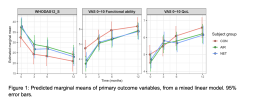
Looks like the authors shared preliminary results in this document to the EU (see attachment). There were no significant group differences for the three main outcomes.
Preliminary mixed models were fitted using data downloaded from HUSeCRF on 30.4.2025. Wefound no significant difference in the effectiveness of interventions

1777477293103.png
This is from a preliminary analysis that includes only 215 out of necessary 270 patients but the report writes that "there is a low possibility that the results will change significantly" with continuing recruitment.
 

Attachments

Strange how they managed to do this because the intervention being tested isn't on Long Covid in particular but on persistentsomatic symptoms. And the scope of the call doesn't mention anything about testing clinical interventions such as mindfullness or cognitive approaches.
https://ec.europa.eu/info/funding-t...topic-details/HORIZON-HLTH-2021-DISEASE-04-07
From the protocol:
In this study we will include patients suffering from persistent somatic symptoms according to the above definition with known physical or psychiatric disorders as causes for the symptoms excluded. In addition, we will apply the specific diagnostic criteria of fibromyalgia and chronic fatigue syndrome, as well as post COVID-19 condition [10, 11, 14],
The wording is messy, but I think it means that they are recruiting FM, ME/CFS and LC patients.
This is from a preliminary analysis that includes only 215 out of necessary 270 patients but the report writes that "there is a low possibility that the results will change significantly" with continuing recruitment.
That’s just 60 % of the original target:
We will aim at recruiting 360 volunteering patients.
 
I think it means that they are recruiting FM, ME/CFS and LC patients.
Agree, confirmed in this trial registration and supplementary material of the protocol.

But it's strange that this study on Long Covid is doing a large trial that includes other patients as well (fibromyalgia prevalence is like 2-4%).

The EU grant was supposed to focus on mechanistic virus-host interplay, like genetics and immuner responses. so including a large RCT of behavioral interventions is already a but curious but doing it on patients who's illness might have nothing to do with this topic is even stranger.
 
That’s just 60 % of the original target:
True, but it sounds as if they themselves think the results won't change and the control group is doing slightly better on each of these preliminary outcomes.

Found it remarkable given that the consortium leaders were arguing that biological studies only lead to null results and that a psychological approach holds more promise. In the French interview with L'Express they mention "Un cerveau bloqué en mode défense" which likely refers to the amygdala theory tested in this trial.
Covid long : un consortium défend la piste du cerveau – L'Express

So if you have preliminary results of this trial pointing towards no effect, the statements made in the article come across as euh... not very nuanced.
 
True, but it sounds as if they themselves think the results won't change and the control group is doing slightly better on each of these preliminary outcomes.

Found it remarkable given that the consortium leaders were arguing that biological studies only lead to null results and that a psychological approach holds more promise. In the French interview with L'Express they mention "Un cerveau bloqué en mode défense" which likely refers to the amygdala theory tested in this trial.
Covid long : un consortium défend la piste du cerveau – L'Express

So if you have preliminary results of this trial pointing towards no effect, the statements made in the article come across as euh... not very nuanced.
I agree.

The clinicaltrials page says that it’s supposed to be blinded:
Masking : Double (Investigator, Outcomes Assessor)
I have no idea how they think they could blind the outcome assessors (the participants), but the investigators were supposed to be blinded. So I don’t know how they could have done preliminary analyses and maintain the blinding.
 
True, but it sounds as if they themselves think the results won't change and the control group is doing slightly better on each of these preliminary outcomes.

Found it remarkable given that the consortium leaders were arguing that biological studies only lead to null results and that a psychological approach holds more promise. In the French interview with L'Express they mention "Un cerveau bloqué en mode défense" which likely refers to the amygdala theory tested in this trial.
Covid long : un consortium défend la piste du cerveau – L'Express

So if you have preliminary results of this trial pointing towards no effect, the statements made in the article come across as euh... not very nuanced.
Consortium leaders should also ask : How much did they contribute to fundamental biological studies, before deciding to give money to groups that only promise, but don't deliver on that promise.
 
Consortium leaders should also ask : How much did they contribute to fundamental biological studies, before deciding to give money to groups that only promise, but don't deliver on that promise.
As I understand it, the consortium leaders are the problem.

Think there was some reasonable biomedical research under this project but wonder how those researchers think about the statements by Liira that they pretty much found nothing. That didn't sound very respectful. It's not that you'll solve a complex syndrome like Long Covid with one European grant of 6.5 million in a couple of years. Strange that the science journalist didn't push back on this.
 
Back
Top Bottom