Deep abdominal breathing reduces heart rate and symptoms during orthostatic challenge in patients with postural orthostatic tachycardia syndrome,2024,

EndME

Senior Member (Voting Rights)

Deep abdominal breathing reduces heart rate and symptoms during orthostatic challenge in patients with postural orthostatic tachycardia syndrome

Background and purpose: This study investigated the effects of deep abdominal breathing on cardiovascular parameters and symptoms in patients with postural orthostatic tachycardia syndrome (POTS) during head-up tilt-table (HUT) challenge.

Methods: Thirty POTS patients completed two consecutive rounds of 10-min HUT in a crossover design. One round was HUT without intervention, and one round combined the HUT with deep breathing at a rate of 6 breaths/min. Cardiovascular parameters, including mean blood pressure and maximum and mean heart rate (HR), were measured supine and standing. Symptoms were assessed using the Vanderbilt Orthostatic Symptom Score (VOSS).

Results: During the breathing technique, the mean HR increase was -7.35 bpm (95% confidence interval [CI] = -11.71 to -2.98), and the maximum HR increase was -6.27 bpm (95% CI = -11.85 to -0.68, p = 0.041), significantly lower compared to normal breathing. Additionally, improvements were observed in all absolute cardiovascular parameters during standing, with VOSS symptoms simultaneously and significantly decreasing by -5.38 (95% CI = -10.43 to -0.36).

Conclusions: Slow deep abdominal breathing can act as a simple technique to reduce the standing HR increase upon HUT in patients with POTS. This suggests that modulation of the cardiopulmonary neurocircuits and the respiratory pump may reduce HR increase and symptoms in patients with POTS. The findings of this study highlight the use of a safe, zero-cost, and simple behavioral tool to suggest to POTS patients for symptom relief apart from standard treatment. The observed improvements in cardiovascular parameters and symptoms offer a promising therapeutic approach for patients in times of inadequate treatment options.

 
Did we really need a study to demonstrate that slower breathing reduced HR?
The findings of this study highlight the use of a safe, zero-cost, and simple behavioral tool to suggest to POTS patients for symptom relief apart from standard treatment.
HR etc. are signs, not symptoms.. Did it affect how they felt, dizziness, weaknes, etc,? Have they tested if the results are transferable to general life?
The observed improvements in cardiovascular parameters and symptoms offer a promising therapeutic approach for patients in times of inadequate treatment options.
So pwOI are supposed to go around breathing super slowly all day? How is that a solution to anything?
 
HR etc. are signs, not symptoms.. Did it affect how they felt, dizziness, weaknes, etc,? Have they tested if the results are transferable to general life?
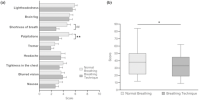
I'm pretty sure they did not suggest that but that this was in reference to the Vanderbilt Orthostatic Symptom Score (VOSS) which capture the 9 following symptoms: mental clouding, brain fog, shortness of breath, palpitations, tremor, headache, tightness in the chest, blurred vision, and nausea. They used other questionnaires in recruitment but not in the study as well (for example MALMÖ which has been used in LC studies).

I think the bigger problem is probably adapted questionnaire answering in this unblinded treatment where question answering follows immediately upon receiving advice the practioners had probably told you should work. I suspect a much more sophistaicated setup is required to tell you something useful.

A perhaps rather funny problem is that the initial cohorts were larger but more people that were initially classified as having POTS didn't later have POTS in their tests and in particular more people in the non-treatment first group were considered as not having POTS than in the treatment first group which might have artifically altered the results in favour of the treatment group without having anything to do with the treatment.
 
I'm pretty sure they did not suggest that but that this was in reference to the Vanderbilt Orthostatic Symptom Score (VOSS) which capture the 9 following symptoms: mental clouding, brain fog, shortness of breath, palpitations, tremor, headache, tightness in the chest, blurred vision, and nausea.
Oh, I can see that in figure 4. Seems like it did nothing for the symptoms except for shortness of breath (no surprise) and palpatations.
IMG_0596.png
I think the bigger problem is probably adapted questionnaire answering in this unblinded treatment where question answering follows immediately upon receiving advice the practioners had probably told you should work.
Yeah, that’s always going to be an issue.
I suspect a much more sophistaicated setup is required to tell you something useful.
With the minuscule results in a biased setup, I think we can be fairly certain that this doesn’t have any relevance. And it would be far too impractical to implement in everyday life.

I also think the focus on HR is misguided. It’s the symptoms that matter.
 
Oh, I can see that in figure 4. Seems like it did nothing for the symptoms except for shortness of breath (no surprise) and palpatations.
View attachment 30590

Yeah, that’s always going to be an issue.

With the minuscule results in a biased setup, I think we can be fairly certain that this doesn’t have any relevance. And it would be far too impractical to implement in everyday life.
Indeed, I hadn't gotten as far as looking at figure 4 yet, but reading what you've written you seem to be rather spot on. If this is the evidence for symptom improvement it doesn't really exist, but then again I also wouldn't necessarily think one should expect an instanteously noticable deduction in brain fog to begin with just from breathing deeper a couple of times. Beyond that they also don't seem to mention why certain people were excluded from the analysis and I'm not sure why you'd introduce different groups if that is not accounted for in something like figure 4 where you don't seem to report whether any order of treatment effects existed.
I also think the focus on HR is misguided. It’s the symptoms that matter.
In people with ME/CFS that appears to be the case to me as well but I'm of the impression there are also POTS patients where the HR might matter more crucially, but I might be wrong?
 
Last edited:
What this study once again does show is high variability of HUT results in POTS and how these results can be altered by patients and practioners fairly easily by certain instructions seemingly without any short-term changes in the majority of symptoms domains.
 
In people with ME/CFS that appears to be the case to me as well but I'm of the impression there are also POTS patients where the HR might matter more crucially, but I might be wrong?
I think how HR is related to symptoms is currently unknown. My increased HR is annoying, but lowering it with very low dose beta blockers made no difference for my OI symptoms in general.
What this study once again does show is high variability of HUT results in POTS and how these results can be altered by patients and practioners fairly easily by certain instructions seemingly without any short-term changes in the majority of symptoms domains.
Perhaps being more comfortable with the procedure the second time around might make your HR decrease slightly. Or maybe you’re nervous for your diagnostic test, and more relaxed when retesting after trying a treatment.

I think this study just demonstrates how unreliable the measurement is and how, as you said, we need better methods for assessing OI interventions.
 
I think how HR is related to symptoms is currently unknown. My increased HR is annoying, but lowering it with very low dose beta blockers made no difference for my OI symptoms in general.
My comment was more about that I think we can have some confidence that in ME/CFS, POTS does not characterise symptoms of OI meaningfully, but I'm not sure if we can make generalistic conclusions for POTS in general. I think there are very much people considered to have POTS where HR is everything, whether POTS is then actually sensible characterisation might be an entirely different question.
Perhaps being more comfortable with the procedure the second time around might make your HR decrease slightly. Or maybe you’re nervous for your diagnostic test, and more relaxed when retesting after trying a treatment.
Well, that's why I thought you'd have the 2 groups but I didn't see much analysis for that, but admittedly I only skimmed over things.
 
My comment was more about that I think we can have some confidence that in ME/CFS, POTS does not characterise symptoms of OI meaningfully, but I'm not sure if we can make generalistic conclusions for POTS in general. I think there are very much people considered to have POTS where HR is everything, whether POTS is then actually sensible characterisation might be an entirely different question.
I don’t think we know anything about the relevance or HR for those people either. It seems to me like lots of people with OI don’t meet the POTS criteria for HR, and some people without any other symptoms do meet them.
Well, that's why I thought you'd have the 2 groups but I didn't see much analysis for that, but admittedly I only skimmed over things.
Oh yeah, that’s a good point.
 
Back
Top Bottom