Cross-disorder comparison of brain structures among 4836 individuals with mental disorders and controls utilizing danish population-based clinical MRI scans
Abstract
Large-scale mega-analyses of worldwide combined Magnetic Resonance Imaging (MRI) studies have demonstrated brain differences between individuals with mental disorders and controls. However, the potential of large-scale observational studies using population-based clinical MRI data remains unexplored.
We analyzed clinical MRI data from 23,545 patients in the Eastern half of Denmark (Capital Region of Denmark and Region Zealand). 2774 patients with mental disorders and 2062 non-psychiatric controls fulfilled our inclusion and exclusion criteria.
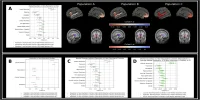
Patients with mental disorders exhibited smaller thalamic (d = −0.298) and amygdala volumes (d = −0.250), with larger ventricles (d = 0.272), and thinner insula (d = −0.177), all p < 0.0001. Analysis across all ROIs revealed a widespread pattern of thinner cortex (d = −0.180), especially in the temporal pole (d = −0.234) and superior frontal (d = −0.212) regions, and increased extracerebral cerebrospinal fluid (d = 0.264).
For volumetric measurements, findings were consistent across different inclusion and exclusion criteria but varied for cortical thickness measurements.
Utilizing this currently largest population-based MRI cohort for mental disorders, we demonstrate that clinical MRI scans can detect brain structural differences among patients with mental disorders in real-world clinical settings, aiding in the stratification of patients without mental disorders. Cross-disorder analyses reveal shared neuroanatomical changes, including globally smaller brain volumes and thinner cortex.
Integrating large-scale clinical MRI data with electronic health records holds promise for improved patient stratification and tracking of disease progression for future longitudinal cross-disorder studies, bridging real-world MRI data with clinical trajectories for further biological subgrouping.
Web | DOI | PDF | Molecular Psychiatry | Open Access
Cerri, Stefano; Nersesjan, Vardan; Klein, Kiril Vadimovic; Cóppulo, Enric Cristòbal; Llambias, Sebastian Nørgaard; Mehdipour Ghazi, Mostafa; Nielsen, Mads; Benros, Michael Eriksen
Abstract
Large-scale mega-analyses of worldwide combined Magnetic Resonance Imaging (MRI) studies have demonstrated brain differences between individuals with mental disorders and controls. However, the potential of large-scale observational studies using population-based clinical MRI data remains unexplored.
We analyzed clinical MRI data from 23,545 patients in the Eastern half of Denmark (Capital Region of Denmark and Region Zealand). 2774 patients with mental disorders and 2062 non-psychiatric controls fulfilled our inclusion and exclusion criteria.
Patients with mental disorders exhibited smaller thalamic (d = −0.298) and amygdala volumes (d = −0.250), with larger ventricles (d = 0.272), and thinner insula (d = −0.177), all p < 0.0001. Analysis across all ROIs revealed a widespread pattern of thinner cortex (d = −0.180), especially in the temporal pole (d = −0.234) and superior frontal (d = −0.212) regions, and increased extracerebral cerebrospinal fluid (d = 0.264).
For volumetric measurements, findings were consistent across different inclusion and exclusion criteria but varied for cortical thickness measurements.
Utilizing this currently largest population-based MRI cohort for mental disorders, we demonstrate that clinical MRI scans can detect brain structural differences among patients with mental disorders in real-world clinical settings, aiding in the stratification of patients without mental disorders. Cross-disorder analyses reveal shared neuroanatomical changes, including globally smaller brain volumes and thinner cortex.
Integrating large-scale clinical MRI data with electronic health records holds promise for improved patient stratification and tracking of disease progression for future longitudinal cross-disorder studies, bridging real-world MRI data with clinical trajectories for further biological subgrouping.
Web | DOI | PDF | Molecular Psychiatry | Open Access