Dolphin
Senior Member (Voting Rights)
Free fulltext:
Kajsa Gode a, Sarah Weström b, Jan Johansson a
aDepartment of Clinical Neuroscience, Division of Eye and Vision, Karolinska Institute, St Erik Eye Hospital, Eugeniavägen 12 SE 171 64, Stockholm, SwedenbDivision of Rehabilitation Medicine, Danderyd University Hospital, Entrévägen 2 SE 182 88, Stockholm, Sweden
The purpose of this study was to study the effects of coloured overlays on reading speed and reading experience.
Twenty-nine patients (45.2 ± 11.3 years) with reading- and vision-related impairments after Covid-19 infection were included. Symptoms were assessed with the Visual Discomfort Scale and Mental Fatigue Scale.
A visual function assessment was performed by a licensed optometrist. Coloured overlays were tried out individually and the Wilkins Rate of Reading test was used to measure the effect on reading speed in words per minute (wpm).
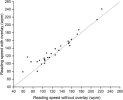
The mean reading speed with overlays was 133.1 ± 37.2 and 124.9 ± 39.6 wpm without (t = 3.7, df = 28, p < 0.01). Fifteen patients (51.7 %) read faster by median 9.9 % (5.0–70.8 %).
Most of the patients (83.3 %) experienced positive visuo-perceptual effects when using the overlay.
A high prevalence of visual function problems was found.
The Visual Discomfort Scale score was positively correlated with Mental Fatigue Scale score (r = 0.67, p < 0.01) and improvement in reading speed (r = 0.48, p = 0.03).
The overlays showed promise as a means for alleviating visual discomfort and improve reading speed.
Additional findings suggest that interventions targeting visual function and mental fatigue also need to be considered.
The improvement in reading with the overlays and its positive correlation with visual discomfort score seem consistent with the attribution of reading difficulty and perceptual distortion to cortical hyperexcitability, a feature that have been indicated after Covid-19.
COVID-19
Visual stress
Reading problems
Visual function
Vision Research
Volume 228, March 2025, 108550Coloured overlays improve reading speed and reading experience in patients with post-COVID-19 syndrome
Kajsa Gode a, Sarah Weström b, Jan Johansson a
aDepartment of Clinical Neuroscience, Division of Eye and Vision, Karolinska Institute, St Erik Eye Hospital, Eugeniavägen 12 SE 171 64, Stockholm, SwedenbDivision of Rehabilitation Medicine, Danderyd University Hospital, Entrévägen 2 SE 182 88, Stockholm, Sweden
Abstract
High prevalences of visual dysfunction and reading-related symptoms have been found in patients with rehabilitation needs after COVID-19 infection.The purpose of this study was to study the effects of coloured overlays on reading speed and reading experience.
Twenty-nine patients (45.2 ± 11.3 years) with reading- and vision-related impairments after Covid-19 infection were included. Symptoms were assessed with the Visual Discomfort Scale and Mental Fatigue Scale.
A visual function assessment was performed by a licensed optometrist. Coloured overlays were tried out individually and the Wilkins Rate of Reading test was used to measure the effect on reading speed in words per minute (wpm).
The mean reading speed with overlays was 133.1 ± 37.2 and 124.9 ± 39.6 wpm without (t = 3.7, df = 28, p < 0.01). Fifteen patients (51.7 %) read faster by median 9.9 % (5.0–70.8 %).
Most of the patients (83.3 %) experienced positive visuo-perceptual effects when using the overlay.
A high prevalence of visual function problems was found.
The Visual Discomfort Scale score was positively correlated with Mental Fatigue Scale score (r = 0.67, p < 0.01) and improvement in reading speed (r = 0.48, p = 0.03).
The overlays showed promise as a means for alleviating visual discomfort and improve reading speed.
Additional findings suggest that interventions targeting visual function and mental fatigue also need to be considered.
The improvement in reading with the overlays and its positive correlation with visual discomfort score seem consistent with the attribution of reading difficulty and perceptual distortion to cortical hyperexcitability, a feature that have been indicated after Covid-19.
Keywords
Coloured overlaysCOVID-19
Visual stress
Reading problems
Visual function