Circulating immune complexes

Arfmeister

Senior Member (Voting Rights)
I’m trying to look for a possible lead:

I recently had high blood-measurements of Circulating Immune Complexes (CIC) at 2 different time points
  • Early September : 130 (reference range 0-20)
  • Half October : 78 (range 0-20)
    • October was AFTER a immune suppressive treatment
Note:
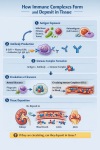
Circulating immune complexes are antigen–antibody complexes normally cleared by:
• Complement system
• Liver & spleen
When clearance fails, complexes circulate and deposit in tissues.

It’s not used as a standalone marker. Specialist interpret CIC together in conjunction with:
• Symptoms and Disease context
• And markers : Complement levels (C3, C4)
• Inflammatory markers (ESR, CRP)
⇒ these were normal within range btw
***

My clinician did not know what it implied, but that it is immune related.
As far as I understand, it is common in lupus, R.A. Sjögren’s syndrome, and some other conditions and chronic infections.

There is very little to be found about Immune Complexes and ME

My questions:
  1. Anyone else had CIC measured?
  2. Is this a possible lead for further investigation or a potential diagnosis / comorbidity?
  3. What other test would you advise?

*PS attachment: chatGTP made an overview as an explanation CIC
(so I cannot vouch for the correctness)
 

Attachments
  • 8AEF7620-F4A0-4BAE-AA06-60239A6363C1.png
    8AEF7620-F4A0-4BAE-AA06-60239A6363C1.png
    1.1 MB · Views: 7
Last edited:
I have found these 3 articles :

1) A 1994 German study found circulating immune complexes in 42% of investigated CFS patients, alongside other markers like elevated TNF-α
<https://pubmed.ncbi.nlm.nih.gov/7856214/ >

2) A 1995 U.S. study of 579 CFS patients (compared to controls) showed significantly elevated circulating immune complexes (adjusted odds ratio: 26.5)
<https://pubmed.ncbi.nlm.nih.gov/7632202/ >

3) a 1991 review noted low levels of circulating immune complexes as a common finding in CFS, and some case-control studies found no significant differences.
<https://pubmed.ncbi.nlm.nih.gov/1902321/>
 
We need to know what assays are being used. Things have moved on from the days of circulating immune complex assays that anyone believed (the 1970s). Most of the old assays depend on complement engagement or artifactual precipitation conditions and may just have measured Ig levels as much as anything.

Do you have any idea what assay was used?

Immune complexes are probably very important in several diseases but for quite different reasons in each disease. I don't see any clinical evidence of circulating immune complexes acting in ME/CFS though.
 
Do you have any idea what assay was used?

The unit used: ED/mL
Reference range 0 to 20 ED/mL

Very likely a C1q binding ELISA
  • I even have the LOINC code 27831-7I

Immune complexes are probably very important in several diseases but for quite different reasons in each disease

Yes. I was wondering if I could go with these results to a run-of-the-mill rheumatologist or immunologist to check if I have a secondary disease.
Or should I have a specific symptomology to go with it?
 
Yes. I was wondering if I could go with these results to a run-of-the-mill rheumatologist or immunologist to check if I have a secondary disease.
Or should I have a specific symptomology to go with it?

For the last twenty years of my working life as a rheumatologist everyone completely ignored immune complex assays as meaningless. I suspect that continues.

If circulating complexes bind C1q they are taken up by red cell CR1 and cleared without ill effect. The fashion for immune complex assays was in the 1980s when nobody understood the role of complement in disease.
 
What does ED stand for?
ED/ml stands for Equivalent Doses/ml
Like Units: µg Eq/mL or EU/mL

doubt C1q would be used in an ELISA since its binding is dependent on steric conformations in fluid phase?

I’m trying to find out. Very complicated to contact the lab (also lacking the capacity)

it’s definitely ELISA. My guess it’s either:
- C3d-Binding Assay
- C1q binding
They both have cut off points at ≥ 20 EU/ml

I will try to find more information

< https://kentri.testcatalog.org/show/FCIC >
 
For the last twenty years of my working life as a rheumatologist everyone completely ignored immune complex assays as meaningless. I suspect that continues.

If circulating complexes bind C1q they are taken up by red cell CR1 and cleared without ill effect. The fashion for immune complex assays was in the 1980s when n

Bugger, So it probably won’t lead to any interest of a specialist ?

Do you also think it doesn’t really imply anything - with typical classic ME symptomology - without any other lab-data ?
 
Do you also think it doesn’t really imply anything - with typical classic ME symptomology - without any other lab-data ?

Yes, we realised in the 1980s that immunoglobulins will stick to complement components in plastic systems for all sorts of irrelevant reasons. I am amazed that these things are still offered. They may have got re-invented by people who are unaware why they were binned.
 
Back
Top Bottom