ME/CFS Science Blog's new article linked to a
review of cytokine assays done in CSF
In this article, we have made a comprehensive overview of research findings on the immune system in patients with myalgic encephalomyelitis/chronic fatigue syndrome (ME/CFS). In contrast to what is frequently claimed, current data do not suggest that (low-grade) inflammation is a key driver of ME/CFS symptoms. There have been major studies into viral persistence, antibodies, and cytokines, but with mostly null results. The most consistent findings in the ME/CFS literature on the immune system over the past 40 years are reduced natural killer cell cytotoxicity and increased levels of...
There were 4 studies, and CXCL10 was measured in 2 of them. If CXCL10 drives feelings of malaise in ME/CFS, you might expect it to be higher in the CSF compared to healthy controls.
One study (
Hornig et al.) found elevated levels (n=32 ME/CFS, 19 controls):
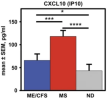
I don't think these p-values were corrected. I'll note that the very high level in MS biobank samples could either be due to active immune processes in the brain, or the fact that synthetic interferon is a standard treatment for MS (and CXCL10 is a strongly induced interferon-stimulated gene). The 19 controls were also from a biobank--the samples were only included if there was no sign of infection in the CNS, but they are not truly healthy controls since the samples were taken to try to diagnose an unknown health issue.
In contrast, Peterson et al. (n=18 ME/CFS, 5 controls) reported only one significantly different finding, and it was IL-10 not CXCL10. Interestingly 2/4 studies found decreased IL-10 in ME/CFS, which is a cytokine that counteracts STAT1-dependent interferon-stimulated gene signaling. But a third study found it was elevated, so seems inconsistent. IL-10 is also involved in and induced by other signaling so it would be considered a poor proxy for the possible influence of IFN/CXCL10.
Unfortunately I am not sure if there's a good way to follow up on this. The next logical question would be whether CXCL10 is most elevated when participants are in active PEM (or if it is significantly higher the most severe someone is). But in either case, I don't think it would be particularly ethical to subject someone in active PEM or a severe pwME to an LP


