
You are using an out of date browser. It may not display this or other websites correctly.
You should upgrade or use an alternative browser.
You should upgrade or use an alternative browser.
Book: 'Tell me where it hurts' by Dr Rachel Zoffness
- Thread starter T&O
- Start date


We really need a better label than invisible because it's absolutely misleading and I hate it every time I see it. Most diseases are invisible, no one can tell for the most part, even physicians without advanced technology, because most diseases don't feature boils or poxes or any of that. It should rather be framed correctly as a failure of medicine. I don't like "not detectable" either, because many diseases are not detectable either and are not mistreated.
A better label would make it clear that this is medicine's job to do. This status has nothing to do with the illness or the patients, it's entirely a property of the medical profession and how they handle it, or fail to. But because everything is marketing and vibes, it has to be short enough to fit on a sticker.
A better label would make it clear that this is medicine's job to do. This status has nothing to do with the illness or the patients, it's entirely a property of the medical profession and how they handle it, or fail to. But because everything is marketing and vibes, it has to be short enough to fit on a sticker.

Peter T
Senior Member (Voting Rights)
We really need a better label than invisible because it's absolutely misleading and I hate it every time I see it.
I never know if ‘invisible illness’ refers to conditions where people can look well, that is have no obvious physical manifestations of their condition, such as a leg in plaster, or to the fact that there is no recognised diagnostic test making tge condition some how medically unseen.
In relation to the former, I must admit I always use a walking stick when I am out of the house even on days when I could manage without, partly in case it turns out I do need it, but also as a signal that I have health issues, particularly when parking in disabled spots.
Yeah same and it annoys me because sometimes it seems to be one or the other and other times it seems both so it all just feels arbitrary.I never know if ‘invisible illness’ refers to conditions where people can look well, that is have no obvious physical manifestations of their condition, such as a leg in plaster, or to the fact that there is no recognised diagnostic test making tge condition some how medically unseen.

I heard it too. I'm sure Zoffness will be turning up on media around the world, promoting her book. She is very slick, her anecdotes and explanations are very well practised. Nothing we have not heard before, but her anecdotes are convincing and she presents herself as compassionate.Heard about this last weekend on Radio NZ national.
Pain is contextual, so the man who had a big nail go through his boot feels pain, even though the nail passed between his toes, while the man who saw a nail from a nail gun go flying off away from him does not realise that he has a nail embedded in his face for days. She tells us that the man with the nail in his face only had a slight headache, but it eventually prompted him to go see the doctor when the 4 inch nail was discovered.
There waa a lot about phantom limb pain. There was an example of how Zoffness had helped a young man emerge from months of being in his room. It seemed to have a lot to do with stopping playing computer games at all hours and cutting his long hair. There was the example of how Usain Bolt has severe scoliosis, but he didn't let the pain stop him from being a great runner, in fact he turned his back deformity that makes one leg considerably shorter than the other into a competitive advantage. (Implication - you people moaning about chronic pain just have the wrong attitude.)
It's all wrapped up with the conclusion that if pain is contextual, we can think out way out of it. And that if pain continues beyond 3 months and the all-seeing medical images can't show a problem, then it is our responsibility to think about the pain in a different way.
The radio interviewer lapped it all up, saying it was inspiring, and acting as though these were great revelations. It really feels impossible to combat this stuff. People want it to be true so badly, and of course, as with most convincing lies, there is a grain of truth.
Last edited:
Here's a link to the RNZ National radio interview:

 www.rnz.co.nz
I expect if you haven't already heard of her, she'll be coming to a media outlet near you very soon.
We've been misunderstanding pain for decades
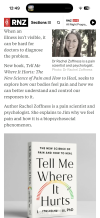
Author Rachel Zoffness is a pain scientist and psychologist. She explains to Jim why we feel pain and how it is a biopsychosocial phenomenon.
www.rnz.co.nz
I expect if you haven't already heard of her, she'll be coming to a media outlet near you very soon.


It sounds dire and incredibly unkind to people suffering horrendous pain. A few freakish examples may make for a best selling book and lots of media coverage for the author, but it doesn't make good science or medicine, or compassionate care.
Reminds me of Suzanne O'Sullivan's books.
I can't help wondering whether authors like this have ever suffered anything remotely like the conditions or symptoms they pontificate about, and how they behave towards others who are suffering.
Reminds me of Suzanne O'Sullivan's books.
I can't help wondering whether authors like this have ever suffered anything remotely like the conditions or symptoms they pontificate about, and how they behave towards others who are suffering.

Lou B Lou
Senior Member (Voting Rights)
If pain is so very subjective and controllable - then what's so wrong with physical torture?
In fact, if pain is so controllable - what's the point of physical torture? And why would torture be prohibited so widely under International Law?
In fact, if pain is so controllable - what's the point of physical torture? And why would torture be prohibited so widely under International Law?
- European Convention on Human Rights (ECHR): Article 3 prohibits torture, inhuman, or degrading treatment.
- UN Convention Against Torture (CAT): An international treaty binding governments to prevent torture and protect victims.
- Human Rights Act 1998: Incorporates these protections into UK law. [1, 2, 3, 4]

Nightsong
Senior Member (Voting Rights)
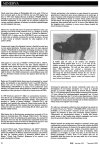
I had heard someone making claims about the "boot nail" case before, so decided to track it down. It comes from a tiny snippet in a Minerva column (comprising miscellaneous news & anecdotes of interest that were sent in) in the BMJ from January 1995. This is literally all that was written about it:
On a foundation of anecdotes such as this a whole "biopsychosocial" edifice and narrative is constructed, the endpoint of which, when applied to patients, is "you're not really ill and should just think yourself better".
On a foundation of anecdotes such as this a whole "biopsychosocial" edifice and narrative is constructed, the endpoint of which, when applied to patients, is "you're not really ill and should just think yourself better".

Or anaesthetic for medical procedures. I will take these people more seriously when they undergo major invasive surgery without it.If pain is so very subjective and controllable - then what's so wrong with physical torture?
In fact, if pain is so controllable - what's the point of physical torture?
It's absurd how blatantly nonsensical this is, how you can have someone making a big reveal out of some deep hidden truth that happens to be the dominant model of the last 3+ decades.Here's a link to the RNZ National radio interview:
We've been misunderstanding pain for decades
Author Rachel Zoffness is a pain scientist and psychologist. She explains to Jim why we feel pain and how it is a biopsychosocial phenomenon.
I expect if you haven't already heard of her, she'll be coming to a media outlet near you very soon.
It's new now. It was new a decade ago. And it was new two decades ago. Even three decades ago, when it was new, it was also the dominant model, it just didn't have as much marketing behind it. It's just like every trial of the same old thing that is also new/novel but backed by years of clinical experience, being tested for the very first time for mere feasibility, but also boasting of being effective, even when, always, the results are negative.
It's the same grift as the old snake oil peddlers. Not a similar one. The very same, identical in every way. Now there is no longer any bottle, or oil, only the snake remains, and it's selling the idea of a concept of the secret to perfect health. Literally The Secret, adapted to health instead of wealth.

Utsikt
Senior Member (Voting Rights)
Transcription:This is literally all that was written about it:
A builder aged 29 came to the accident and emergency department having jumped down on to a 15 cm nail. As the smallest movement of the nail was painful he was sedated with fentanyl and midazolam. The nail was then pulled out from below. When his boot was removed a miraculous cure appeared to have taken place. Despite entering proximal to the steel toecap the nail had penetrated between the toes: the foot was entirely uninjured.
There’s no documentation. No images of the foot, and no discussion about the possibility of the patient being scared or in panic, instead of in pain. There might also have been some slight injury to the foot that they glossed over - a paper cut really hurts, and I can imagine having a nail rubbing in it would be quite unpleasant. The feet are sensitive.-JP FISHER, senior house officer, D T HASSAN, senior registrar, N O'CONNOR, registrar, accident and emergency depart- ment, Leicester Royal Infirmary.
Historically, almost all of the examples presented this way turned out to be wildly misleading, sometimes made up. It's safe to assume that the details here may depict a convincing narrative, but they are likely a significant distortion of what actually happened.There waa a lot about phantom limb pain. There was an example of how Zoffness had helped a young man emerge from months of being in his room. It seemed to have a lot to do with stopping playing computer games at all hours and cutting his long hair. There was the example of how Usain Bolt has severe scoliosis, but he didn't let the pain stop him from being a great runner, in fact he turned his back deformity that makes one leg considerably shorter than the other into a competitive advantage. (Implication - you people moaning about chronic pain just have the wrong attitude.)
But still it's wild how "we can't trust patient anecdotes" quickly becomes "you can't not trust physician-recounted anecdotes" whenever The Narrative is popular. All the rules and principles are completely flexible if they are to be used in the production of a popular fairy tale. Even though all those rules will be absolute if they are not part of The Popular Narrative, showing how everyone understands that they declare up and down, or more specifically the direction of causality, as it pleases them, rather than which is more plausible, probably or even rational.
This part is especially not believable:Transcription:
There’s no documentation. No images of the foot, and no discussion about the possibility of the patient being scared or in panic, instead of in pain. There might also have been some slight injury to the foot that they glossed over - a paper cut really hurts, and I can imagine having a nail rubbing in it would be quite unpleasant. The feet are sensitive.
That's not something likely to happen for the mere possibility of an injury like this, unchecked because it's still in the boot. At least make it realistic. But as you say, there are no verified details. That something so flimsy must be invoked to support a model is as sure a thing that the model is a bunch of hot air.As the smallest movement of the nail was painful he was sedated with fentanyl and midazolam.
There is one unmistakable pattern in such anecdotes, they follow the same trend as Bigfoot sightings: more common as you go back in time, much less so as cameras become available in everyone's pockets / medical records become more standardized and detailed.
Utsikt
Senior Member (Voting Rights)
And let’s not forget the fake blue baby anecdotes. I wonder what the sources of the boot guy have to say about it today.This part is especially not believable:
That's not something likely to happen for the mere possibility of an injury like this, unchecked because it's still in the boot. At least make it realistic. But as you say, there are no verified details. That something so flimsy must be invoked to support a model is as sure a thing that the model is a bunch of hot air.
There is one unmistakable pattern in such anecdotes, they follow the same trend as Bigfoot sightings: more common as you go back in time, much less so as cameras become available in everyone's pockets / medical records become more standardized and detailed.

Kitty
Senior Member (Voting Rights)
My rule: If it says "how to heal" it's definitely psycho-bollocks and probably a grift.
My broken ribs and bruised spleen hurt like hell, and nobody once mentioned how to heal. They gave me dihydrocodeine and advised that sitting on a higher chair might make it less painful to get up.
My broken ribs and bruised spleen hurt like hell, and nobody once mentioned how to heal. They gave me dihydrocodeine and advised that sitting on a higher chair might make it less painful to get up.

Arnie Pye
Senior Member (Voting Rights)
Author Rachel Zoffness is a pain scientist and psychologist. She explains to Jim why we feel pain and how it is a biopsychosocial phenomenon.
I know it is none of my business, but I would love to know the experience(s) of severe pain that authors like this one have gone through and then pontificate about. I often think they must have almost no experience of anything worse than a cold or a mildly stubbed toe.
Why don't such authors discuss the pain of something the general reader might have more idea about e.g. appendicitis, a broken leg, a woman having a heart attack dismissed as being anxious and attention-seeking, and so on.
I went back to listen to the radio item and unfortunately the recording has a bit missing around the 10 minute mark, where the discussion of the nail in the boot and the nail in the face was.
Re torture and anaesthetic, I think their answer would be that they aren't suggesting that pain is not real, and or that pain lasting less than 3 months is not valid. But, when it lasts more than 3 months or longer than the time it should take to heal, somehow it miraculously changes to something that is not protective, 'a disease of the central nervous system', and should be ignored.
Re torture and anaesthetic, I think their answer would be that they aren't suggesting that pain is not real, and or that pain lasting less than 3 months is not valid. But, when it lasts more than 3 months or longer than the time it should take to heal, somehow it miraculously changes to something that is not protective, 'a disease of the central nervous system', and should be ignored.
Thanks @Nightsong. That's remarkable. Zoffness tells us she got the anecdote about Usain Bolt and his scoliosis off Medtwitter.I had heard someone making claims about the "boot nail" case before, so decided to track it down. It comes from a tiny snippet in a Minerva column (comprising miscellaneous news & anecdotes of interest that were sent in) in the BMJ from January 1995. This is literally all that was written about it: