Ravn
Senior Member (Voting Rights)
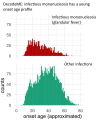
Interesting work, thanks @Simon M. It's probably as much as can be done with the available data (unless the decode data can somehow be re-analysed by age of onset subgoup)
I don’t know what to think of the results, still on the fence.
Could be mostly diagnostic bias. Doctors may just be diagnosing certain groups more because they have two stereotypes in their mind, the PVF in a teenager after mono, and the middle-aged woman unable to cope with life’s demands . Others with the same presentation may just be more likely to get a different diagnosis. I first fell ill at age 10. An initial PVF explanation was soon replaced by ‘growing pains’. A major relapse in my late 20s was (wrongly) deemed MS. Wasn’t until I hit middle age ME/CFS was even considered. Also, all the data is from Europe which makes it more likely that doctors share the same biases. Would be interesting to see if there’s a double peak in completely different cultures as well, if suitable data can be found
Or it could reflect a biological reality. Though even in this case it may still all be one and the same illness the risk of which increases with age. The first peak my just be a blip on top of the ‘normal’ age-related increase, caused by higher numbers of mono in that age group. And the decreasing case numbers in the older age groups may be due to almost everyone who’s susceptible having already succumbed. Would be interesting to see data from countries where everyone gets EBV early and consequently there isn’t much mono, would the early peak still show?
Or it could be an important clue to pathology. In which case, would it make sense to look at papers looking at major physiological changes during normal ageing, also beyond puberty and menopause, changes that might plausibly increase the likelihood of something going wrong in susceptible people? For example this paper (barely) discussed here?
I don’t know what to think of the results, still on the fence.
Could be mostly diagnostic bias. Doctors may just be diagnosing certain groups more because they have two stereotypes in their mind, the PVF in a teenager after mono, and the middle-aged woman unable to cope with life’s demands
. Others with the same presentation may just be more likely to get a different diagnosis. I first fell ill at age 10. An initial PVF explanation was soon replaced by ‘growing pains’. A major relapse in my late 20s was (wrongly) deemed MS. Wasn’t until I hit middle age ME/CFS was even considered. Also, all the data is from Europe which makes it more likely that doctors share the same biases. Would be interesting to see if there’s a double peak in completely different cultures as well, if suitable data can be foundOr it could reflect a biological reality. Though even in this case it may still all be one and the same illness the risk of which increases with age. The first peak my just be a blip on top of the ‘normal’ age-related increase, caused by higher numbers of mono in that age group. And the decreasing case numbers in the older age groups may be due to almost everyone who’s susceptible having already succumbed. Would be interesting to see data from countries where everyone gets EBV early and consequently there isn’t much mono, would the early peak still show?
Or it could be an important clue to pathology. In which case, would it make sense to look at papers looking at major physiological changes during normal ageing, also beyond puberty and menopause, changes that might plausibly increase the likelihood of something going wrong in susceptible people? For example this paper (barely) discussed here?