Blog: DNA sequencing study to help pinpoint biology of ME gets £4.7m

Simon M

Senior Member (Voting Rights)
DNA sequencing study to help pinpoint biology of ME gets £4.7m

The science of Sequence ME and Long Covid

The UK government has awarded nearly £5 million to fund full sequencing of the DNA of 6,000 people with ME using the best available technology. This will help scientists home in on what is really driving the disease. And will probably be the biggest study of its kind for any disease.

The UK government has committed £4.7 million directly to ME/CFS research through an award from its Office for Life Sciences to the landmark study Sequence ME & Long Covid. The award will pay for full sequencing of the DNA of 6,000 people with ME/CFS, using the method of British biotech company Oxford Nanopore Technologies.

This is an extraordinary moment for ME/CFS. It used to get by on the dregs of research funding, but now has a study that will probably be the largest of any single disease using this technique. It Is the result of a lot of work by a lot of people.

The DNA samples are already available through the DecodeME study. Sequence ME & Long Covid ultimately aims to sequence 9,000 people with ME/CFS and 9,000 with Long Covid – as funds permit. The project is led by the University of Edinburgh and Action for ME.

Full sequencing can reveal more

The new method gives real depth of genetic detail. DecodeME used older, much cheaper technology looking at common DNA differences at about half a million places in the whole genome. It found a genetic signal in eight small regions of DNA, but these contained dozens of genes, and it isn’t yet clear which ones are involved in ME/CFS.

Using the Oxford Nanopore Technologies approach, Sequence ME & Long Covid will be able to sequence almost all of the 3 billion chemical 'letters' in the human genome. As Professor Chris Ponting, scientific lead for the study said,

“This project will allow us to pinpoint individual genes disrupted in ME/CFS… breaking down this complex disease into its underlying biological causes – bringing us closer to more precise diagnosis and, ultimately, targeted treatments.”

The technology
1778573550340.png

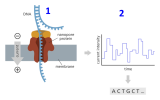
At its heart, the sophisticated Oxford Nanopore technology is simple, as shown in the image above,

  • A strand of DNA is threaded through a tiny hole in a membrane - a nanopore.
  • Each of the four chemical letters (A, T, G and C) creates a distinct electrical signal as it passes through the pore – and the DNA sequence can be read out from the electrical trace, one letter at a time.

30 second video


read the full blog for more:
  • why full sequencing help pinpoints the biology behind ME/CFS
  • why the long read of the nanopore approach is so important (finds genetic changes other methods miss
  • plus nanopore method detects gene silencing (epigenetics)
  • cutting edge data analysis from the European Bioinformatics Institute, a partner in the study
 
Last edited:
I'm guessing this funding would not have happened without the original DecodeME study, which demonstrated there is something worthy of further investigation. Together with Long Covid implications.

Great video by the way!
It wouldn't, because of the samples.
And thanks re video - credit to @Adam pwme for the video creation. My thanks for his work and his patience (animations from Oxford nanopore, words and any errors by me),

Something amiss in this sentence:
It used to get by on the dregs of research funding has new a study that will probably be the largest for a single disease using this technique.

But this one is just right:
Thanks. Does this work?
This is an extraordinary moment for ME/CFS. It used to get by on the dregs of research funding has new a study that will probably be the largest for a single disease using this technique. It Is the result of a lot of work by a lot of people.
 
Thank you for another great blog post and a very clear explanation of the Nanopore technology, it's amazing!

Given the two age peak result, and the possibility of two pathways into ME/CFS -- do we have any idea if the sequenceME data can be analyzed taking into account age of onset? Or would that leave too few cases in each set for statistics to find anything?
 
I'm confused by this bit. I thought you were saying the existing DecodeME samples are already available? Or are they from a later batch than those used in the original study?
I believe Simon is, correctly, saying that the funding wouldn't have happened without DecodeME, as DecodeME showed that there was something worth investigating further and meant that the samples were already available.
 
Great blog and wonderful news!

I was struck by this line:
This is an extraordinary moment for ME/CFS. It used to get by on the dregs of research funding has new a study that will probably be the largest for a single disease using this technique.
I didn't know this. So this would be an area of technology and biomedicine where ME/CFS is actually in the lead?
 
DNA sequencing study to help pinpoint biology of ME gets £4.7m

The science of Sequence ME and Long Covid

The UK government has awarded nearly £5 million to fund full sequencing of the DNA of 6,000 people with ME using the best available technology. This will help scientists home in on what is really driving the disease. And will probably be the biggest study of its kind for any disease.

The UK government has committed £4.7 million directly to ME/CFS research through an award from its Office for Life Sciences to the landmark study Sequence ME & Long Covid. The award will pay for full sequencing of the DNA of 6,000 people with ME/CFS, using the method of British biotech company Oxford Nanopore Technologies.

This is an extraordinary moment for ME/CFS. It used to get by on the dregs of research funding, but now has a study that will probably be the largest of any single disease using this technique. It Is the result of a lot of work by a lot of people.

The DNA samples are already available through the DecodeME study. Sequence ME & Long Covid ultimately aims to sequence 9,000 people with ME/CFS and 9,000 with Long Covid – as funds permit. The project is led by the University of Edinburgh and Action for ME.

Full sequencing can reveal more

The new method gives real depth of genetic detail. DecodeME used older, much cheaper technology looking at common DNA differences at about half a million places in the whole genome. It found a genetic signal in eight small regions of DNA, but these contained dozens of genes, and it isn’t yet clear which ones are involved in ME/CFS.

Using the Oxford Nanopore Technologies approach, Sequence ME & Long Covid will be able to sequence almost all of the 3 billion chemical 'letters' in the human genome. As Professor Chris Ponting, scientific lead for the study said,

“This project will allow us to pinpoint individual genes disrupted in ME/CFS… breaking down this complex disease into its underlying biological causes – bringing us closer to more precise diagnosis and, ultimately, targeted treatments.”

The technology

View attachment 32299

At its heart, the sophisticated Oxford Nanopore technology is simple, as shown in the image above,

  • A strand of DNA is threaded through a tiny hole in a membrane - a nanopore.
  • Each of the four chemical letters (A, T, G and C) creates a distinct electrical signal as it passes through the pore – and the DNA sequence can be read out from the electrical trace, one letter at a time.

30 second video


read the full blog for more:
  • why full sequencing help pinpoints the biology behind ME/CFS
  • why the long read of the nanopore approach is so important (finds genetic changes other methods miss
  • plus nanopore method detects gene silencing (epigenetics)
  • cutting edge data analysis from the European Bioinformatics Institute, a partner in the study

Wow - amazing news!!!
 
I didn't know this. So this would be an area of technology and biomedicine where ME/CFS is actually in the lead?
Yes, according to Chris. Although it's qualified by this kind of long-Read sequencing that also picks up epigenetic signals.

It is, astonishing, though and something to celebrate.


I'm confused by this bit. I thought you were saying the existing DecodeME samples are already available? Or are they from a later batch than those used in the origin
Sorry for the ambiguity – I was saying that the samples are good to go. Which obviously saves a huge amount of time and money. For long Covid, they first have to agree a case definition of LC, then go out and recruit people, collect samples and do DNA extraction.
 
For long Covid, they first have to agree a case definition of LC
Do you know much about how this is planning to be done?

Because you can pick up quite different things depending on the case definition, and even then, even the strictest definitions will pick up quite a heterogenous group. From people who have what looks like OI, to maybe Post-Viral Fatigue, to full blown ME/CFS, to stomach-symptoms post-COVID to who knows what else (and that’s assuming all known pathologies and “minor” things like loss of taste are excluded). And then what happens to post-covid me/cfs samples? do they get included? are they redundant.

Perhaps you’re not the right person to ask this and this isn’t the right thread to pose these questions, sorry if that’s the case. But I’m a bit worried unless there’s a clear vision or very meticulous subtyping that sequence long covid could yield a bit of a muddle data wise.
 
Do you know much about how this is planning to be done?

Because you can pick up quite different things depending on the case definition, and even then, even the strictest definitions will pick up quite a heterogenous group. From people who have what looks like OI, to maybe Post-Viral Fatigue, to full blown ME/CFS, to stomach-symptoms post-COVID to who knows what else (and that’s assuming all known pathologies and “minor” things like loss of taste are excluded). And then what happens to post-covid me/cfs samples? do they get included? are they redundant.

Perhaps you’re not the right person to ask this and this isn’t the right thread to pose these questions, sorry if that’s the case. But I’m a bit worried unless there’s a clear vision or very meticulous subtyping that sequence long covid could yield a bit of a muddle data wise.
In case it helps, a reply of mine to a similar question over on the main SequenceME thread,
The definition is yet to be decided upon and forms part of the work already funded by previous supporters. I can't guarantee at this stage what the definition will be but we are well aware that it will need to be better than anything as vague as "3 months of any symptom at all after a Covid infection". Given that eventually we will be comparing them with DecodeME particpants I personally would like to see all LC participants evaluated with the DecodeME questionnaire for likely ME/CFS status.
 
Back
Top Bottom