Bi-ancestral depression GWAS in the Million Veteran Program and meta-analysis in >1.2 million individuals [...], 2021, Levey et al

forestglip

Moderator
Staff member
Bi-ancestral depression GWAS in the Million Veteran Program and meta-analysis in >1.2 million individuals highlight new therapeutic directions

Levey, Daniel F.; Stein, Murray B.; Wendt, Frank R.; Pathak, Gita A.; Zhou, Hang; Aslan, Mihaela; Quaden, Rachel; Harrington, Kelly M.; Nuñez, Yaira Z.; Overstreet, Cassie; Radhakrishnan, Krishnan; Sanacora, Gerard; McIntosh, Andrew M.; Shi, Jingchunzi; Shringarpure, Suyash S.; Concato, John; Polimanti, Renato; Gelernter, Joel

Abstract
Major depressive disorder is the most common neuropsychiatric disorder, affecting 11% of veterans. We report results of a large meta-analysis of depression using data from the Million Veteran Program (MVP), 23andMe Inc., UK Biobank, and FinnGen; including individuals of European ancestry (n=1,154,267; 340,591 cases) and African ancestry (n=59,600; 25,843 cases).

Transcriptome-wide association study (TWAS) analyses revealed significant associations with expression of NEGR1 in the hypothalamus and DRD2 in the nucleus accumbens, among others. 178 genomic risk loci were fine-mapped, and we identified likely pathogenicity in these variants and overlapping gene expression for 17 genes from our TWAS, including TRAF3. Finally, we were able to show substantial replications of our findings in a large independent cohort (N=1,342,778) provided by 23andMe.

This study sheds light on the genetic architecture of depression and provides new insight into the interrelatedness of complex psychiatric traits.

Web | DOI | PMC | PDF | Nature Neuroscience | Open Access (On PMC)
 
2021 study, but I was interested in it because it's so large (>350,000 cases), and to see how the MAGMA tissue enrichment might compare with DecodeME or a large anxiety GWAS, which seem to have similar MAGMA results.

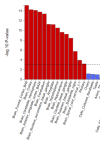
Here is the MAGMA tissue enrichment from this study:
1770833438160.png

In order of significance:
  1. Frontal Cortex
  2. Cortex
  3. Cerebellar hemisphere
  4. Anterior cingulate cortex BA24
  5. Cerebellum
  6. Nucleus accumbens
  7. Amygdala
  8. Hypothalamus
  9. Hippocampus
  10. Caudate nucleus
  11. Putamen
  12. Substantia nigra
  13. Spinal cord
  14. Pituitary

Compared to DecodeME:
  1. Frontal cortex
  2. Cortex
  3. Anterior cingulate cortex BA24
  4. Nucleus accumbens
  5. Caudate nucleus
  6. Amygdala
  7. Hippocampus
  8. Cerebellar hemisphere
  9. Hypothalamus
  10. Cerebellum
  11. Putamen
  12. Spinal cord
  13. Substantia nigra

And the recent anxiety GWAS:
  1. Frontal cortex
  2. Cortex
  3. Anterior cingulate cortex BA24
  4. Nucleus accumbens
  5. Cerebellar hemisphere
  6. Cerebellum
  7. Caudate nucleus
  8. Amygdala
  9. Hypothalamus
  10. Putamen
  11. Hippocampus
  12. Substantia nigra
  13. Spinal cord

It's frontal cortex and cortex leading the pack in all of these. Anterior cingulate cortex and nucleus accumbens aren't far behind in this depression GWAS, and they are 3rd and 4th most significant in anxiety and ME/CFS.
 
Last edited:
I am not sure how they established that NEGR1 expression in hypothalamus and DRD2 in nucleus accumbens was relevant.
A transcriptome-wide assocation study (TWAS), used here, does something like trains a machine learning model to predict expression of a given gene based on SNP patterns (using existing expression databases like GTEx), then uses some method (that I don't really understand) on GWAS summary statistics to see how well the disease status associates to the identified genetic component of expression of the gene based on the ML model. That's probably not perfectly correct, but basically, it's a more advanced way of seeing how well the SNP associations from a disease study match with SNP associations from gene expression studies.

DecodeME used a different method to see if the significant variants in the study matched expression of genes (and if so, they were labeled "Tier 1" genes), but it's somewhat the same idea.
 
Last edited:
So how do they link the NEGR1 genetic linkage specifically to hypothalamic expression? That is what I am confused about.
To add to the above post, they are looking for how well SNP associations match with gene expression in specific tissues. Like DecodeME did using a different method, where they found, for example, that ME/CFS SNPs matched up with expression of RABGAP1L expression in several specific tissues.
 
To add to the above post, they are looking for how well SNP associations match with gene expression in specific tissues. Like DecodeME did using a different method, where they found, for example, that ME/CFS SNPs matched up with expression of RABGAP1L expression in several specific tissues.
But «exists in this tissue in general» is not the same as «is pathological in this tissue»?

What if the pathology is in a different tissue where NEGR1 is also expressed?
 
But «exists in this tissue in general» is not the same as «is pathological in this tissue»?

What if the pathology is in a different tissue where NEGR1 is also expressed?
Yeah, it's possible. It's more meant as one piece of evidence. If the GWAS points to a gene's expression in one specific tissue, and other evidence implicates the same tissue, it adds to the evidence. Though, it could be that a hypothalamus association might just exist due to similarity of hypothalamus expression to a different tissue.

I think maybe the specific gene identified might be a stronger connection than the specific tissue, since similar SNP patterns might affect the same gene in different tissues, but not so much affect different genes in the same way.
 
To add to the above post, they are looking for how well SNP associations match with gene expression in specific tissues.

But how did they possibly get enough bits of brain tissue from people with positive and negative SNP variants to home in on one region like hypothalamus? That seems to me like the sort of thing machine learning spits out but without any rea justification.
 
But how did they possibly get enough bits of brain tissue from people with positive and negative SNP variants to home in on one region like hypothalamus? That seems to me like the sort of thing machine learning spits out but without any rea justification.
The expression data for hypothalamus, and all other tissues, is from an existing database of variant-expression associations, GTEx. There was no new testing of gene expression in this study, if that's what you mean.

From GTEx:
The project collected samples from up to 54 non-diseased tissue sites across nearly 1,000 deceased individuals. All individuals were densely genotyped to assess genetic variation within their genomes by Whole Genome Sequencing (WGS). Gene expression of each tissue was assessed by RNA sequencing (bulk RNA-seq). Expression quantitative trait loci (eQTLs) were identified as genetic variants that were significantly correlated with changes in the expression of nearby genes. The project provides a comprehensive identification of tissue-shared and tissue-specific human eQTLs, as well as a valuable basis for the mechanistic interpretation of the many non-coding genetic variants that have been associated with common human diseases, such as heart disease, cancer, diabetes, asthma, and stroke.

So the question they're trying to answer, basically, is "do the SNPs associated with depression in this study match up with the SNPs associated with expression of NEGR1 in the hypothalamus (and all other genes and tissues) in the GTEx study?".
 
The expression data for hypothalamus, and all other tissues, is from an existing database of variant-expression associations, GTEx.

That makes sense. I am surprised that such data exist for brains. If they can collect 1000 brains and study expression profiles for every part for thousands or hundreds of thousands of SNP variants that is impressive an suggests that all the needed brain studies on ME/CFS could be done by next Thursday if there was a will!
 
That makes sense. I am surprised that such data exist for brains. If they can collect 1000 brains and study expression profiles for every part for thousands or hundreds of thousands of SNP variants that is impressive an suggests that all the needed brain studies on ME/CFS could be done by next Thursday if there was a will!
Ha maybe. Though GTEx probably gets a lot of funding because the data can then be used by any other GWAS studies in any diseases, to try to see if results line up with gene expression - as it was used here, and as it was used in DecodeME, for example.
 
So do we have any information about the possible link to NEGR1 in ME/CFS in terms of where the relevant (different) SNPs would have altered expression. I am doubtful one could draw any sensible conclusion but it might be interesting.

I am sorry that I cannot keep up with the detail of the methodology here, even if I get the general idea as to what has gone on.
 
So do we have any information about the possible link to NEGR1 in ME/CFS in terms of where the relevant (different) SNPs would have altered expression.
No, they didn't look at gene expression linked to the SNPs near NEGR1 because that locus didn't quite reach genome-wide significance.

I think it might be doable with the freely available DecodeME data by someone who knows how, but I don't think I have the knowledge or energy to do so.
 
Actually, maybe I can do a very simple version. Just checking if specific variants from DecodeME are associated with tissue expression in GTEx. The top variant in the NEGR1 locus is 1:73126414:C:CA (rs34330896). Here's the page for that variant on GTEx: https://www.gtexportal.org/home/snp/rs34330896

There are only two associations for this variant with gene expression. The ME/CFS risk allele (CA) is associated with increased expression of two long non-coding RNA (LINC01360 and LINC02797) in the testes. Not sure how far that gets us. More sophisticated techniques might be able to identify coding genes.
 
That makes sense. I am surprised that such data exist for brains. If they can collect 1000 brains and study expression profiles for every part for thousands or hundreds of thousands of SNP variants that is impressive an suggests that all the needed brain studies on ME/CFS could be done by next Thursday if there was a will!
It helps that GWAS is already looking at common SNPs, increasing the likelihood that some number of donors in the tissue bank had that SNP. I would assume it works far less well for rare variants
 
They looked for drugs that might target the depression-associated genes. It might be an interesting technique to use for ME/CFS genes.
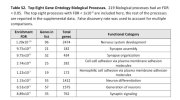
The Manually Annotated Targets and Drugs Online Resource (MATADOR) database was tested for enrichment for 426 significant genes from the MAGMA analysis.
This analysis identified 10 drug annotations with FDR < 0.05 including four drugs that are either estrogen receptor agonists (diethylstilbestrol, Implanon [etonogestril implant]), or anti-estrogens (tamoxifen and raloxifene); in addition to nicotine, cocaine, cyclothiazide, felbamate, and riluzole.

Discussion about some of these drugs:
Riluzole, an NMDA antagonist currently used to treat amyotrophic lateral sclerosis, was one of our top findings. This drug is currently in trials for combination therapy for treatment resistant depression.
Another drug, cyclothiazide, is an allosteric modulator of AMPA (glutamatergic) receptors. Allosteric modulation of glutamatergic receptors has been considered a mechanistic treatment target for depression.
This screen also identified an anti-seizure medication, felbamate, which has side effects including increasing depressive symptoms, suicidal ideation, and attempts.
These three identified drugs, riluzole, felbamate and cyclothiazide, have been shown to modulate glutamatergic activity. Although the exact mechanisms underlying the drugs’ effects on the system remain to be elucidated, it is especially interesting that they were identified in this study considering the emerging evidence of glutamate’s role in the pathophysiology and treatment of mood disorders and the recent US FDA approval of ketamine for treatment-resistant depression.
Riluzole has already been identified as a potential antidepressant treatment, with support for its antidepressant properties found in rodent models31 and small clinical studies. However, larger scale clinical trials have not provided clear evidence to support its efficacy.
 
Back
Top Bottom