Assessing Functional Capacity in [ME/CFS]: A Patient Informed Questionnaire [FUNCAP], 2024, Sommerfelt et al

Not sure if I'm missing something or you misunderstand what I'm trying to articulate. I am attempting to point out a perceived weakness in the design of FUNCAP. Line by line or in isolation, I would have to honestly answer "I must limit other activities on the same day." Yet, with the exception of those who are nearly incapacitated with illness, it's not realistic to assume anyone is able to do as few as one activity per day to avoid triggering PEM.
Yet FUNCAP seems to ask about activities in isolation which is completely meaningless and unrealistic.
FUNCAP doesn’t ask «what would this activity result in in isolation».

It asks you to consider an average day (of activities) the last month, and then to estimate to what extent doing X would affect how much else you could do that day (and the following days).
FUNCAP5 currently gives me a score of

>Mild: Less than a 50% reduction in activity level compared to before the illness.
The paper also acknowledges that FUNCAP has a harder time differentiating between mild and >mild, as well as severe and very severe, and that it isn’t the end all be all of total functional capacity for pwME/CFS.

And I think that doctors should be made aware that trying to go beyond what you currently can manage is going to reduce the effective functional capacity because PEM costs more afterwards than it takes to cause it.
 
Moved posts
FUNCAP is also susceptible to manipulation, because it asks you what think would happen. If you convince someone they are better, they will get a better score.

But it’s much more relevant for ME/CFS than any other PROM.

If there were improvements for individuals due to the treatment, it would affect the averages on a group level. Because there were no differences on a group level, we can’t claim that anyone benefitted from the treatment.

Which is why tele- and 3-day-interventions are so popular now..

An issue with Funcap is it's sensitivity to change. Because it's asking how someone percieves what would happen if they did a task. A person's health could improve but there would be a delay for that person to pervcieve that negative outcomes to exertion are gone. That delay would be different to different people based on how often they do the tasks in the Funcap and realise they have reduced setbacks.
 
Last edited by a moderator:
An issue with Funcap is it's sensitivity to change. Because it's asking how someone percieves what would happen if they did a task. A person's health could improve but there would be a delay for that person to pervcieve that negative outcomes to exertion are gone. That delay would be different to different people based on how often they do the tasks in the Funcap and realise they have reduced setbacks.

It doesn't work like that in real life, though. People with ME/CFS tend frequently to overstretch their capacity (mainly due to lack of any practical alternative), and PEM is a feeling of illness as well as profound exhaustion. You don't fail to notice that you haven't got horrible 'flu symptoms today, or that essential daily activities that used to trigger them currently don't.

Finding out you don't have the PEM you'd normally get only takes 24 - 48 hours, and a sustained increase in function will take a few more days to test out.
 
It doesn't work like that in real life, though. People with ME/CFS tend frequently to overstretch their capacity (mainly due to lack of any practical alternative), and PEM is a feeling of illness as well as profound exhaustion. You don't fail to notice that you haven't got horrible 'flu symptoms today, or that essential daily activities that used to trigger them currently don't.

Finding out you don't have the PEM you'd normally get only takes 24 - 48 hours, and a sustained increase in function will take a few more days to test out.
I don't agree, for me it mostly picks up how well I am pacing.

When I just started tracking my FUNCAP it was much higher because I was still impacted from CBT - so it was not comparable to my scores now despite same capacity and step counts.

When I had random improvement for just 1 month (doubled stepcounts from 1200 to 3000 average), my score did not increase at all because I simply was still trying to pace like before but clearly in reality not doing so according to step counts.

I am sure it would pick up over 2-3 months & full remission, but step counts are much better.. It also is just impacted so much by how you approach pacing and whether you have had CBT or not etc.
 
It doesn't work like that in real life, though. People with ME/CFS tend frequently to overstretch their capacity (mainly due to lack of any practical alternative), and PEM is a feeling of illness as well as profound exhaustion. You don't fail to notice that you haven't got horrible 'flu symptoms today, or that essential daily activities that used to trigger them currently don't.

Finding out you don't have the PEM you'd normally get only takes 24 - 48 hours, and a sustained increase in function will take a few more days to test out.
But most people don’t do the entire scale of activities, so you’d still have to guess for most. And when you’re guessing, the answers will be affected by all kinds of biases.
 
But most people don’t do the entire scale of activities, so you’d still have to guess for most.

No, of course, but because we have to push against our limits doing things we can't avoid—whether that's going out to work or getting up to use a commode—that's where we tend to see any changes almost immediately.

Most people may only be guessing to an extent anyway. I can be confident enough that I can't walk 100 metres because the seven metres between the bed and the ensuite loo makes my legs hurt and turn to jelly, and that I can't cook a meal because I'm regularly having to leave toast half buttered due to keeling over with OI.

It sometimes improves a bit, but I still know where my limits are; I immediately have to fill the extra capacity with things I needed to do and couldn't. [Inserted: We talk about pacing, but] very little activity is ever truly optional with an illness that creates a constant struggle to meet your basic physical needs and stay mentally healthy.
 
would have loved to look at it, but I only have an android phone :(
But if there is anything I can help with, let me know!

Responding to a 2024 comment! I've got a prototype working on Android (though early days). As I had no prior experience with Android development I've been using Claude.AI to translate it from my existing iPhone code.

Interestingly the AI spotted an issue that I hadn't noticed: an unusual reversal/overlap. It queried the raw data I had given it, suggesting I might have entered it wrong. Checking back to the source data I was using, I wonder if the numeric data given in the supplementary files correlates with the graphs.

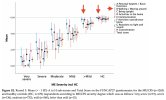
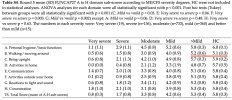
From supplementary file, this is the chart and raw data for F27, looking at domain B) "walking/moving around" in dark green / teal. I've arrowed and underlined in red. Mean ± SD are —

F27 Chart Annot.jpgF27 Data Annot.jpg

V Severe 0.5 ± 0.6
Severe 1.5 ± 0.8
Moderate 3.0 ± 0.9
Mild 4.0 ± 0.9
Mild or better 5.2 ± 0.6
Healthy 5.1 ± 0.3

Looking at the charts the means look to be approximately —

V Severe 0.5
Severe 1.5
Moderate 3.0
Mild 4.0
Mild or better 5.2
Healthy 5.9

---

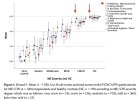
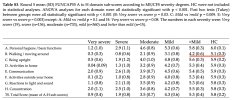
From paper and supplementary, looking at F55, again domain B) walking / moving around, but this time in light blue:

F55 Chart Annot.jpgF55 Data Annot.jpg


Mean ± SD are —

V Severe 0.3 (0.3)
Severe 0.8 (0.6)
Moderate 2.1 (0.9)
Mild 3.1 (0.8)
Mild or better 4.2 (0.6)
Healthy 5.1 (0.3)


Looking at the charts the means look to be approximately —

V Severe 0.6
Severe 1.6
Moderate 3.0
Mild 4.0
Mild or better 5.1
Healthy 5.8

---


I'd appreciate others having a look to confirm in case I'm misreading.
 
Back
Top Bottom