Article: Deadly bat-borne virus with no cure spreading in India with 'epidemic potential' as new cases emerge (Nipah virus)

Sly Saint

Senior Member (Voting Rights)
Indian health officials are scrambling to contain a deadly virus after five cases of the incurable disease were detected near one of the country's biggest cities.

The bat-borne Nipah virus has been identified in West Bengal, close to the state capital Kolkata, India's third-most populous city, prompting urgent contact tracing and quarantines.
Authorities confirmed that three new infections were reported this week, according to officials cited by the Press Trust of India news agency.

They include a doctor, a nurse, and a health staff member. Two nurses - one male and one female - had already tested positive earlier.

Both were working at the private Narayana Multispecialty Hospital in Barasat, around 15 miles north of Kolkata.

Narayan Swaroop Nigam, the principal secretary of the department of health and family, said one of the two nurses is in critical condition after both developed high fevers and respiratory issues between New Year's Eve and January 2, The Telegraph reports.

The critically ill nurse, who is now in a coma, is believed to have contracted the infection while treating a patient suffering from severe respiratory problems.

That patient died before tests could be carried out.
In response, officials have tested 180 people and quarantined 20 high-risk contacts as fears grow of further spread.

Nipah virus spreads between animals and humans, most commonly from infected bats or pigs, and can also be transmitted from person to person.

Fruit bats, which are widespread across India's cities and countryside, are the virus's natural hosts.
 
Today's news:

Airports across Asia reintroduce Covid-style health checks after outbreak of deadly Nipah virus in India

Thailand Ramps Up Airport Health Screening As Deadly Nipah Virus Outbreak Sparks Panic Across India

India Rushes to Contain New Virus Outbreak

I had heard India was still implementing laws, to clear the homeless from city streets, but I doubt they are now allocated to hotels instead, as Britain managed to do, temporarily (last time).

People now fear undetected transmission. People are panicking. Early symptoms are like flu, but if progressing - brain inflammation (which one is allowed to call an encephalitis), seizures and coma etc, so yes it was crucial to detect it fast and isolate cases.

Healthworkers are catching it. One nurse maybe caught it from treating a patient with a severe respiratory illness. The fruit bats are everywhere (in India). 100 people were quarantined and a hospital closed, already. The outbreaks had been sporadic for some years.

I think once local airports are galvanised then all the global airports must also be galvanised. I think it was California had become the 1st united state to rejoin the WHO now that the USA had its 1 year period of grace and is leaving the WHO, opted out of global pandemic programs

It will be very nice if we need not find out the hard way which governments were prepared and which are still making promotional movies instead. Maybe the British can rush out another vaccine to attenuate it for some, and maybe there is no aftermath for survivors.

I think its not air-bourne, but spread through contaminated food and body fluids. Everyone needs a home and every home needs a toilet. At least its not Ebola and I still have an income with a supply of water, food, fuel.
 
On the WHO website, I cannot find any reference to this Nipah outbreak. The WHO indicates that India's public information is good, so we do not need WHO's authoritative, independent info.

It was last year that the WHO saw a need to improve on India's public information

WHO > Emergencoes > Disease Outbreak News said:
Latest WHO Disease Outbreak News (DONs), providing information on confirmed acute public health events or potential events of concern.

According to Article 11.4 of the International Health Regulations (2005) [IHR (2005)], WHO may make information on acute public health events available, if other information about the same event has already become publicly available and there is a need for the dissemination of authoritative and independent information. The DON reports fulfill this requirement.

The events reported in the DON is not an exhaustive list of events that WHO is responding to globally but include those that meet the criteria for information to be made available to the public.

So our news of the current outbreak is good enough. India is now WHO-compliant, and the WHO may be responding, just not publicly. Two Nipah outbreaks in 2025 did warrant the WHO's authoritative independent news (see below).

Nipah is not on the WHO's list of current global emergency situations

I see no WHO travel restriction, and its current global emergency situation report is on the rapid multi-country surge of cholera (returned to 45 more countries in 2024).

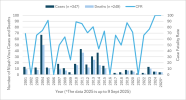
Recently, Nipah became 100% fatal but previously less than that. It seems much better controlled since the bigger problems around the time of SARS:

The WHO Nipah Disease Outbreak News Aug 2025 - India:

"The case-fatality rates in outbreaks across Bangladesh, India, Malaysia, and Singapore typically range from 40% to 100%, depending on local capabilities for early detection and clinical management."

1769595609510.png

The WHO Nipah Disease Outbreak News Sep 2025 - Bangladesh:

"Intensive supportive care is recommended to treat severe respiratory and neurologic complications."

compiled WHO News Aug & Sep 2025 said:
Henipavirus nipahense (Nipah virus) is considered a priority pathogen for the acceleration of medical countermeasures (MCMs) to respond to epidemics and pandemics as part of the WHO R&D Blueprint for Epidemics.

Laboratory diagnosis of a patient with a clinical history of NiV infection can be made during the acute and convalescent phases of the disease by using a combination of tests.

The main tests used are Reverse Transcription Polymerase Chain Reaction (RT-PCR) from bodily fluids and antibody detection via enzyme-linked immunosorbent assay (ELISA).

The incubation period ranges on average from 4 to 14 days. However, an incubation period of up to 45 days has been reported once. People infected with NiV may remain asymptomatic.

Although direct human-to-human transmission has been reported in previous outbreaks, it has been less frequent in recent years

A confirmed history of consuming raw date palm sap (DPS) or tari (fermented date palm sap), seems significant in some but not all cases:

Freshly collected date palm juice should be boiled, and fruits should be thoroughly washed and peeled before consumption. Fruits with signs of bat bites should be discarded. Areas where bats are known to roost should be avoided.
 
Back
Top Bottom