Wyva
Senior Member (Voting Rights)
Xinxin Cheng, Wenkuan Wang, Tingting Xu, Yanjie Wang, Xina Zhen, Wenxuan Man, Shuo Gao & Yonghui Yin
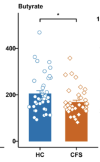
Fecal SCFAs concentrations were quantified using Gas Chromatography–Mass Spectrometry (GC–MS). Spearman correlation analysis with false discovery rate (FDR) adjustment was performed to elucidate associations among gut microbiota, SCFAs, and clinical scores. Compared to the HC group, the CFS group exhibited reduced gut microbiota α-diversity (e.g., ACE, Chao1, Shannon indices, all P < 0.01) and significantly altered β-diversity (ADONIS, P = 0.006). After FDR adjustment, fecal levels of acetate, butyrate, isobutyrate, and isovalerate remained significantly lower in the CFS group (all q < 0.05). Differential abundance analysis revealed a significant reduction in key taxa including the phylum Firmicutes (q = 0.010), class Verrucomicrobiae (q = 0.038), order Clostridiales (q = 0.043), and families Rikenellaceae (q = 0.011) and Ruminococcaceae (q = 0.049).
Spearman correlation analysis solidified functional connections: key SCFA-producing taxa (e.g., Faecalibacterium, Subdoligranulum, Ruminococcaceae) were positively correlated with butyrate levels (r = 0.52–0.56, all q < 0.05). Furthermore, reduced abundances of Rikenellaceae and Alistipes were associated with lower SF-36 scores (r = 0.26, q = 0.032) and higher fatigue scores (FSS/FS-14, r = − 0.28 to − 0.30, q < 0.05). Isovalerate levels were negatively correlated with FS-14 scores (r = − 0.307, q = 0.014). Among CFS patients, those with higher dietary fiber intake had significantly higher levels of acetate and isovalerate than those with lower intake (both q < 0.05).
Patients with CFS exhibit significant gut dysbiosis and abnormal SCFA metabolism. The reduction in key SCFA-producing taxa, their positive correlations with SCFAs levels, and the negative correlations of both with fatigue severity solidify a functional link between gut microbial depletion, reduced SCFAs, and clinical symptoms in CFS. Higher dietary fiber intake may partially ameliorate SCFAs metabolic disturbances in CFS patients.
Open access: https://www.nature.com/articles/s41598-025-27564-y
Abstract
To investigate differences in gut microbiota composition and short-chain fatty acids (SCFAs) metabolism between patients with Chronic Fatigue Syndrome (CFS) and Healthy Controls (HC), and to explore their associations with the CFS pathogenesis. This case–control study included 80 subjects, comprising 40 patients with CFS and 40 age- and sex-matched HC. Fecal microbial community structure was analyzed using 16S rRNA gene high-throughput sequencing.Fecal SCFAs concentrations were quantified using Gas Chromatography–Mass Spectrometry (GC–MS). Spearman correlation analysis with false discovery rate (FDR) adjustment was performed to elucidate associations among gut microbiota, SCFAs, and clinical scores. Compared to the HC group, the CFS group exhibited reduced gut microbiota α-diversity (e.g., ACE, Chao1, Shannon indices, all P < 0.01) and significantly altered β-diversity (ADONIS, P = 0.006). After FDR adjustment, fecal levels of acetate, butyrate, isobutyrate, and isovalerate remained significantly lower in the CFS group (all q < 0.05). Differential abundance analysis revealed a significant reduction in key taxa including the phylum Firmicutes (q = 0.010), class Verrucomicrobiae (q = 0.038), order Clostridiales (q = 0.043), and families Rikenellaceae (q = 0.011) and Ruminococcaceae (q = 0.049).
Spearman correlation analysis solidified functional connections: key SCFA-producing taxa (e.g., Faecalibacterium, Subdoligranulum, Ruminococcaceae) were positively correlated with butyrate levels (r = 0.52–0.56, all q < 0.05). Furthermore, reduced abundances of Rikenellaceae and Alistipes were associated with lower SF-36 scores (r = 0.26, q = 0.032) and higher fatigue scores (FSS/FS-14, r = − 0.28 to − 0.30, q < 0.05). Isovalerate levels were negatively correlated with FS-14 scores (r = − 0.307, q = 0.014). Among CFS patients, those with higher dietary fiber intake had significantly higher levels of acetate and isovalerate than those with lower intake (both q < 0.05).
Patients with CFS exhibit significant gut dysbiosis and abnormal SCFA metabolism. The reduction in key SCFA-producing taxa, their positive correlations with SCFAs levels, and the negative correlations of both with fatigue severity solidify a functional link between gut microbial depletion, reduced SCFAs, and clinical symptoms in CFS. Higher dietary fiber intake may partially ameliorate SCFAs metabolic disturbances in CFS patients.
Open access: https://www.nature.com/articles/s41598-025-27564-y