
You are using an out of date browser. It may not display this or other websites correctly.
You should upgrade or use an alternative browser.
You should upgrade or use an alternative browser.
A natural experiment on the effect of herpes zoster vaccination on dementia, 2025, Eyting et al
- Thread starter Mij
- Start date

Are you referring to the new study linked in another thread?Not read the paper yet, but can they get beyond demonstrating an association. The abstract seems to be claiming they have proved causation which the previous studies reported definitely did not.
It's basically the same methodology as this thread's study, but instead of looking at dementia diagnoses, they looked at two other metrics: diagnosis of mild cognitive impairment and death from dementia. So something like a sensitivity check. If the effect they saw of vaccines reducing dementia is real, then you should also see the vaccine reducing these other dementia related metrics - and they did.
Are these studies demonstrating causality? While it's still not a randomized controlled trial, it's about the closest you could get from observational data. Instead of researchers splitting a group of people into a treatment group and a control group at random, it was basically the government doing that by choosing who was allowed to get the vaccine. Though it wasn't exactly random - they split based on whether people were born before or after a specific date. But they argue that apart from whether or not they were eligible for the vaccine, these two groups did not systematically differ in any other major ways.
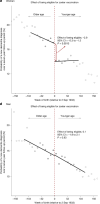
Then they looked at the population several years after becoming eligible for the vaccine. The birthdate cutoff was September 2, 1933. People born after could get it (and about half did) and people born before could not. They checked the dementia rates of people born on either side of that birthdate. You would expect a smooth transition in dementia rates, but they saw a sudden decrease in cases for people born right after that date. Figure 3 from this thread's study shows that sudden change:

Though it appears that the effect is really only apparent for women. This is split by sex:
Last edited:

Peter T
Senior Member (Voting Rights)
Are you referring to the new study linked in another thread?
I am not sure now as I had not realised there were two separate studies/threads until after I had commented. Brain fog quite foggy today.
With the change in vaccine eligibility, people still had to make an active decision to have it, and there was some confusion on the ground about who was eligible. As a result of the NHS promotion I had asked my GP practice for the jab, but was told I was not eligible, however several months after that my practice invited me to book in for the jab. However I guess given a 50% take up rate it makes selection bias less likely an issue.
That's the thing. Selection bias doesn't really matter here.With the change in vaccine eligibility, people still had to make an active decision to have it, and there was some confusion on the ground about who was eligible. As a result of the NHS promotion I had asked my GP practice for the jab, but was told I was not eligible, however several months after that my practice invited me to book in for the jab. However I guess given a 50% take up rate it makes selection bias less likely an issue.
Simple way to imagine it: there's a room of people. They all randomly decided to wear a red or blue shirt that morning (akin to being born before or after the cutoff date in the actual study).
Someone walks in and says "people wearing red, you can have the vaccine if you want. People wearing blue are not allowed."
Imagine in the red group, there is some intense selection effect. Only the people who are very unlikely to get dementia anyway end up taking the vaccine for whatever reason. This would be a problem if you were comparing the people who took the vaccine to those that didn't.
But that's not what they did. They compared the entire red group to the entire blue group. There should be just as many people who are likely to naturally get or not get dementia in both groups. So they're not actually "selecting for" healthier people in the red (vaccine) group.
Imagine there was no real effect from the vaccine. If you compare the red group to the blue group, there should be no difference in dementia rates no matter who in the red group actually was able to or decided to take the vaccine. Yet the study found a difference in dementia rates.
Peter T
Senior Member (Voting Rights)
Thank you @forestglip

Utsikt
Senior Member (Voting Rights)
From July 2023, a criticism of the preprint:
Shingles vaccine & dementia prevention: too good to be true? by Ellie Murray
Is that right, though?The paper seems to cover the main point above that the September 1st cutoff might affect dementia rates because of differing schooling length before and after. They showed that there was no such difference in dementia surrounding the same month and day in prior birth years, only the year that included the vaccine eligibility cut off.
They say this about education:
Equal level of education != equal years of education across the date threshold, because the people after the threshold presumably required one more year of education to get the same level of education.Fourth, using data from the 2011 Census, we show in Supplementary Figs. 15–17 that there are no discontinuities across the 2 September 1933 threshold in the proportion of individuals in Wales who reached a particular level of education.
My mom’s equivalent to a BSc took 14 years of school in total. 9+3+2, with 2 being the BSc-equivalent. Mine took 16 years due to changes in the length of the education: 10+3+3. Yet we have the same level of education (if you exclude my MSc from the calculations).
Equal level of education != equal years of education across the date threshold, because the people after the threshold presumably required one more year of education to get the same level of education.
My mom’s equivalent to a BSc took 14 years of school in total. 9+3+2, with 2 being the BSc-equivalent. Mine took 16 years due to changes in the length of the education: 10+3+3. Yet we have the same level of education (if you exclude my MSc from the calculations).
If eligibility for school was the reason for having more or less dementia, then you'd expect to see the same effect in other years, right? Instead of splitting the groups by being born before or after September 2, 1933, what if you split groups by being born before or after September 2, 1932? The same effect due to entering school a year early should still apply.
But they say the drop in dementia cases was not seen when changing the year but otherwise repeating the same analysis:
Second, we examined whether the day–month (that is, 2 September) date-of-birth cut-off used for zoster vaccine eligibility was also used by other interventions that affect dementia risk. We did so by implementing the identical analysis as for 1 September 2013 (the actual date on which the zoster vaccine program started) for 1 September of each of the three years before and after 2013.
Thus, for example, when shifting the start date of the program to 1 September 2012, we compared those around the 2 September 1932 date-of-birth threshold with the follow-up period starting on 1 September 2012.
As an additional check that enabled us to maintain the length of the seven-year follow-up period used in our primary analyses, we shifted the program start date to 1 September of each of the 6 years preceding (but not after) 2013.
As expected, for both of these checks, we find a significant effect on dementia occurrence only for the date-of-birth cutoff (2 September 1933) that was actually used by the zoster vaccination program (Supplementary Figs. 12 and 13).
Sure, maybe something in this specific year changed in regard to education. But as far as I know, the criticism didn't suggest what that might be, so it's just speculating that some unknown thing relating to education happened and that this is more likely than the known major event of being eligible for vaccination.
I think she might have missed that sensitivity check in the paper. Here's someone asking her if the peer reviewed version of the study checking other years allays her concerns (her post was about the preprint).
The same sensitivity check the person asked about was in the preprint too, though.
She wrote an updated critique for the peer-reviewed version which might provide some clarity, but it's behind a Substack paywall. [Edit: Nevermind, I think that's just the preprint criticism copied from Medium to Substack. She said to stay tuned for a post about the peer reviewed version, but I don't know if she ended up writing one.]
Edit: Another person asking about if it would be better if the authors did the thing that they did do:
Response:Cool! Does the lack of an effect in populations split around that same birthdate but in prior years, or in years preceding 2013 when the vaccine was introduced, allay your concern about the "September effect" of the diff in age at school onset? (Not sure if that control was part of the preprint.)
I’ll have to read the paper before I can comment
The same sensitivity check the person asked about was in the preprint too, though.
She wrote an updated critique for the peer-reviewed version which might provide some clarity, but it's behind a Substack paywall. [Edit: Nevermind, I think that's just the preprint criticism copied from Medium to Substack. She said to stay tuned for a post about the peer reviewed version, but I don't know if she ended up writing one.]
Edit: Another person asking about if it would be better if the authors did the thing that they did do:
Response:Could your argument that confounding by number of years schooling could be evaluated by simply picking a different year (that did not affect shingles vaccine eligibility) and comparing individuals for the same two birth weeks. If the association were still observed it would not be due to vaccine.
Yes, it could have been. And I shared these comments with the authors when I wrote them.
Last edited:
Posts about different papers have been split off to their own threads:
The recombinant shingles vaccine is associated with lower risk of dementia, 2024, Dercon et al
Lower risk of dementia with AS01-adjuvanted vaccination against shingles and respiratory syncytial virus infections, 2025, Taquet et al
The recombinant shingles vaccine is associated with lower risk of dementia, 2024, Dercon et al
Lower risk of dementia with AS01-adjuvanted vaccination against shingles and respiratory syncytial virus infections, 2025, Taquet et al

The change in risk in females looks quite compelling. It's interesting that there was no change in risk in males.
Scrabbling for an alternative explanation, there is the fact that the people on the 'no vaccination' side were born and may have had their earliest years more affected by the Great Depression and the industrial decline in Wales before it. (The study is on data from Wales. The study looked at people born up to 3 years either side of the Sep 2033 date.
It seems likely that many of the babies in those early 1930s had a tough start to life. I suppose it's conceivable that the girl babies might have been a bit more deprived than the boy babies?
AI says:
I think things were still tough in Wales after 1933. But, perhaps the earlier years were more dislocating and people adapted over time. Scarlet fever most affects children aged 2 to 10 years old, so maybe that scarlet fever epidemic in Wales in 1933 affected the people born before Sep 1933 and that set people up for earlier dementia? Maybe the decline in industries in Wales actually reduced levels of environmental pollution over time, maybe having less coal dust in the home environment or not having a father exposed to the toxins and lack of sun of coal mining was a pre-natal advantage?
I don't think my alternative theories are rock solid, far from it. But, I think there are enough questions there that this study isn't the last word on the idea of the shingles vaccine being protective against dementia. (I haven't looked at the other papers.)
I wonder how the researchers chose that 'three years before - three years after' time frame. Perhaps it was a nice coincidence that the timing gave the most compelling result?
Scrabbling for an alternative explanation, there is the fact that the people on the 'no vaccination' side were born and may have had their earliest years more affected by the Great Depression and the industrial decline in Wales before it. (The study is on data from Wales. The study looked at people born up to 3 years either side of the Sep 2033 date.
Wikipedia said:Particularly hardest hit by economic problems were the industrial and mining areas in the north of England, Scotland, Northern Irelandand Wales. Unemployment reached 70% in some areas at the start of the 1930s (with more than 3 million out of work nationally) and many families depended entirely on payments from local government known as the dole.
It seems likely that many of the babies in those early 1930s had a tough start to life. I suppose it's conceivable that the girl babies might have been a bit more deprived than the boy babies?
AI says:
Being born during the Great Depression is associated with poorer adult health outcomes, including a higher incidence of chronic diseases, accelerated biological aging, increased disability, and higher mortality rates.
These long-term effects are attributed to the significant stress and deprivation experienced during a sensitive period of early development, particularly in utero and early childhood.
Impact of poverty on child health
- Malnutrition: Diets often lacked essential nutrients like fresh fruits and vegetables, leading to widespread malnutrition and vitamin deficiencies.
- Increased disease: Poor nutrition weakened children, making them more vulnerable to infectious diseases such as scarlet fever, diphtheria, tuberculosis, and polio.
- Poor living conditions: Many families lived in damp, cold, and overcrowded housing without electricity or modern sanitation, which created a breeding ground for disease.
Specific health challenges
- Scarlet fever: An epidemic in 1933 was noted to be particularly severe due to the general malnutrition of the children, according to Dr. Rankin, the Chief Medical Officer for the Gelligaer District Council.
- Rickets: Scurvy, caused by a lack of vitamin C from fresh produce, was a devastating consequence of poor diets.
- Polio and TB: These diseases were prevalent among poor children and often led to lifelong physical disabilities.
I think things were still tough in Wales after 1933. But, perhaps the earlier years were more dislocating and people adapted over time. Scarlet fever most affects children aged 2 to 10 years old, so maybe that scarlet fever epidemic in Wales in 1933 affected the people born before Sep 1933 and that set people up for earlier dementia? Maybe the decline in industries in Wales actually reduced levels of environmental pollution over time, maybe having less coal dust in the home environment or not having a father exposed to the toxins and lack of sun of coal mining was a pre-natal advantage?
I don't think my alternative theories are rock solid, far from it. But, I think there are enough questions there that this study isn't the last word on the idea of the shingles vaccine being protective against dementia. (I haven't looked at the other papers.)
I wonder how the researchers chose that 'three years before - three years after' time frame. Perhaps it was a nice coincidence that the timing gave the most compelling result?
there is the fact that the people on the 'no vaccination' side were born and may have had their earliest years more affected by the Great Depression and the industrial decline in Wales before it.
Note that the regression they did weighed birthweeks closer to the cutoff point more heavily. That's the grey shading of the dots in the figures above. It looks like past about [edit: two years] on either side, there was very little weight given to the data points. They did this because the further apart people are in time of birth in the two groups, the more confounders you'd expect that could skew the analysis.I wonder how the researchers chose that 'three years before - three years after' time frame. Perhaps it was a nice coincidence that the timing gave the most compelling result?
Paper said:Second, we are unable to provide estimates for the effectiveness of the zoster vaccine for reducing dementia occurrence in age groups other than those who were weighted most heavily in our regression discontinuity analyses (primarily those aged 79 to 80 years).
The main thing of interest is how suddenly the probability of dementia drops for people born directly after the cutoff. I'd expect it to be more gradual if it was due to something like the Great Depression, which didn't have a hard cutoff.
If there was confounding, which I think is possible, I think it'd be related to education. Starting school a year later is the only relevant event I know of, apart from vaccination, that was a major difference in life events between people born directly on either side of that birthdate cutoff.
Someone's comment on Pubpeer noted a potential interesting detail about the groups being in different school years:
One interesting thing about this particular generation: it seems these were the first to experience schooling to age 15 instead of age 14 since the change came through in 1947 and the UK school year is/was set by age at 1 Sept.
Another thing that ChatGPT suggested to me when I was trying to get it to suggest confounders is related to school year and World War II.
It said that schooling begins at age 5 in Wales, which seems right. So children born in the weeks before September 1933 would have been 5 before September 1, 1938 and would have entered school that year. Children born in the weeks after, would have entered school a year later, at the end of 1939. Notably, World War II started September 1, 1939.
Is there a reason children first starting school immediately at the start of WWII would end up better protected from dementia than children who had already completed a year of school? I'm not sure what the connection would be.
Last edited:

Kitty
Senior Member (Voting Rights)
If there was confounding, which I think is possible, I think it'd be related to education.
It doesn't sound all that convincing, though. Dementias strike highly educated and highly intelligent people as well as ones with little formal education and normal intelligence.
What interests me more is the apparent immune component to dementia susceptibility, and the female bias in protection from vaccination. It almost appears as if there are two types of susceptibility, and/or two routes into developing the disease.
Yes, it's hard to see how one extra year of schooling would make a difference to dementia susceptibility. I'd bet on the impact of the 1933 scarlet fever outbreak over that.It doesn't sound all that convincing, though. Dementias strike highly educated and highly intelligent people as well as ones with little formal education and normal intelligence.
Yes, if it was education-related confounding, I don't think it'd just be something like they learned more in school or had better teachers or something like that. I'd think it'd be something like people existing in a different school year with a whole different group of peers and possibly life events, might have had differences in various major ways from those in a different school year.It doesn't sound all that convincing, though. Dementias strike highly educated and highly intelligent people as well as ones with little formal education and normal intelligence.
Though I still think the vaccination being responsible for the effect is probably most likely, considering that there seem to be a lot of studies finding associations between dementia and vaccines or infections in ways other than this study, with some linked above.
Kitty
Senior Member (Voting Rights)
Children born in the weeks after, would have entered school a year later, at the end of 1939.
I think that would need more research anyway, as some primary schools have had staged entrance for decades. My elderly neighbour, for instance, told me a story of having to start school one freezing January because her birthday was in October, which stuck in my mind because my best friend (born in September) started after Christmas too. The neighbour's age suggests that would have been in the late 1940s, and for my friend it was the mid-60s. England, though, not Wales.
Just coming back to this after having watched a good video on iodine and health.
Further to the idea that changes in (mal)nutrition probably had an effect, it looks as though the practice of supplementing cattle feed with iodine in the dairy industry started in Wales in the 1930s.
From the UK Iodine Group:
Good iodine levels during childhood improve brain function - that could be protective against dementia or at least delay symptoms severe enough to prompt diagnosis.
Further to the idea that changes in (mal)nutrition probably had an effect, it looks as though the practice of supplementing cattle feed with iodine in the dairy industry started in Wales in the 1930s.
From the UK Iodine Group:
Historical iodine status in the UK
- Iodine deficiency was once common in the UK in the 1800s and early part of the 20th century.
- Goitre (the physical symptom of iodine deficiency) was found in several regions – including the South West, Wales and the Peak District.
- In the Peak District, it was so common it was called Derbyshire neck.
- Cretinism (individuals with extreme learning difficulties) was also found in some areas of the UK
How was goitre eradicated in the UK?
- Unlike many countries, the UK did not introduce a formal iodine-fortification programme. In many countries, iodine was added to table salt (called iodised salt) and this increased iodine intake. An iodised salt programme was not introduced in the UK.
- In the UK, iodine intake increased as a result of changes in the dairy-farming industry. In the 1930s, farmers began to add iodine to cattle feed in order to improve cattle health – it was not done for human health or to improve iodine intake in the general population.
- The additional iodine in the cattle feed increased the iodine concentration of milk.
- In addition, disinfectants in the dairy industry contained iodine (called iodophor disinfectants). This increased the iodine concentration of milk.
- Therefore milk-iodine concentration increased and milk and dairy products became an important source of iodine.
Good iodine levels during childhood improve brain function - that could be protective against dementia or at least delay symptoms severe enough to prompt diagnosis.
Last edited:
2026: Nature Medicine comment: "Why large-scale randomized trials of live-attenuated shingles vaccination for dementia prevention are urgently needed"
Pascal Geldsetzer
"In my view, we have never had as robust a body of evidence from observational data on an intervention for dementia as we do for live-attenuated shingles vaccination. Both a recent US National Institutes of Health expert workshop and an international expert consensus on Alzheimer’s disease drug repurposing identified large-scale randomized trials of shingles vaccination for dementia prevention as the crucial next step for the field."
Paywalled comment
Pascal Geldsetzer
"In my view, we have never had as robust a body of evidence from observational data on an intervention for dementia as we do for live-attenuated shingles vaccination. Both a recent US National Institutes of Health expert workshop and an international expert consensus on Alzheimer’s disease drug repurposing identified large-scale randomized trials of shingles vaccination for dementia prevention as the crucial next step for the field."
Paywalled comment
Kitty
Senior Member (Voting Rights)
We probably also need to do more comparisons with live-attenuated versus non-live, as some countries now only use the latter type.
It's probably too early to say, since the transition to using non-live vaccine as standard is relatively recent. Assuming the protective effect is real, non-live might perform just as well and has the advantage of being more effective at preventing shingles and safe for immunocompromised people.
[Edited slightly]
It's probably too early to say, since the transition to using non-live vaccine as standard is relatively recent. Assuming the protective effect is real, non-live might perform just as well and has the advantage of being more effective at preventing shingles and safe for immunocompromised people.
[Edited slightly]
I agree it is a complicated time period for that break to be over. Free school meals came in around 1944 apparently and rationing only ended fully in 1954. So 1933 birthed would have been 11 when that came in.The change in risk in females looks quite compelling. It's interesting that there was no change in risk in males.
Scrabbling for an alternative explanation, there is the fact that the people on the 'no vaccination' side were born and may have had their earliest years more affected by the Great Depression and the industrial decline in Wales before it. (The study is on data from Wales. The study looked at people born up to 3 years either side of the Sep 2033 date.
It seems likely that many of the babies in those early 1930s had a tough start to life. I suppose it's conceivable that the girl babies might have been a bit more deprived than the boy babies?
AI says:
I think things were still tough in Wales after 1933. But, perhaps the earlier years were more dislocating and people adapted over time. Scarlet fever most affects children aged 2 to 10 years old, so maybe that scarlet fever epidemic in Wales in 1933 affected the people born before Sep 1933 and that set people up for earlier dementia? Maybe the decline in industries in Wales actually reduced levels of environmental pollution over time, maybe having less coal dust in the home environment or not having a father exposed to the toxins and lack of sun of coal mining was a pre-natal advantage?
I don't think my alternative theories are rock solid, far from it. But, I think there are enough questions there that this study isn't the last word on the idea of the shingles vaccine being protective against dementia. (I haven't looked at the other papers.)
I wonder how the researchers chose that 'three years before - three years after' time frame. Perhaps it was a nice coincidence that the timing gave the most compelling result?
Plus there is the contraceptive pill right around the same generation. 1961 for married women and then 1967. Which means those born in 1933 married and 28yrs old aren't looking at potentially having so many kids. Apparently the ave age for women to marry then was 20-24yrs old then
There is also the roll-out of HRT which apparently was in the 1990s, with peak prescribing 50-54yrs old. so would coincide too
The other issues come from things that vice versa increased men's lifespan where they might have died from something else before getting dementia. Which would mean pre- and post- isn't really comparing the same population (a bit like the drop-outs issue). Coronary heart disease has dropped by something like 70% in welsh men over the decades.

Fewer people in Wales dying from heart disease – new report | GOV.WALES
Fewer people are dying prematurely from coronary heart disease in Wales, with a 68% reduction in the death rate over the last 20 years.
Over the last 20 years in Wales, there has been a 68% reduction in the rate of people dying from premature coronary heart disease, before the age of 75; Since 2009 alone, there’s been a 20% reduction, due in part to the improved detection of heart disease amongst GPs, the ban on smoking in public places and other public health interventions, and better treatments within the NHS
Heart disease is a major killer in Wales, particularly affecting our poorer communities, with 1 in 7 men and nearly 1 in 10 women dying from the disease.