A crumb of a clue on epidemiology

A counterpoint would be that mecfs hits adolescents, who are presumably not drinking and have no liver function risk factors.

Please have a look at the following thread. Alcohol has been on my radar for quite some time (May 2018). Please also make sure you read the comments :


https://forums.phoenixrising.me/threads/alcohol-tolerance-before-me-cfs.60004/

@Murph I will try to explain what may be happening (a hypothesis). Interestingly, one of my key questions with patients is whether they liked drinking when they were young.

1) I believe that patients who got MECFS early on (e.g. before 16 years of age) may have the clearest genetic signature. ( Does such genetic study exists btw?)

2) For the cohort of adolescents : I believe that we are looking at compensated functioning for a significant number of them. So there are no issues with drinking until a number of "hepatic hits" takes place (e.g. medication, EBV / COVID19/HHV6 infection, toxin exposure) that disrupts this compensated functioning. It is then that certain genetic combinations make it difficult to restore proper metabolic and immune function and as a result we get MECFS and -most likely- no tolerance to alcohol.

I do not know also whether a temporal aspect exists. For example, what if -given each one's genetic profile- each "hepatic hit" gradually affects negatively important metabolic functions? What if, growing up, lowers the tolerance of "hepatic hits" that can be taken?
 
Last edited:
A few more alcohol related stats.

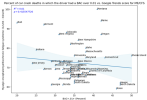
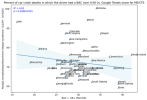
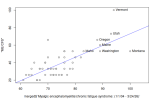
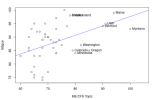
First, I looked at car crash deaths in which the driver had a blood alcohol content (BAC) greater than 0.01 or 0.08, as a proportion of all car crash deaths, from NHTSA. I picked the year 2015, since that seems like it would be the best year to compare to the Google Trends data, which spans 2004 to 2026, and 2015 is right in the middle.

There looks to be no positive relationship, maybe a small negative relationship, when correlating ME/CFS searches with either alcohol car crash stat.

BAC = 0.01+
1775579400827.png

BAC = 0.08+
1775579434578.png

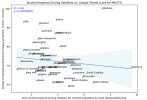
Since it's a bit hard to interpret alcohol car crash deaths out of all car crash deaths, I also did it with alcohol impaired driving fatalities per 100,000 population, using 2015 data from Foundation for Advancing Alcohol Responsibility.

No correlation.
1775585713070.png

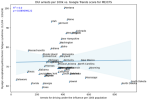
I also looked at number of arrests for driving under the influence in a state per 100,000 population, calculated using arrest numbers and population from FBI 2015 data. Also no relationship.
1775584871737.png

---

And since I already had the arrests dataset, I checked correlation of rate of all arrest types vs ME/CFS searches:
1775587423488.png

Many crime types are negatively correlated. So it is probably a general correlation of more "crime" is associated with less searches, as opposed to any specific class of crime. There's a small negative correlation with drunkenness too, which goes a bit opposite of the alcohol stats, but this might be confounded by the general crime rate of the state.

---

So prescriptions for alcohol cravings drugs, deaths due to alcohol, and government regulation of alcohol sales are positively correlated with ME/CFS searches.

But alcohol consumption, DUI arrests, drunkness arrests, and DUI fatalities are negatively correlated or not correlated with ME/CFS searches.
 
Last edited:
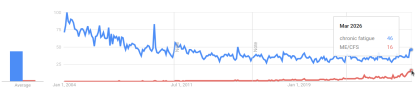
Random thought of the day: it occurs to me that collecting search trends data over time might also reveal some interesting patterns. For example there was some evidence (link) of seasonal patterns to referrals to ME/CFS paediatric clinics in the UK - that might just be artefactual but I wonder if searches for ME/CFS exhibit seasonality too. Also if ME/CFS searches spike a few months after a particularly bad winter 'flu season or localised outbreaks of infective illness...
 
Random thought of the day: it occurs to me that collecting search trends data over time might also reveal some interesting patterns. For example there was some evidence (link) of seasonal patterns to referrals to ME/CFS paediatric clinics in the UK - that might just be artefactual but I wonder if searches for ME/CFS exhibit seasonality too. Also if ME/CFS searches spike a few months after a particularly bad winter 'flu season or localised outbreaks of infective illness...
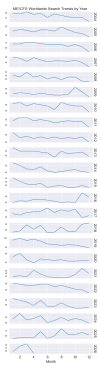
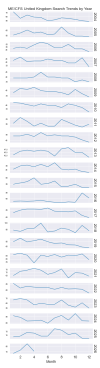
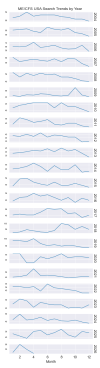
Interesting idea. I just did a few quick plots using the time version of the Trends data, one each for worldwide, United Kingdom, and USA.

I downloaded the whole timespan at once for each region, which gives one value per month. If downloading one year at a time, it gives one value per week, if higher resolution is desired.

For each plot, it shows the data separately per year, stacked on top of each other to see if there might be a common pattern across years. I don't see any obvious yearly pattern.
worldwide_compare_years_mecfs.pnguk_compare_years_mecfs.pngusa_compare_years_mecfs.png
 
Last edited:
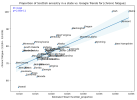
Didn’t DecodeME only use people with European ancestry (or something like that)?

Too foggy to think it all through, but it feels like “group X” not being in the study might make interpreting “this variant is associated with ME/CFS and group X has it less often” more complicated.
They used people with majority of something white ancestry, I forget how they put it, but they used mine and mine is majority European but also includes black African.
 
They used people with majority of something white ancestry, I forget how they put it, but they used mine and mine is majority European but also includes black African.
It would’ve been by degree of similarity to reference populations. “European” from 1000 genomes project includes samples from a couple different countries including Britain
 
I think what could be interesting is looking for the best correlations of ME/CFS searches with other searches. For example, if the states that search most for ME/CFS also search most for "mono".

There's no publicly available API for Google Trends, though, so data would have to be downloaded one at a time through the browser. The idea I had was to start by looking at the correlation of ME/CFS searches with searches for 10 random words. For the most correlated search term, find 10 concepts related to that search term, with something like a thesaurus, and test correlation with those to see if any are even better. And keep iterating.

But I think without being able to automate doing that for thousands of search terms, it might be too slow to be fruitful. But maybe still worth testing with some hand selected terms.
 
Back
Top Bottom