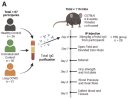
A causal link between autoantibodies and neurological symptoms in long COVID, 2024, Santos Guedes de Sa, Iwasaki et al

Curious what the explanation might be that antibodies from LC are more likely to cause pain sensitivity in mice compared to antibodies from convalescent controls. Several groups have reported this now.

Looks like this group did in-depth measurements to figure out what causes this but that they didn't fully manage to figure it out.
I think this is why it took so long to publish they were unable to isolate the ultimate smoking gun ab like more profound papers (Lanz Robinson 2022 Nature on EBNA1 and GlialCAM in MS). Isolated the monoclonal from a patient; induced same symptoms and simultaneous T cell immune infiltration in mice with tolerance breaking vaccines vs the molecular mimic peptide. That paper did full mechanism round trip and imagine Iwasaki was shooting for that and they never quite accomplished it. Still a great paper.
 
Then they aren’t the «same» autoantibodies, just part of the same over-arching measurement category, like you said.

So «normal» would have to be defined based on more accurate measurements.
Exactly. An antibody “sticking” is not an antibody “doing.” You cannot tell from larger antigens what a titer vs something means. Some autoabs are agonists. Some are antagonists. Some are even catalytic? Some are protein clearing. Some are paradoxically protein lifetime and signal extending. Some are cytotoxic; some are more protective. And sadly each individual ab sort of needs its own bespoke functional assays to see what it’s doing. I’m hopeful someday we can have a catalogue sort of like OMIM of known site/isotype specific pathogenic autoabs - ie minimal sites you can trust likely cause functional changes by antibody sticking alone. There are some that behave like this - the anti transcolbalamin B12 blocking minimal epitope seems to mostly mean the same thing each time. But you couldn’t guess that from the whole protein you need to specifically assay the pathogenic binding site.
 
I think this is why it took so long to publish they were unable to isolate the ultimate smoking gun ab like more profound papers (Lanz Robinson 2022 Nature on EBNA1 and GlialCAM in MS). Isolated the monoclonal from a patient; induced same symptoms and simultaneous T cell immune infiltration in mice with tolerance breaking vaccines vs the molecular mimic peptide. That paper did full mechanism round trip and imagine Iwasaki was shooting for that and they never quite accomplished it. Still a great paper.
I made a thread for the MS paper.
 
So «normal» would have to be defined based on more accurate measurements.

If the stereochemical conformations of an anti-X antibody run into billions, with three degrees of spatial freedom then there never will be any 'accurate measurements'. Unless you freeze the whole patient and cut frozen sections for single cell RNA analysis and then use the new quaternary structure-predicting software to predict the shape. (And do hundreds of thousands of unethical experiments on normal people to find out the impact of each conformation.) This is where you have to work with the limits of what is ascertainable in immunology.

I am not sure who is arguing what any more! I recognised thirty years ago that you don't get a lot of useful information out of vast data banks on 'autoantibodies'. You have to focus on evidence for higher level regulatory errors that predict practical therapies.
 
An antibody “sticking” is not an antibody “doing.” You cannot tell from larger antigens what a titer vs something means. Some autoabs are agonists. Some are antagonists. Some are even catalytic? Some are protein clearing. Some are paradoxically protein lifetime and signal extending. Some are cytotoxic; some are more protective. And sadly each individual ab sort of needs its own bespoke functional assays to see what it’s doing.
I agree that antibodies have different functional roles that are more relevant to understanding the disease mechanism than titers alone. Though it also becomes tricky to explain a disease that can persist for years or decades via functionally different autoantibodies at “normal” levels. Even the anti-IFN and grave’s disease examples produce clinically relevant outcomes at measurably high titers.

If by random chance someone ended up with a plasma cell producing antibody that activates some cell surface protein and the antibody is at “normal” levels, that’s going to be a fraction of a fraction of a fraction of total antibody. So that tiny fraction of functionally distinct autoantibodies would have to be enough to completely alter the functioning of some relevant part of the body (sufficiently saturating that affected part at all times despite having no homing mechanism to end up in a specific part of the body). And LLPCs are long lived but also die off eventually, so it would also somehow have to sustain itself for decades in the case of ME/CFS despite the original pathogenic plasma cells dying off over time (since the long term propagation of autoantibodies in most autoimmune diseases very much relies on continuous creation of clonally expanded B cells, which we don’t see here)

Temporary symptoms post-COVID I can see as potentially being driven by something like this. Years long debilitating disease? I’m less sure it’s feasible to blame a stealth micro fraction of autoantibodies.
 
If the stereochemical conformations of an anti-X antibody run into billions, with three degrees of spatial freedom then there never will be any 'accurate measurements'.
Oh it's much more than that! There's many more ways to make an antibody variable region than there are atoms in the universe (or bitcoin cryptography keys, etc choose your favorite absurd number). And the possible universe of autoantigens is every protein and macromolecule in the human body multiplied by every possible chemical transformation thereof (imagine many non-genotoxic modern molecules cause issues this way - good old literature to tobacco smoke adducts, etc).

I think we are quite open to and understanding of each others arguments on most of this.

Where our positions differ is I think there is strong fundamental evidence that out of this absurd immunologic complexity real signals materialize (the same way it also manages to materialize as a good, intended, anti-pathogen immune response). I reject the position that this is all just incomprehensible noise or weak background :) there are real signals to be found - I have seen several novel ones found - and I believe it's worth searching harder. We are blessed by the fact that where this 'noise' likely matters is where it interferes with native human molecular functions and structures. Epitope spreading is also our friend and I think a 'plain native human proteome' on a chip is a lot more informative than most realize for generating leads. Autoabs seem to centralize on specific targets (in the Iwasaki paper this is MED20 - nearly every patient in her cohort claiming to have long-COVID has autoabs to this protein). These signatures are distinct, and while not always mechanistic - I do believe biologically real and worth pursuing!
 
If by random chance someone ended up with a plasma cell producing antibody that activates some cell surface protein and the antibody is at “normal” levels, that’s going to be a fraction of a fraction of a fraction of total antibody. So that tiny fraction of functionally distinct autoantibodies would have to be enough to completely alter the functioning of some relevant part of the body (sufficiently saturating that affected part at all times despite having no homing mechanism to end up in a specific part of the body). And LLPCs are long lived but also die off eventually, so it would also somehow have to sustain itself for decades in the case of ME/CFS despite the original pathogenic plasma cells dying off over time (since the long term propagation of autoantibodies in most autoimmune diseases very much relies on continuous creation of clonally expanded B cells, which we don’t see here)
Right so what is paradoxical - and why I am so stubborn in my position - is that I see autoabs behave in exactly these absurdly long lived and stable ways. Identical twins have entirely unique autoab profiles from each other and they are generally stable (adding some new reactions) between ages 55-70+ (15-20+ years). Also everyone keeps talking about 'weak' or 'low titer' -- I am not claiming the ones that matter are weak or low titer; also what does 'weak' mean if you can reproducibly measure this signature across twenty years?? You're claiming 'well the LLPCs' turn over (and I really need to publish this vs argue here - just a conference poster) - but there's very much more stability than you'd expect suggesting exactly the permanent acquired stability I claim can lead to the effect.

Many proteins and signal molecules are quite rare. They aren't replicating in insane logarithmic ways like a virus - it doesn't necessarily take a ton of autoab to completely alter a pathway.

Poster link here: https://www.cdilabs.com/content/literatures/massively-mulitplexed-serology

One year gap (not that long but still impressive and more formally published): https://www.nature.com/articles/s41598-022-10174-3
1780103141880.png
 
Curious what the explanation might be that antibodies from LC are more likely to cause pain sensitivity in mice compared to antibodies from convalescent controls. Several groups have reported this now.

Looks like this group did in-depth measurements to figure out what causes this but that they didn't fully manage to figure it out.

Faulty LLPC in the bone marrow, it is obvious at least to me. The simplest explanation. Hence why Dara worked for some.

Chronic stress, disease and exercise combine and trigger the one time development of a faulty LLPC, which then live forever.

We know vaccination antibodies can last a lifetime. I don’t know why this fact is ignored. In favor of LLPCs turning over.
 
Last edited:
@Tyler Hulett did Akiko do the IGG transfer study with healthy controls? Becuase that would end the debate…. Surely she cannot have missed something so simple

Even me as a layman can say that’s a common sense thing to do. Have to get healthy controls in…

If you transfer healthy IGG into mice and nothing happens… you prove your point.
 
Last edited:
We know vaccination antibodies can last a lifetime
Yes and usually consist of different antibodies from a bunch of plasma cells from an original set of multiple clonally expanded B cells induced by a strong targeted immune response. Which generally aren’t actively binding to their antigen unless the individual encounters that pathogen again, unlike an autoantigen which would be constantly present.

I’m not saying it’s impossible for what @Tyler Hulett is saying to be true. Just that it’s an explanation that requires a lot of finagling to make sense with the picture of ME/CFS or ME/CFS-like long covid and I differ on the strength of the positive evidence to justify the finagling. I think it’s generally a good thing for people to explore different angles and have different inclinations for whats the most promising avenue, though the debate is necessary too
 
Last edited:
We need more research in this direction. Obviously the gold standard would be to take IGG from severe ME patients and transfer into healthy humans, and see. But this would not happen because of ethics.
 
did Akiko do the IGG transfer study with healthy controls? Becuase that would end the debate…. Surely she cannot have missed something so simple

Paper said:
To evaluate if AABs identified in the LC group are pathogenic in vivo, we developed a mouse passive transfer model. Mice received 38.4 mg/kg of total IgG intraperitoneally (i.p.), with each mouse receiving IgG from a different donor. The mice were co-housed, with each cage housing one mouse that received an injection of PBS, IgG from healthy control, convalescent control, or LC donors.


Causal 1.jpgCausal 2.jpg
 
Identical twins have entirely unique autoab profiles from each other and they are generally stable (adding some new reactions) between ages 55-70+ (15-20+ years). Also everyone keeps talking about 'weak' or 'low titer' -- I am not claiming the ones that matter are weak or low titer; also what does 'weak' mean if you can reproducibly measure this signature across twenty years?? You're claiming 'well the LLPCs' turn over (and I really need to publish this vs argue here - just a conference poster) - but there's very much more stability than you'd expect suggesting exactly the permanent acquired stability I claim can lead to the effect.

This is actually a very neat observation, supporting the crucial role of stochasticity in the generation of antibody repertoire long term - the central tenet of our 1999 model.
 
@Tyler Hulett did Akiko do the IGG transfer study with healthy controls? Becuase that would end the debate…. Surely she cannot have missed something so simple

Even me as a layman can say that’s a common sense thing to do. Have to get healthy controls in…

If you transfer healthy IGG into mice and nothing happens… you prove your point.
Yes they compared the effect vs healthy IgG transfer
 
There was a paper from the group of Andreas Goebel who first demonstrated this transfer of IgG effect in fibromyalgia. They argue that "FMS-IgG binds to mast cells in a MRGPRX2/b2-dependent manner, leading to mast cell recruitment and IL-6 secretion. [...] The ablation of mice Mrgprb2 mast cells or deleting Mrgprb2 receptors prevented IgG-induced heightened sensitivity to mechanical and cold stimuli."
[Preprint] The sensitising effect of IgG in fibromyalgia syndrome is mediated by Mrgprb2 in mast cells, 2025, Sanchez et al. | Science for ME

Unfortunately, I didn't see anything about this in the Iwasaki paper.
 
Back
Top Bottom